12 Apr, 2026
Last Updated: 20 Apr, 2026
Travel has a way of flattening places into their most dramatic headline.
A town becomes the cleanest village in Asia.
A valley becomes the Scotland of the East.
And somewhere in the far hills of Nagaland, a living community is reduced to a single phrase:
The Headhunter Village.
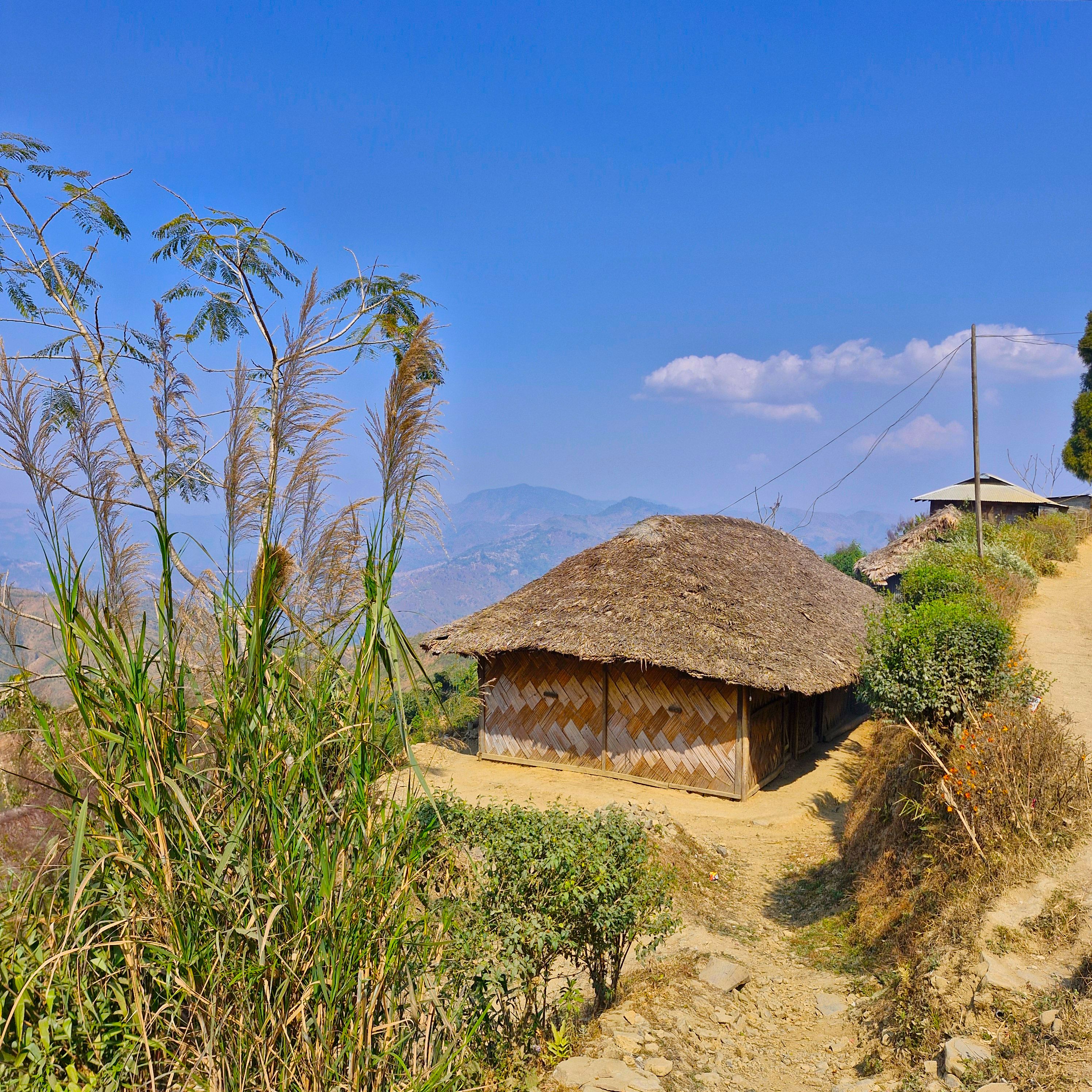 A traditional house in Longwa, Mon district, Nagaland
That was how I first heard of Longwa.
A backpacker came into the hostel at Kohima from there, still sun-creased from the road, said it like he was recounting a film: tattooed elders, skulls on the walls, a house in two countries. He paused for effect. "Last living headhunters. The real ones."
That was enough. I spent the next hour reading everything I could find on the internet— the Konyak tribe tradition, the border anomaly, the chief whose bedroom exists simultaneously in India and Myanmar. By next morning, Longwa was my next destination.
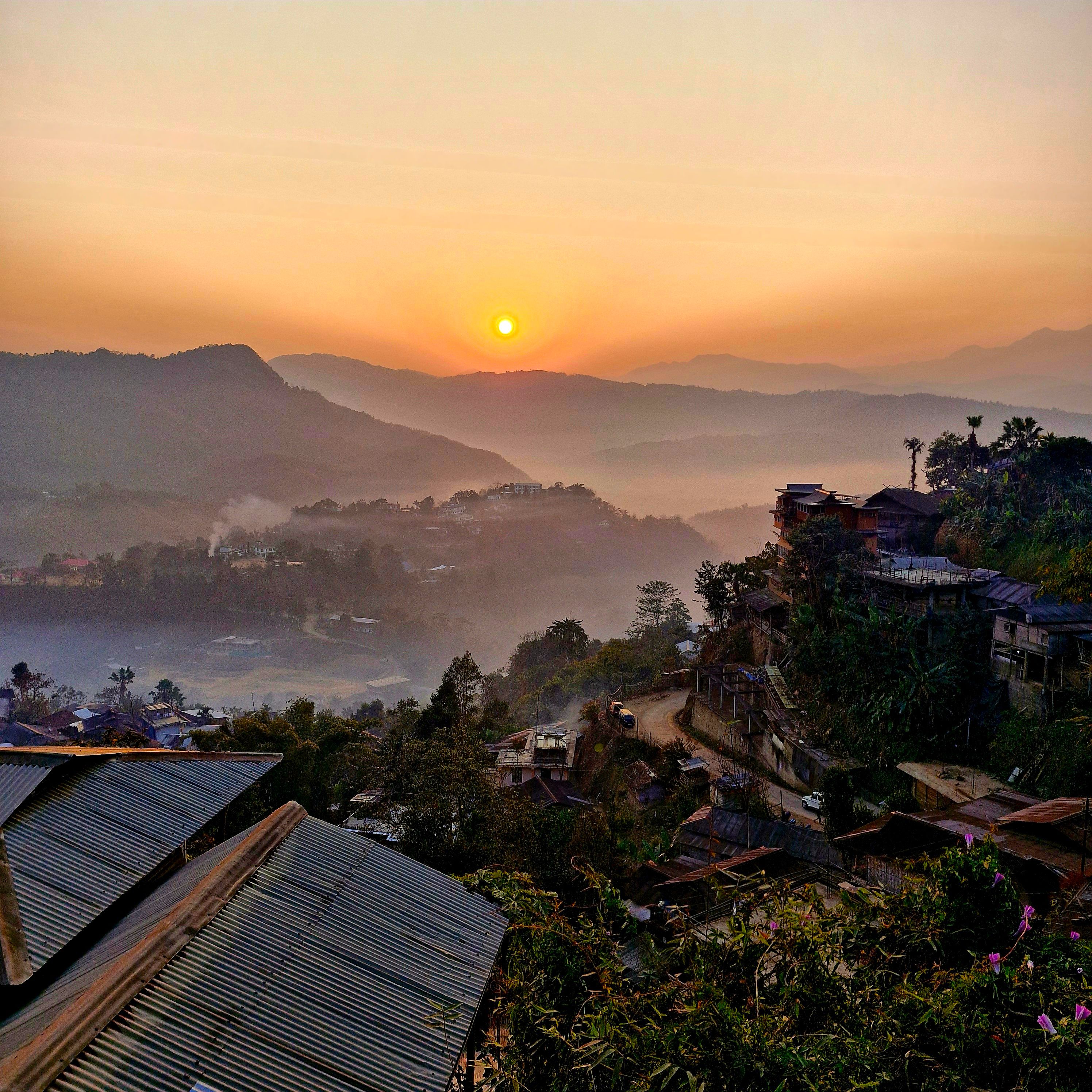 Sunrise at Mon Town, Nagaland
At the sumo counter in Mon town, Nagaland — the shared jeeps that serve as lifelines across much of Northeast India — I was told there were no seats to Longwa for three days.
Two vehicles ran daily. None on Sunday. Saturday's were blocked for a village council meeting.
I had to be in Manali by Monday to host my next experiential group trip. The maths didn't work.
Defeated, I sat across the road at a tea stall, nursing a too-sweet chai recovering from the 16-hour bus journey. Still staring at the counter the way you stare at a locked door you're not sure you actually wanted to open. Then, twenty minutes after departure time, one passenger didn't show up. The clerk waved me over without ceremony.
Middle seat okay?
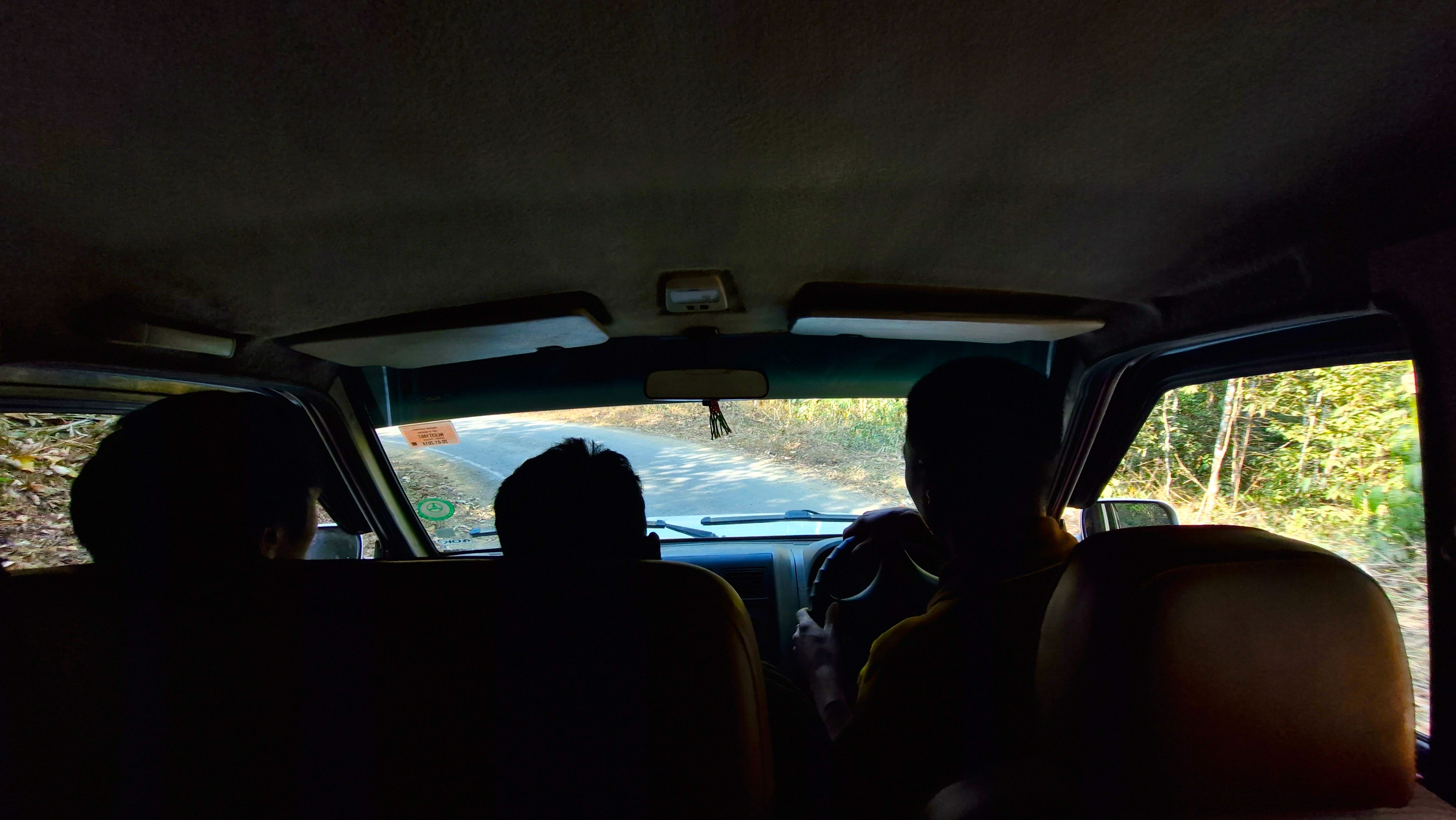
My rucksack was in the back of the sumo before he even finished asking.
The road to Longwa from Mon climbed for three hours — part tarmac, part mud, part an ongoing negotiation between the vehicle and the mountain. The man beside me had a loaded long-barrel gun resting across his knees. Behind me, a bundle of machetes lay stacked against the rear seats.
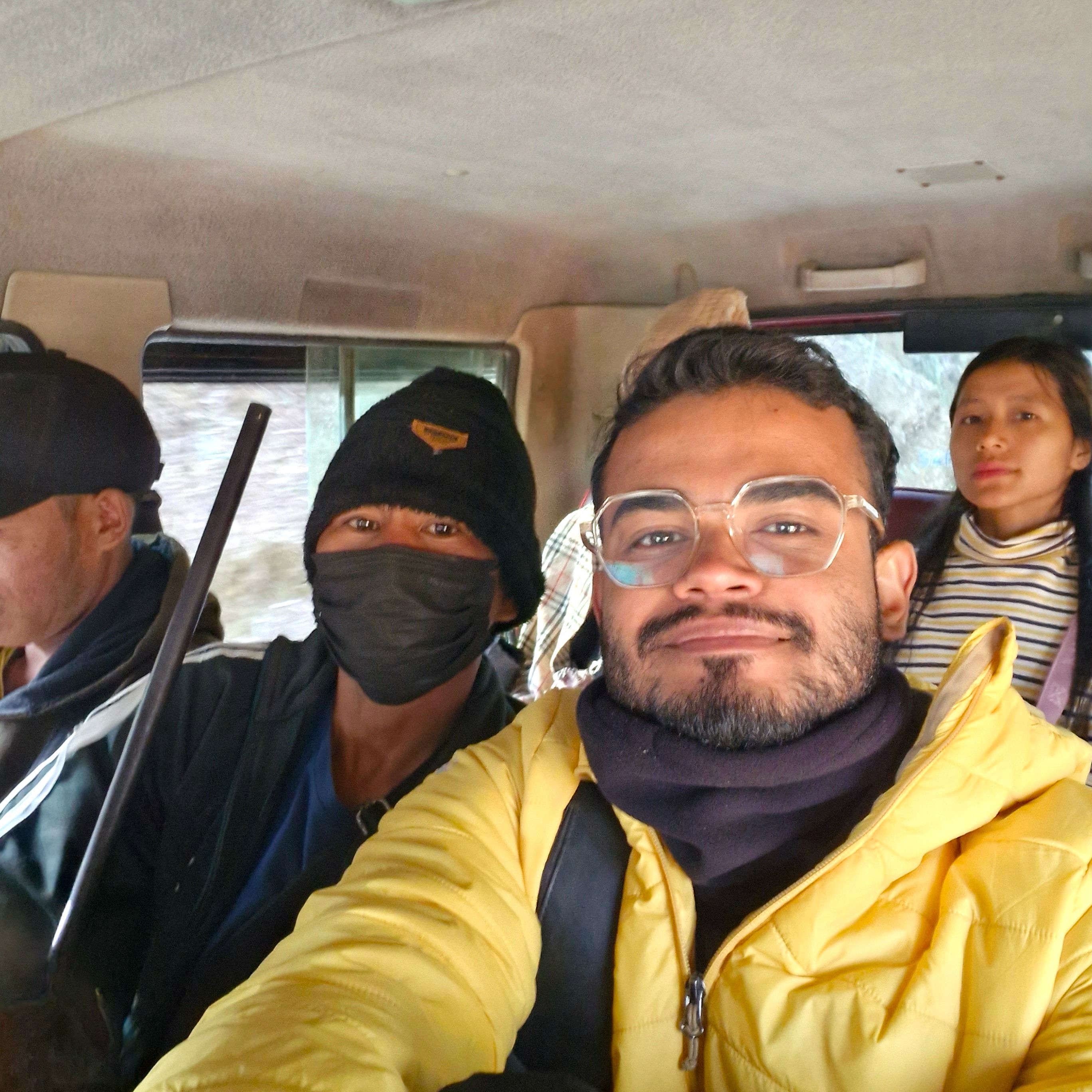 Co-passengers enroute Longwa, Mon District, Nagaland
For a moment, it felt cinematic — like the landscape was doing me a favour, arranging itself into something worth photographing. Then I looked more carefully at the bags. Rice. Cooking oil. A plastic sack of onions. A wrapped parcel of something that smelled like dried fish.
These weren't warriors. They were people going home after a long trip to town, carrying the ordinary weight of a week's supplies back to a place where even ordinary things require extraordinary effort to obtain.
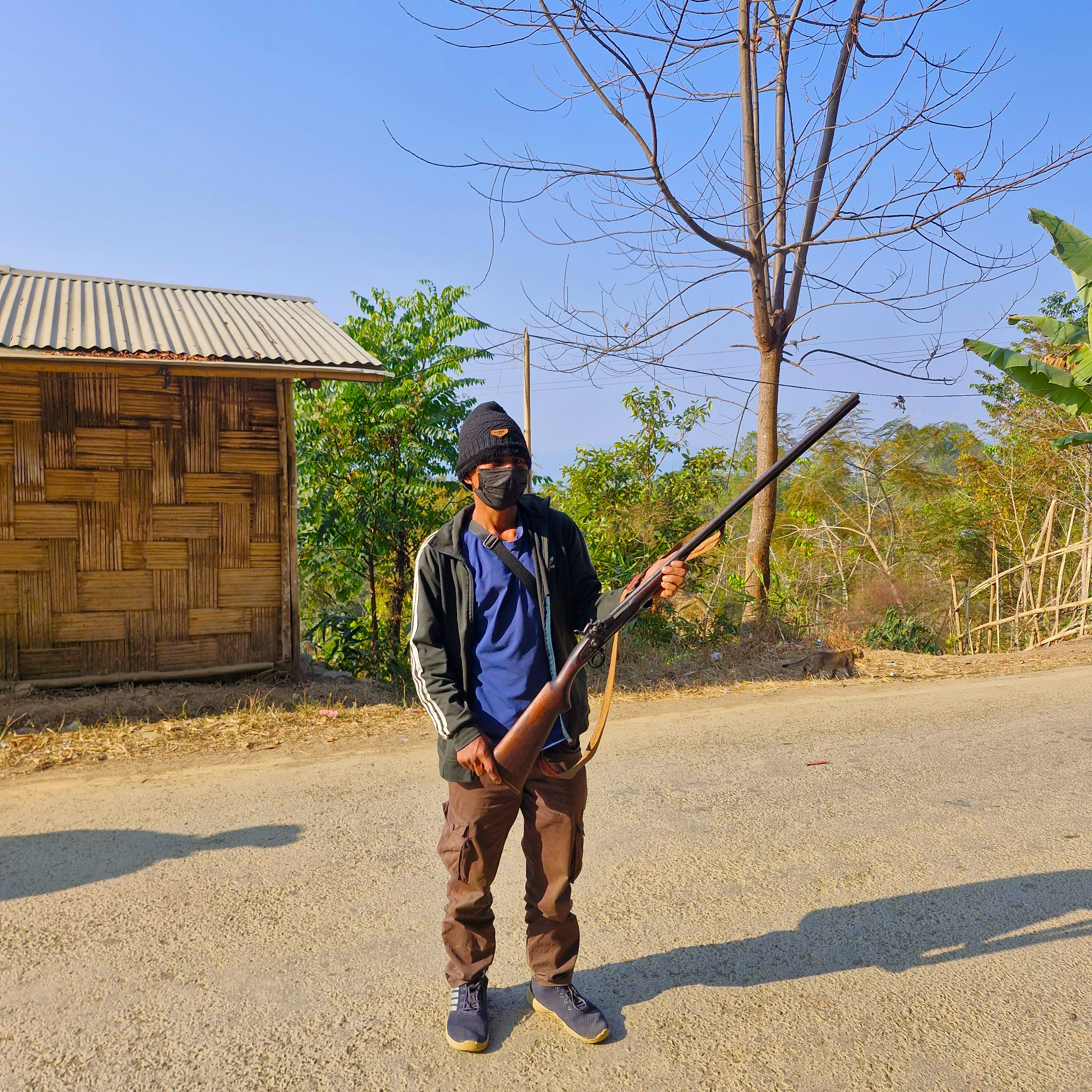 Indigenous gun used for hunting
The guns were hunting tools. The machetes, agricultural. The Longwa village council regulates firearms tightly — ownership tied to subsistence, not ceremony. A co-passenger explained this the way you'd explain anything obvious: briefly, without drama, because the drama had always been mine to begin with.
The image I had built of Longwa began to loosen somewhere between Phomching and the helipad sign — not replaced by something better, just made more honest.
Beyond the last settlement, the road narrowed. A modest sign appeared at the edge of a bend: Longwa Helipad – 3 km.
Passengers began disappearing into footpaths that split from the road and vanished into the hillside. The further we drove, the quieter the jeep became, until it was just me, the driver, and the sound of the engine working too hard on the slope.
After registering at the security checkpoint near the India-Myanmar border, I checked into a traditional Konyak house — two storeys, converted to a homestay with minimal ceremony.
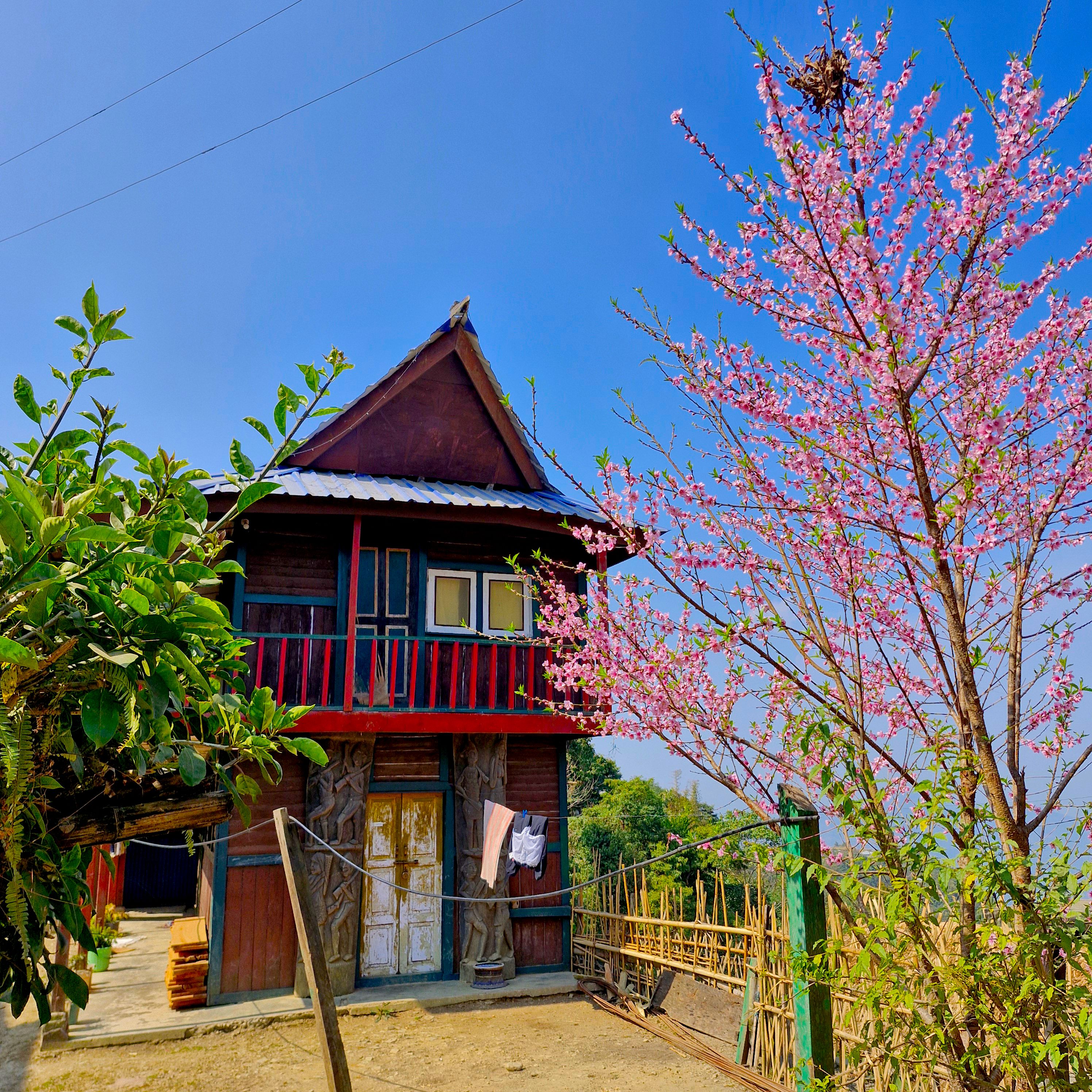 The homestay
The wooden beams were carved from single logs, dense with age. Motifs of mithun and hornbill ran up the doorframes. A tiger mid-leap across a lintel. Human figures, arms raised, in postures I couldn't read but felt.
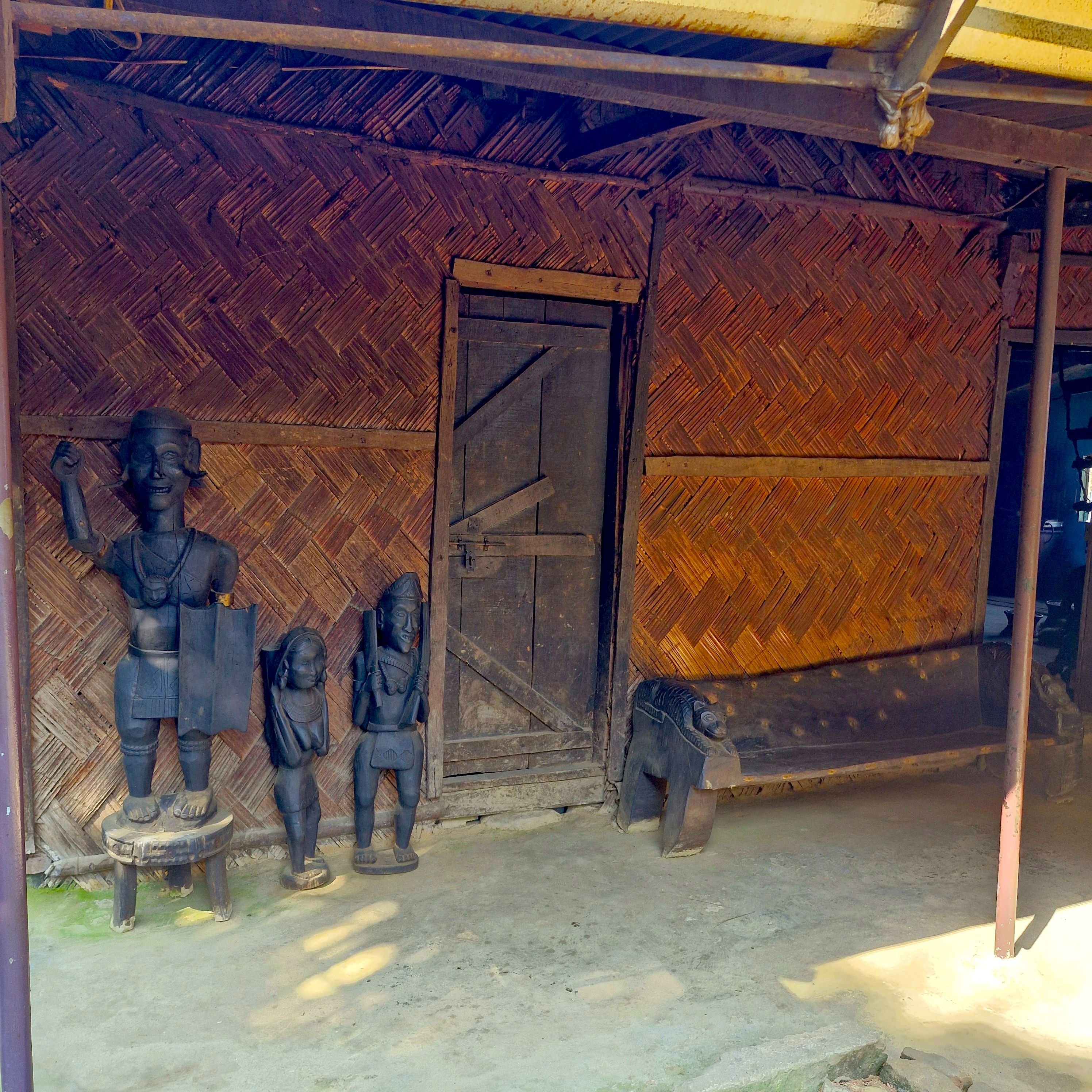 The traditional wood-carvings
The smoke from the hearth had been accumulating in these walls for longer than anyone living could say. Lunch came from that hearth:
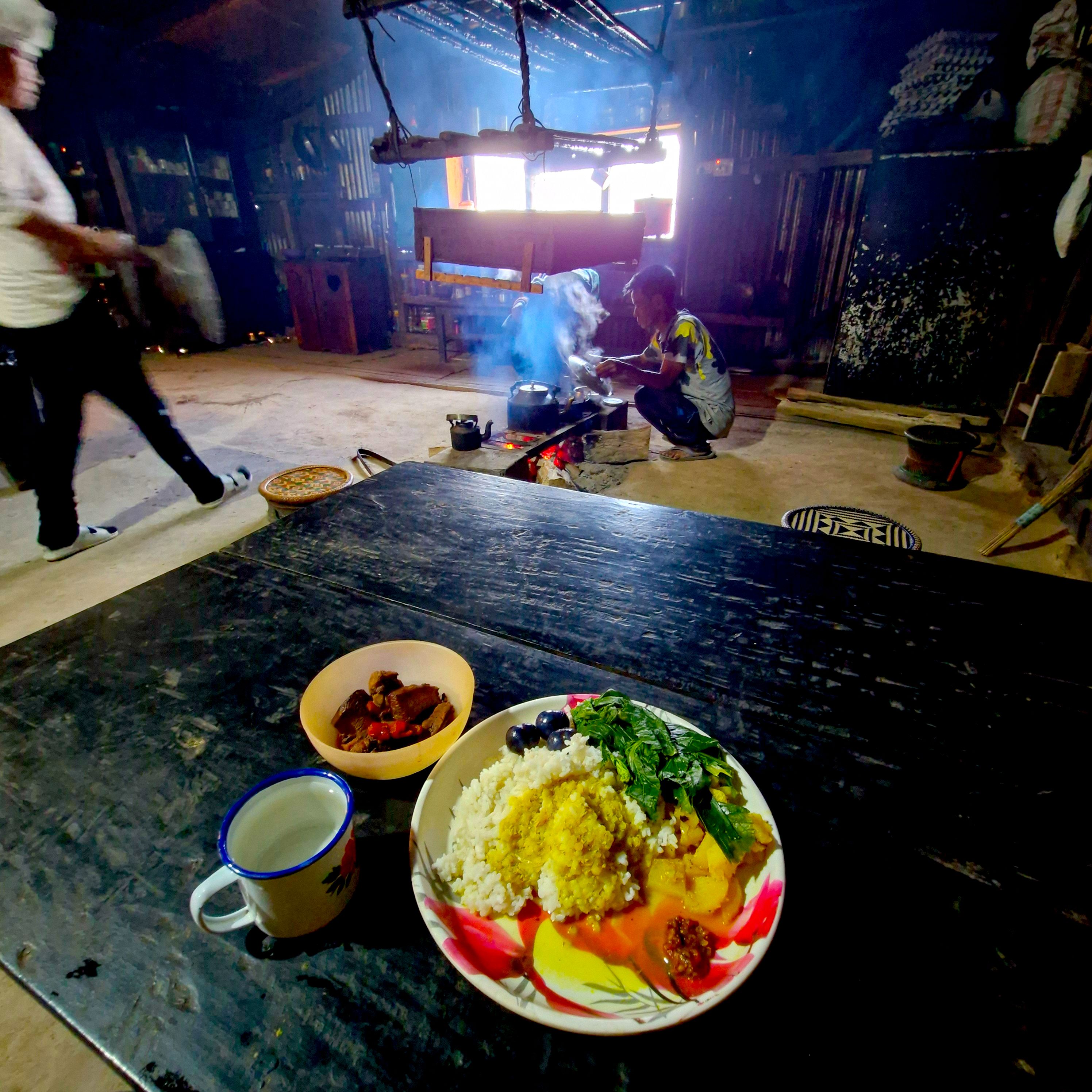 The meal
Red rice, still steaming.
Dal, thin and salted just enough.
Potatoes. Wild berries.
Boiled mustard greens.
Dry pork fry — blackened at the edges, sharp with smoke.
My host, Jeilei, sat across from me and talked while I ate. Life in Longwa, he explained, has never been entirely contained by the border. Families here have ties across both countries — cousins in Myanmar, land that pre-dates the line drawn over it, trade that flows in both directions through an understanding older than either government. The border is real. It is also, in many daily respects, a formality imposed on a way of life that pre-existed it by centuries.
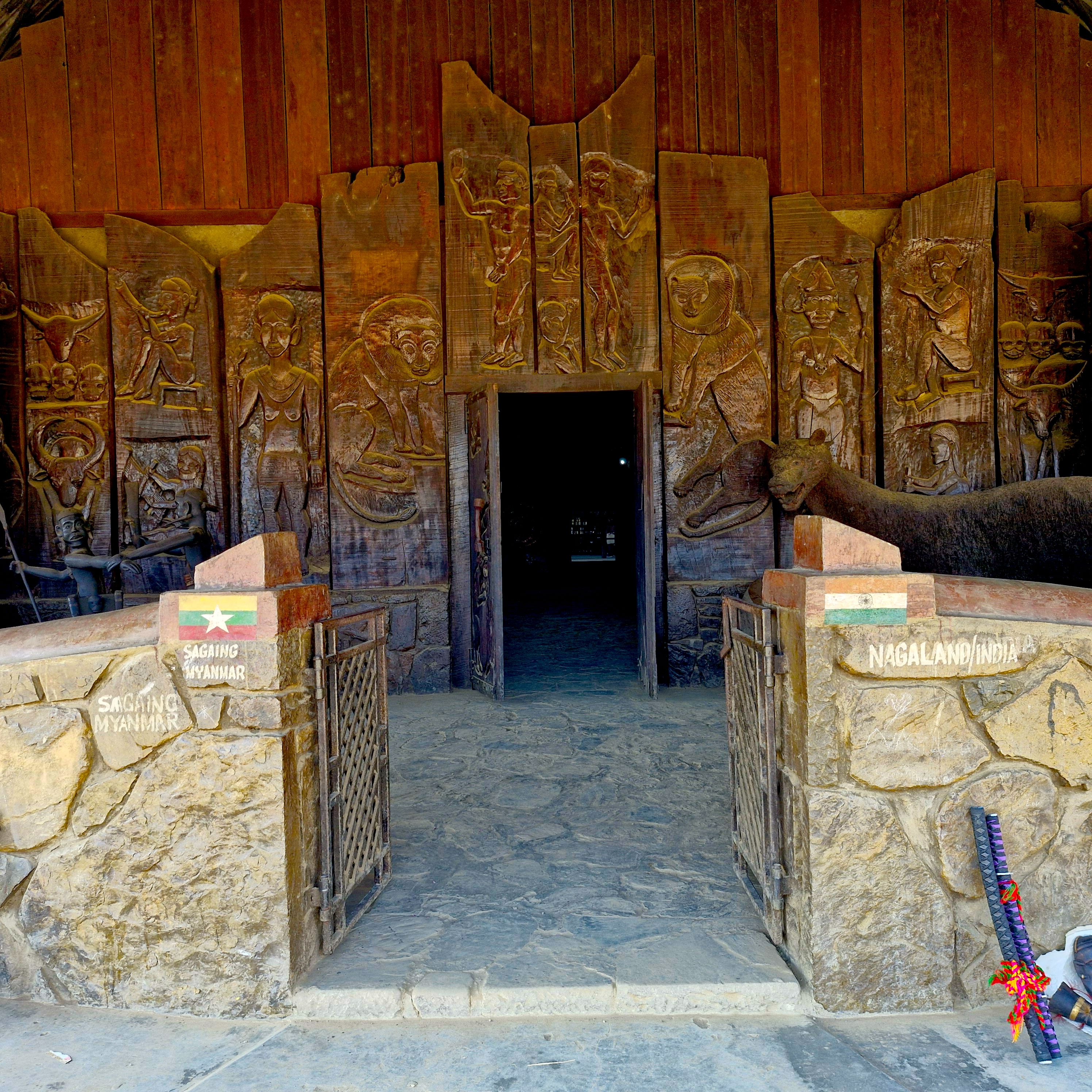 Entrance to Angh's Palace, Longwa
That afternoon Jeilei walked me through the village. The Angh's palace first — the hereditary chief's residence at the highest point, its fame already well-documented: one half in India, one half in Myanmar, the India-Myanmar border passing through the building's centre like a chalk line drawn on a floor by someone who had never been inside.
What no article had mentioned was the hearth.
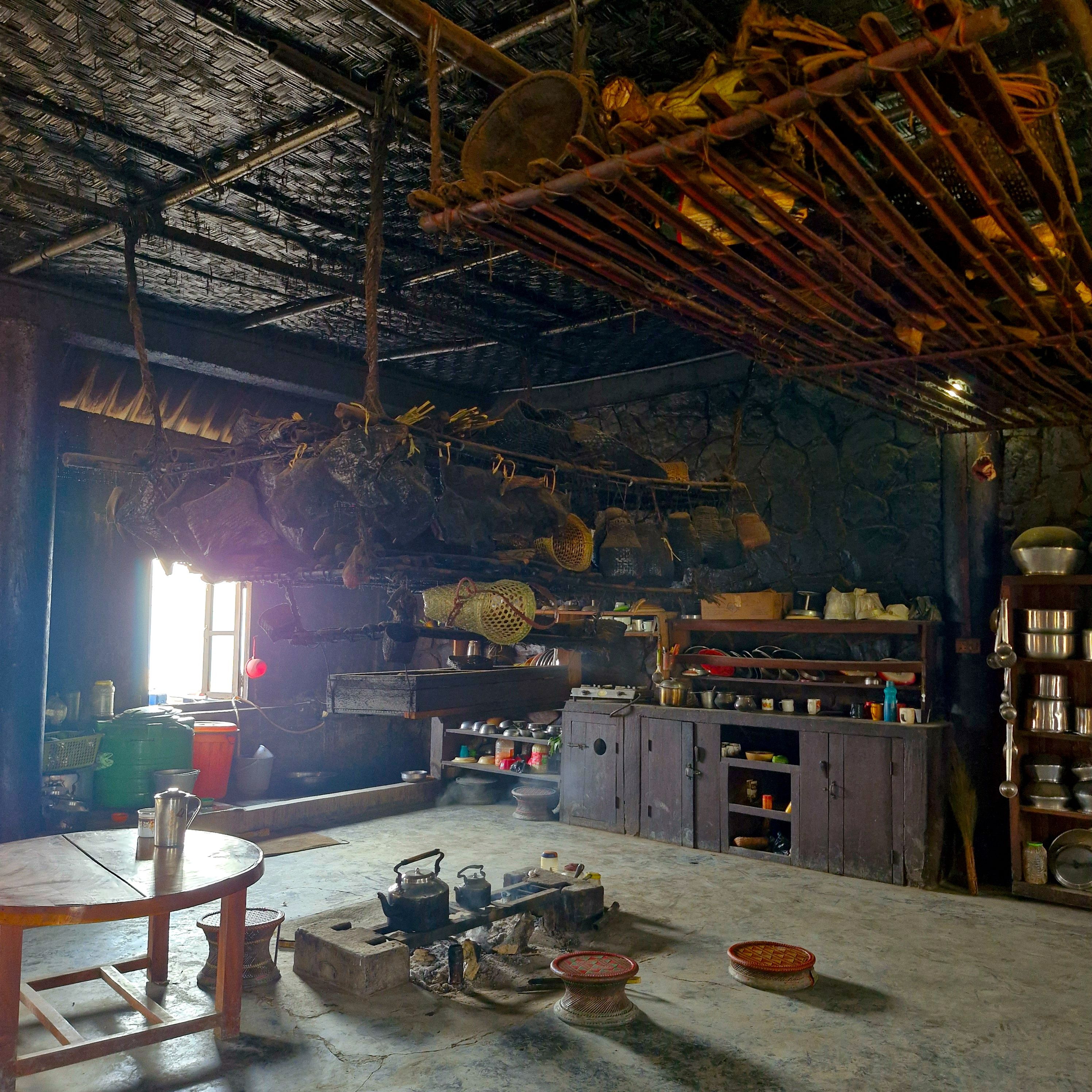 The central hearth at the Angh's Palace
It sat at the heart of the room — low, blackened, radiating the same patient heat that hearths everywhere have always radiated. Around it: the same soot-darkened walls, the same curling smoke finding the same gaps in the timber, the same warmth landing on whoever stood close enough to feel it.
The border passed through this room. Through this hearth, almost. And the fire did not notice. The smoke did not choose a side. The warmth it gave — to the India half of the room and the Myanmar half — was identical.
I had expected the Angh's house to be the place where the border felt most dramatic. Instead it was the place where borders felt most absurd. Not meaningless — the checkpoint outside was real, the registration I had signed was real. But standing at that hearth, I understood something about the distance between a line on a map and a line in a life. The former is drawn by governments. The latter by fire, by smoke, by the smell of woodsmoke in a stranger's walls — things that have never required a country to exist.
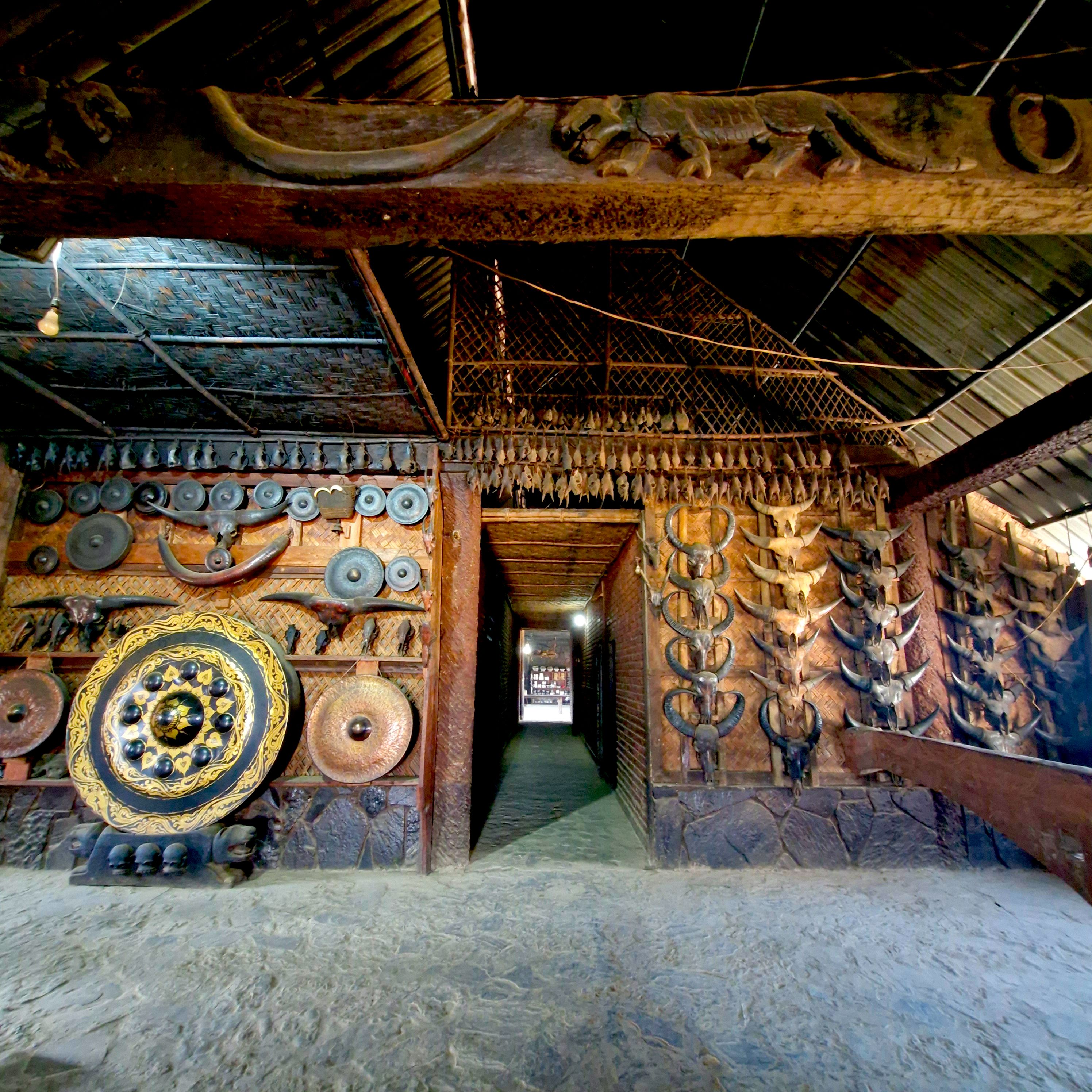 The Palace Hall
Inside, rows of mithun skulls lined the walls. Markers of communal standing. The visual vocabulary of Konyak authority, accumulated over generations. I looked at them briefly, noted them, moved on. It was the hearth I kept returning to in my mind.
Further on, the next stop was at a workshop. Two men bent over a workbench, assembling a muzzleloader from scrap metal and salvaged wood.
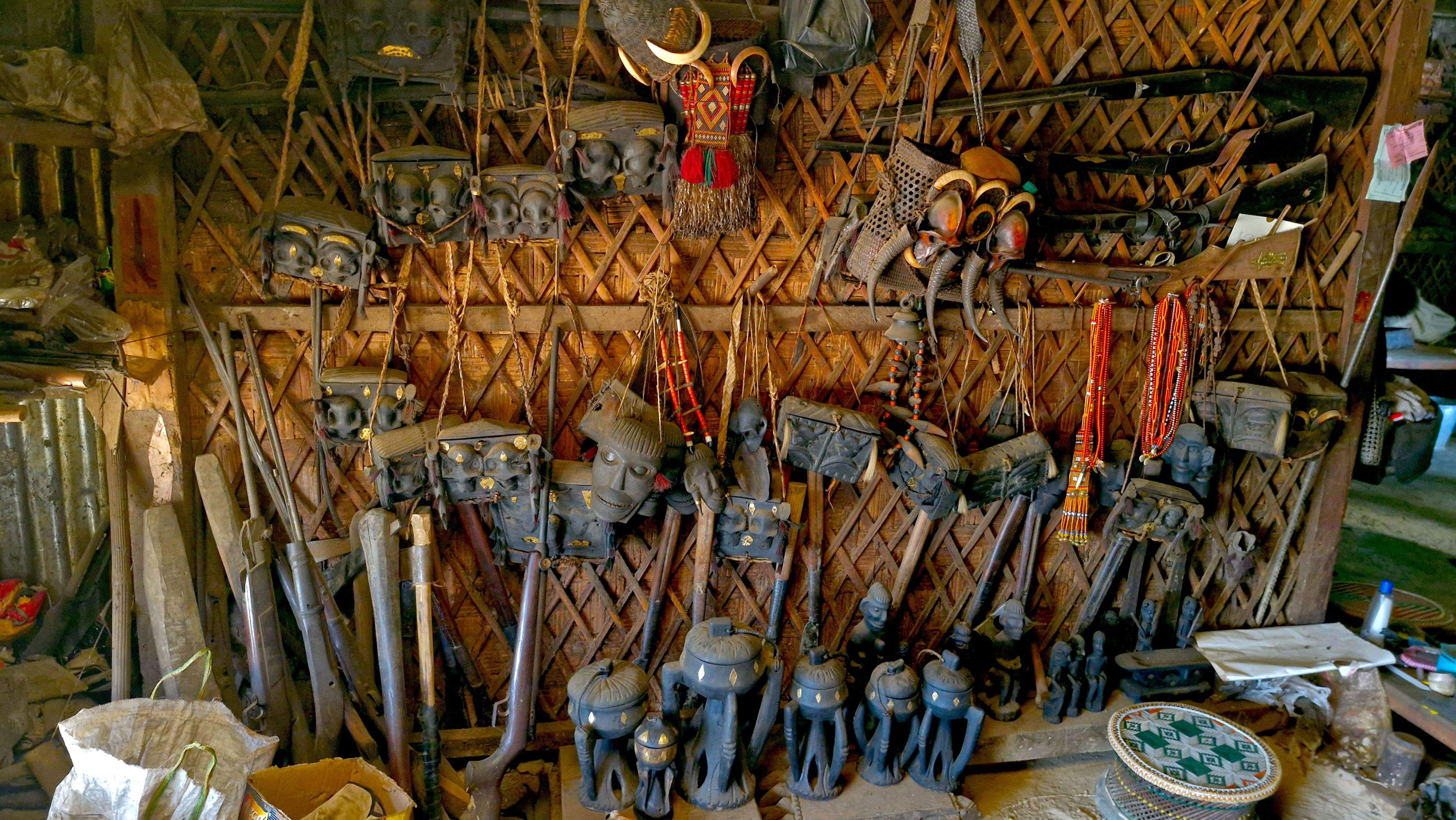 Gun Workshop, Longwa
Gun-making in Longwa village operates under strict council oversight — each weapon accounted for, each owner known. Tradition and practicality in the same object, in a place where the two have never required separating.
I had arrived expecting Longwa to perform itself for me. It had no interest in the role.
The clearing was easy to miss — a patch of flattened earth off the main track, half-shaded by a tree I couldn't name, close enough to the road that motorbikes occasionally passed without slowing.
Four plastic chairs. Four old men.
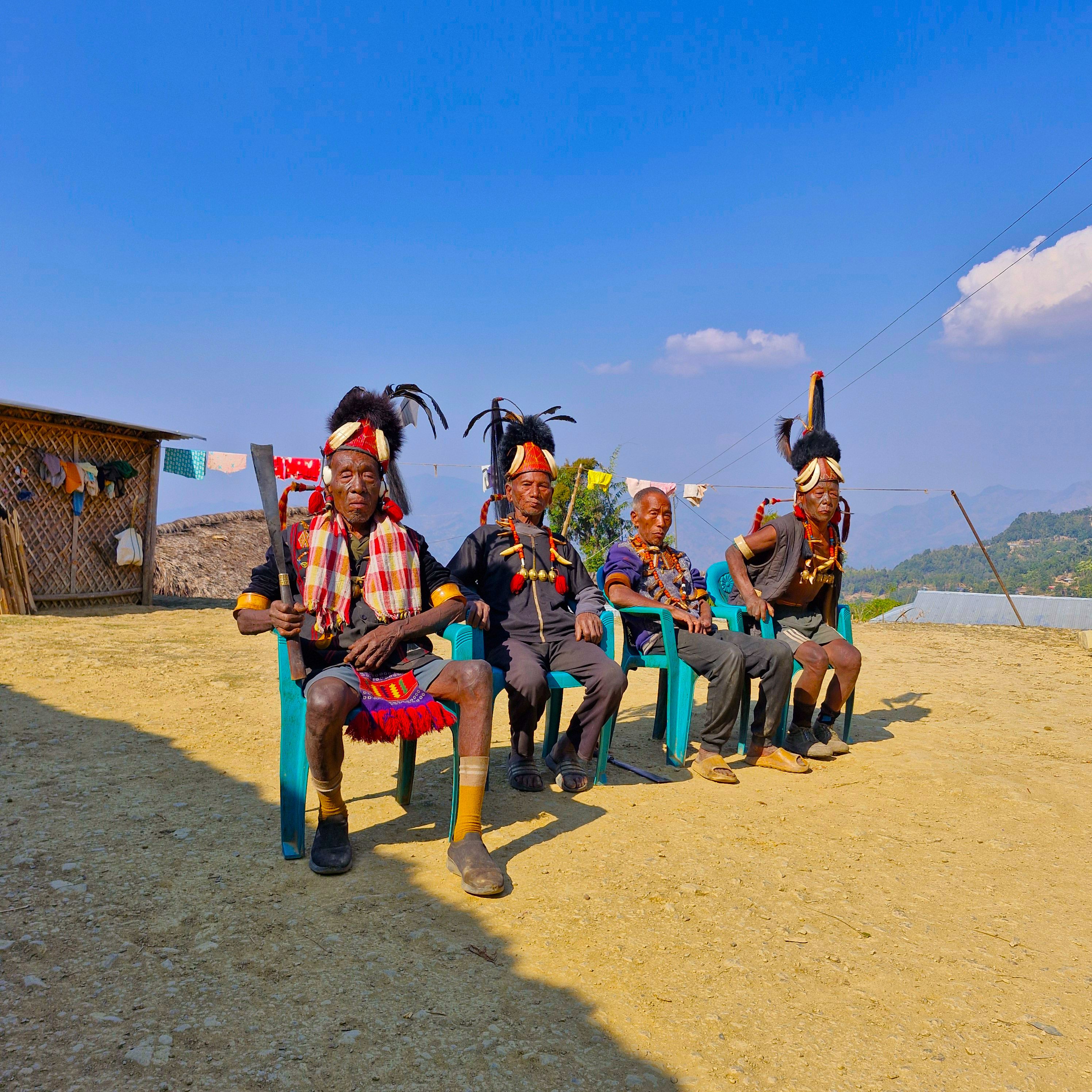
They sat the way people sit when they have been sitting in the same place for years — not relaxed exactly, but settled. Rooted. The oldest had a face that time had worked on thoroughly: deep lines running parallel from cheekbone to jaw, and beneath them, still legible, the blue-black tattoos of the Konyak tribe. The ink had faded to the colour of a bruise healing, but the pattern held — geometric, deliberate, earned.
Before I could introduce myself, one of the elders raised a hand — not a greeting, a pause — and said something I didn't understand. A younger man nearby translated without expression:
If you want to speak with them, you pay first.
If you want a photograph, you pay more.
He named a figure. I agreed. A transaction, conducted in full daylight, with no pretence on either side.
Only then did the elder nod, and the afternoon shifted.
Through Jeilei's translation, they spoke with the precision of people who have explained the same thing many times and refined it until only what mattered remained. The Konyak people believed that a person's spirit resided in the skull. To take an enemy's head was to bring that spirit back — to strengthen the village's fertility, harvests, livestock, survival. Headhunting was not violence in isolation. It was an economy of the sacred.
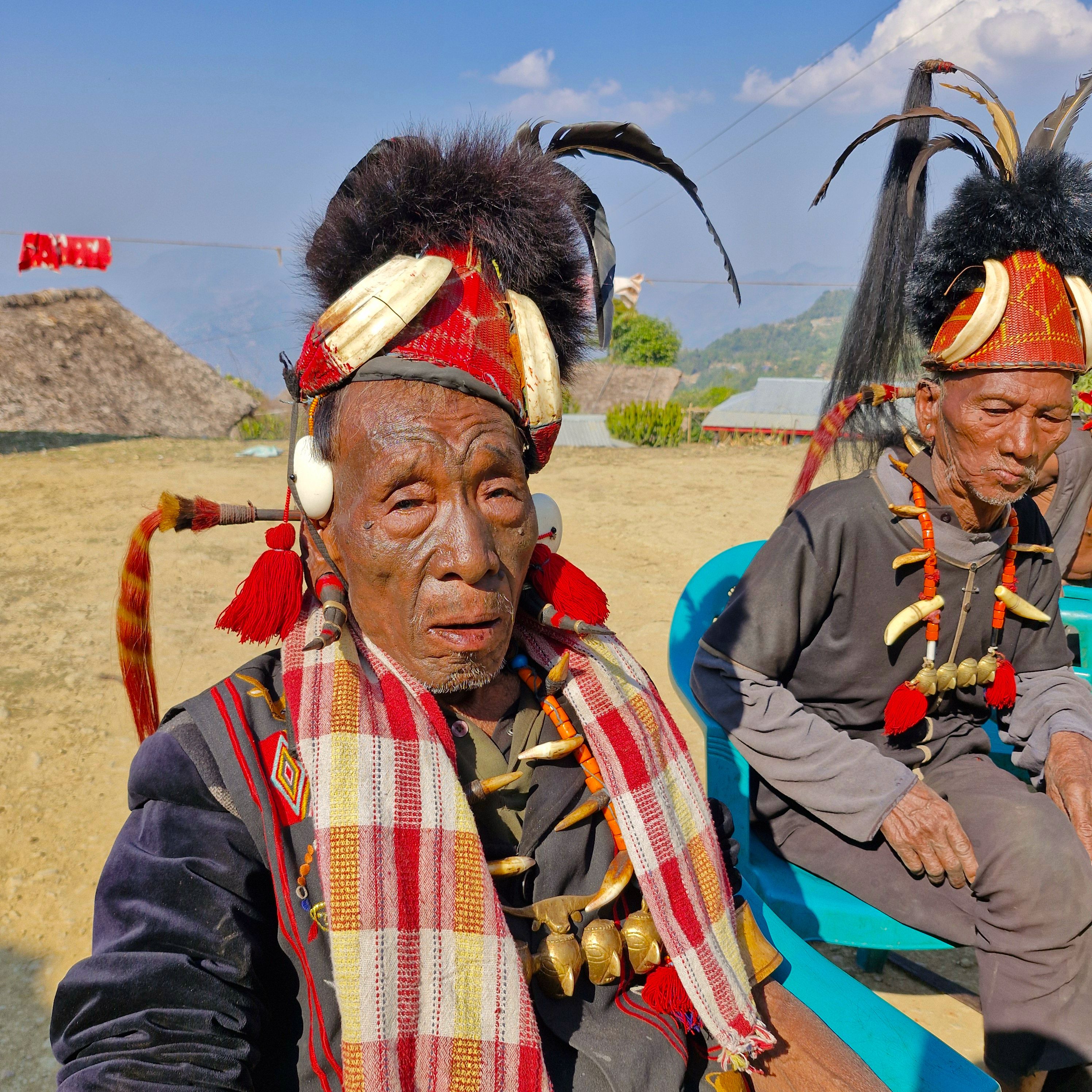 The warrior faces
A facial tattoo was the record of that economy. It could not be given. It could not be inherited. The mark was made only after a warrior's first raid — after blood, after proof. These four men, sitting in plastic chairs in an afternoon clearing while a motorbike idled past on the road, carried that record on their faces still. The practice died in the 1960s, following administrative pressure, missionary influence, and integration into modern state structures.
I asked, eventually, about the payment.
The eldest looked at me for a moment before answering — the kind of look that does its own translation. Then, through Jeilei, he said: they had lost count of the number of people who had come. Vloggers. Photographers. Travel influencers. Most arrived already knowing what they wanted — the tattoos, the skulls, the phrase last living headhunters — and left with exactly that. Almost none asked about the hospital that had taken decades to begin building.
Almost none stayed long enough to notice that the younger generation was leaving Mon district. Almost none returned anything that lasted.
They took the image.
They left the reality where they found it.
The payment was not bitterness. It was the only leverage a man with a famous face and no infrastructure has over the people who profit from photographing it.
These men had once been feared for taking heads. The irony — that the world now came to take from them instead, and called it cultural tourism — sat in the clearing with us, unspoken, perfectly understood.
And then, as if arranged by some particularly unsubtle novelist, it happened again. Right there. While we were still talking.
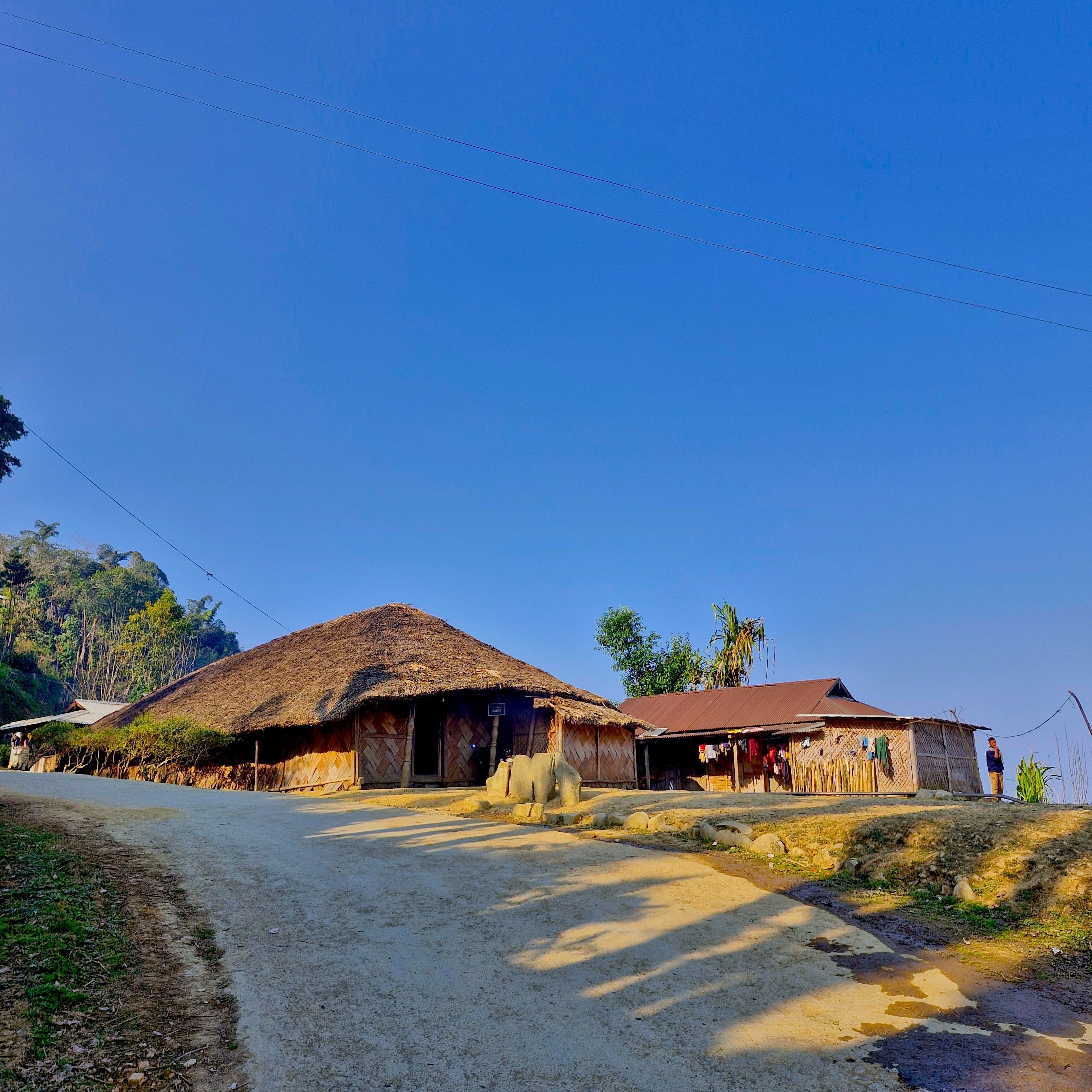 The Old Angh's house at the clearing
Two motorbikes pulled up at the clearing's edge — expensive machines, ridden by men in riding gear that suggested the bikes had cost more than most households in Longwa village earn in a year. They dismounted without greeting anyone. One raised a camera — a professional single-frame body, the kind that announces itself. They began shooting. No pause. No acknowledgement of the men in the chairs. No eye contact sought or given. Just the sound of the shutter, and their own narration to each other, low and certain, built entirely from the phrase they had arrived already carrying:
The last living headhunters.
The same four words that every travel blog, every YouTube thumbnail, every Instagram caption had used before them.
The younger translator stepped forward and explained the payment process — the same quiet explanation he had given me twenty minutes earlier. The riders looked at each other. A beat passed. Then they capped the lens, walked back to their bikes, and left. No acknowledgement of the elders. No word offered in either direction. Just the sound of expensive engines receding up the hill.
The elders in the final stretch of their lives, their bodies visibly carrying the weight of age, frailty, watched them go. Said nothing. Expressions did not change. They had, I understood, watched this exact sequence play out more times than either of us could count. The motorbikes were new. Everything else was identical.
I did not know what to say. So I said nothing either. We sat in the clearing for a while longer, the afternoon light continuing its indifference around us, and I thought about all the content those men had just made — the footage, the narration, the last living headhunters — and how none of it would include this moment.
The refusal.
The silence afterward.
The elder's face, which had seen enough of the world's appetite to no longer be surprised by it.
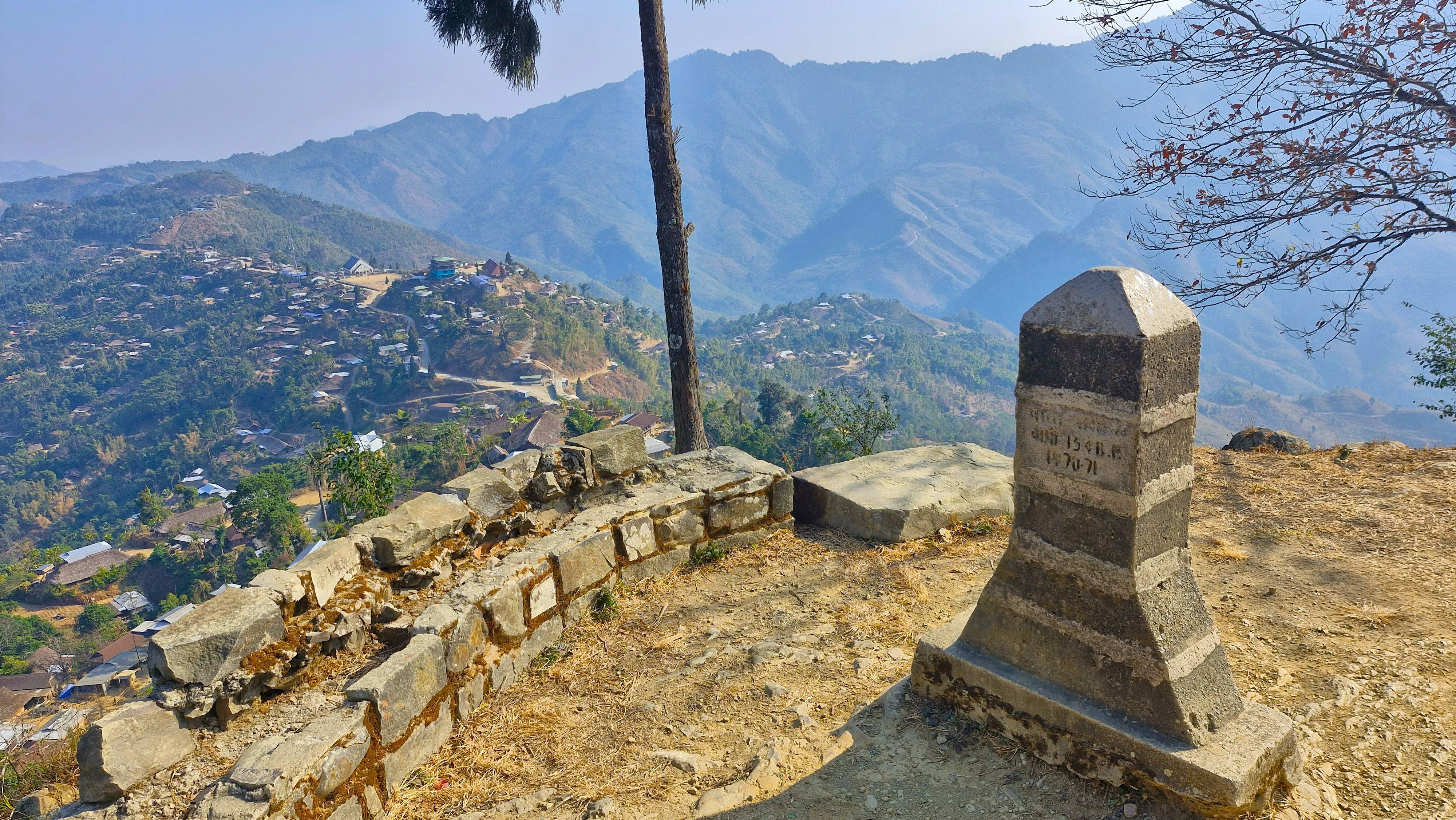
Before the village woke up the next morning, I walked to Pillar 154 — the border marker between India and Myanmar, and the best viewpoint over Longwa village spread across the ridges below.
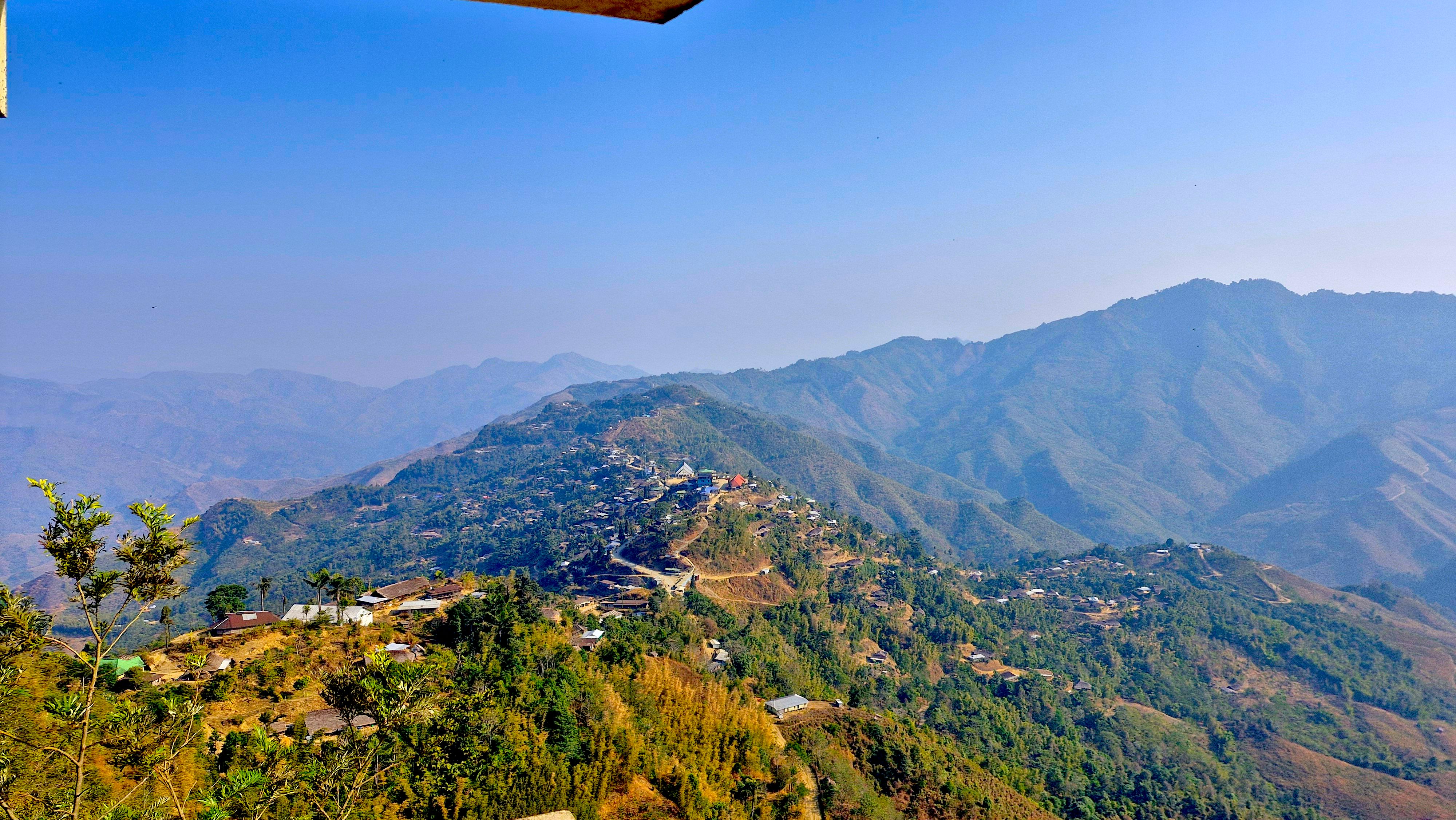 Longwa village, Mon district, Nagaland
On the trail I met a young man in his twenties — studying at Kohima Science College, back for the weekend council meeting. He turned and walked with me.
Most of his friends, he said, were gone. Education first, then work, then the slow realisation that coming back meant giving up what education had made possible. The village that outsiders spent days reaching — the offbeat Nagaland destination that travel blogs called a hidden gem — was, for many who actually belonged to it, becoming a place to visit rather than a place to be from. He said this without self-pity, with the even tone of someone describing the weather.
We stood at the pillar for a while. Below us, Longwa lay across the hills in both directions — houses, terraces, smoke beginning to rise from morning fires in Myanmar. The border, from up here, was invisible. Which was the point, and also the problem.
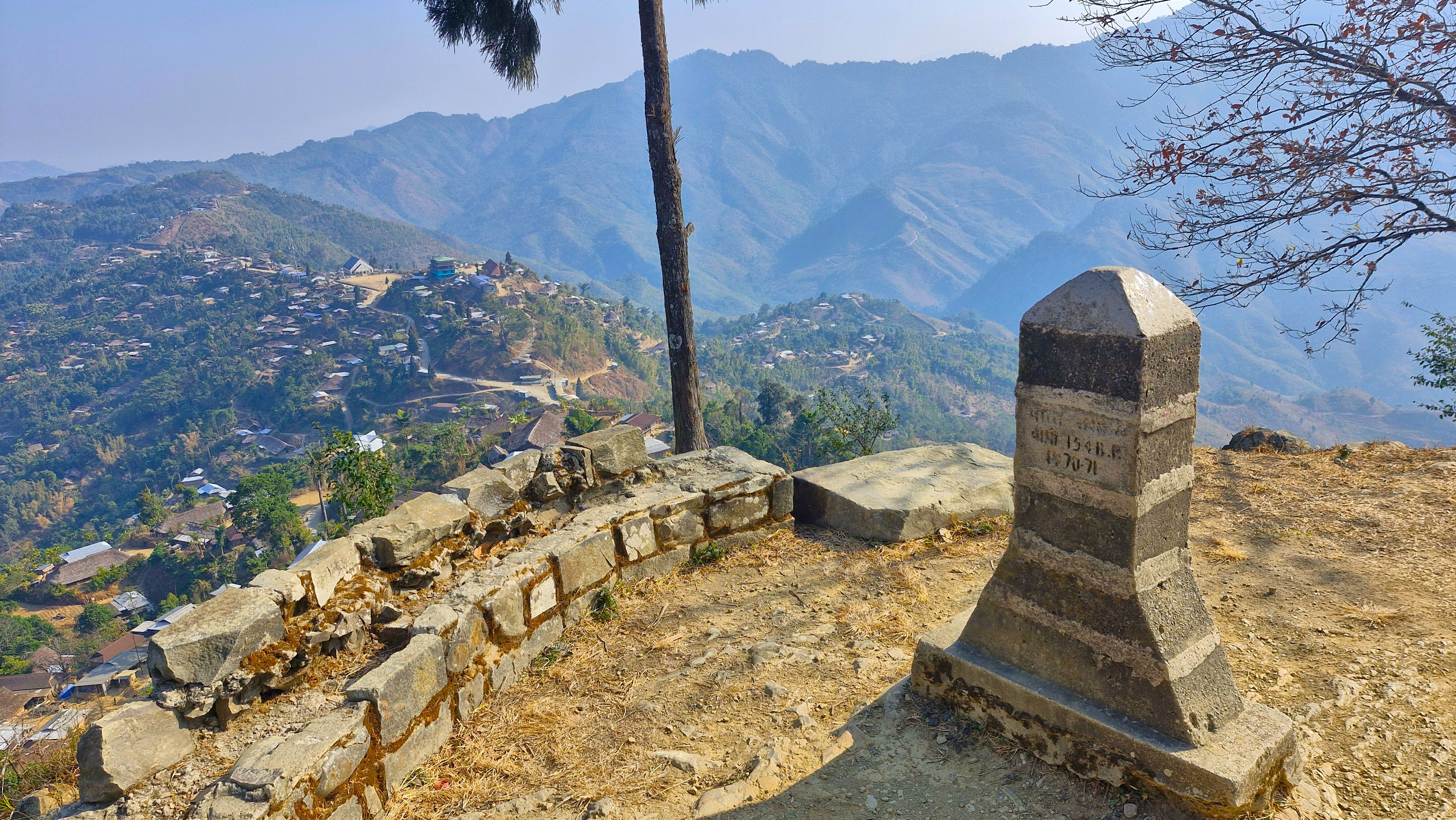 Pillar 154
I had come because the world had taught me to know this place by one dramatic label. What I found instead was a community that had spent decades watching that label arrive before them, distort what it touched, and leave without asking what it had missed.
The headhunting was real, and documented, and finished. What was still ongoing — the infrastructure debt, the outmigration, the particular exhaustion of being famous for the most sensational version of your past — that part never made the thumbnails.
The most honest thing I can offer, in return for what the clearing gave me, is to refuse to repeat the reduction.
Longwa village is not just a headhunter village.
It is a border village in Nagaland, a living community, a place in the middle of a difficult negotiation with its own future.
The headhunting was the least interesting thing about it.
And I nearly missed all of it chasing a label someone else had written.
As I write this now, one of those four men is gone.
I don't know which one. I don't know the date, or the circumstances. What I know is that the number has changed — from four to three — and that somewhere, right now, a travel blog still describes Longwa as the home of the last living headhunters without knowing, or caring, that the count is no longer accurate. The thumbnail hasn't been updated. The caption still reads the same. The label persists, indifferent to the life that has left it behind.
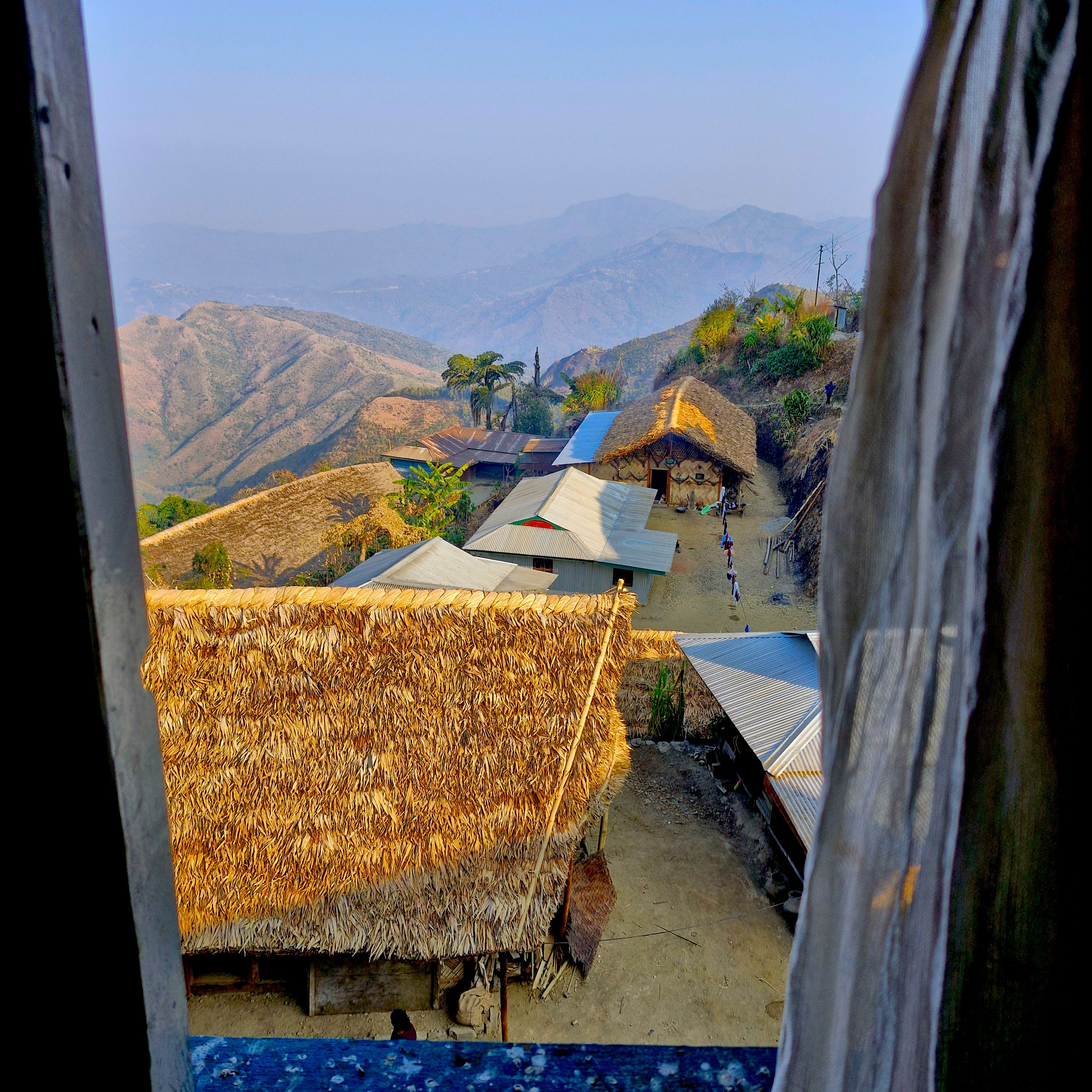 View from the homestay
And here is the question I haven't been able to put down since I heard: when the last of them goes, what happens to Longwa in the algorithm? Will the motorbikes still come? Will the single-frame cameras still appear at the clearing's edge, looking for a chair that no longer has someone in it? Or will the destination simply drop from the trending list — quietly, without ceremony — the way a place does when it has stopped being useful to the people passing through it?
The village will remain. The hearth will still burn on both sides of the border. The young men will continue leaving for Kohima, and some will come back, and some won't. The council will still meet on Saturdays. The sumo jeeps will still run — not on Sundays.
But the clearing may go quiet.
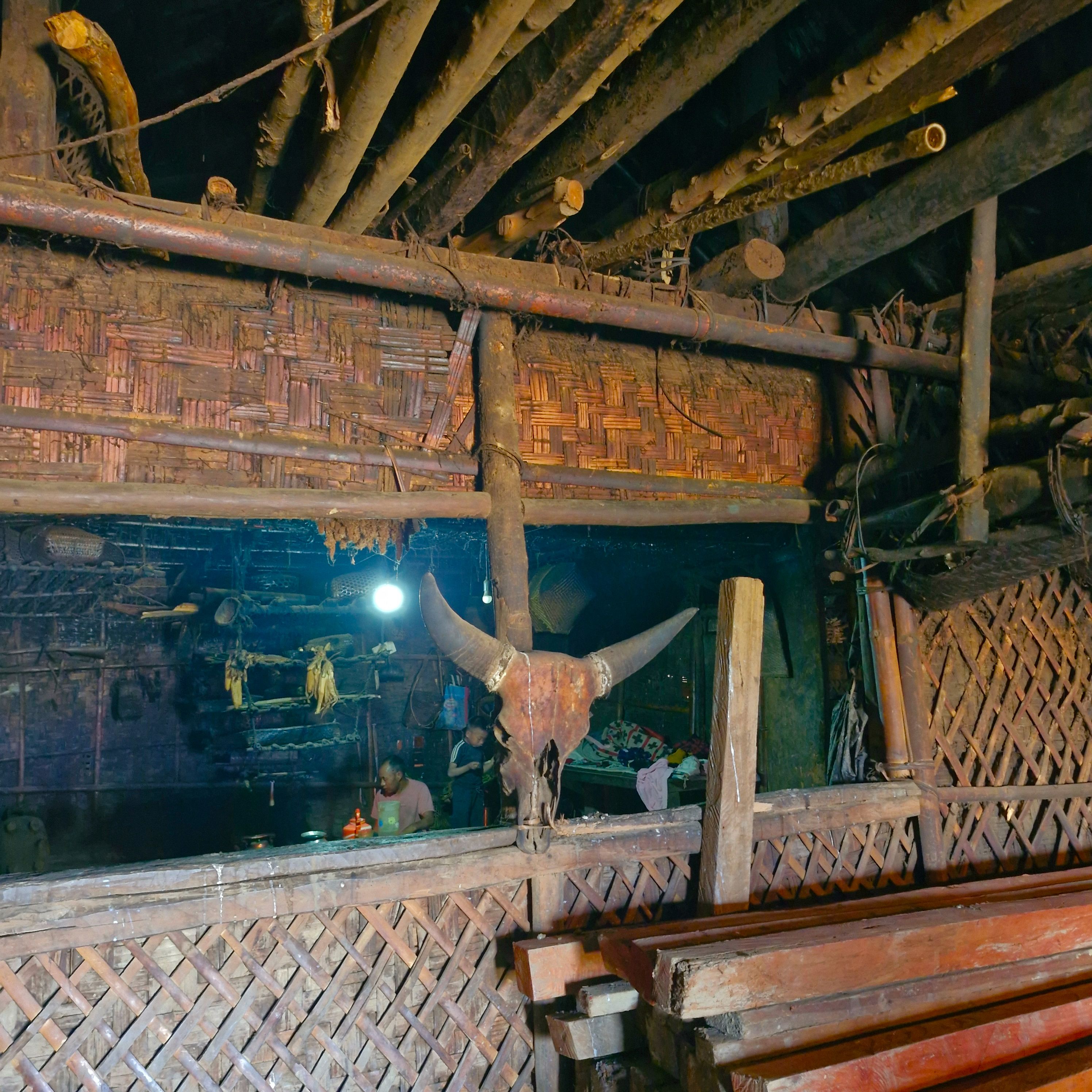 Inside a local house
And in that quiet, the real question about responsible travel in Nagaland — about responsible travel anywhere — will remain unanswered:
Were we ever actually interested in the place, or only in what the place could do for our content?
I went to Longwa because the world had taught me to know it by one dramatic label. I leave it, now, carrying a different weight entirely — the weight of a name I never learned, a chair that is empty, and the knowledge that the most important stories about a place are almost always the ones that don't survive the edit.