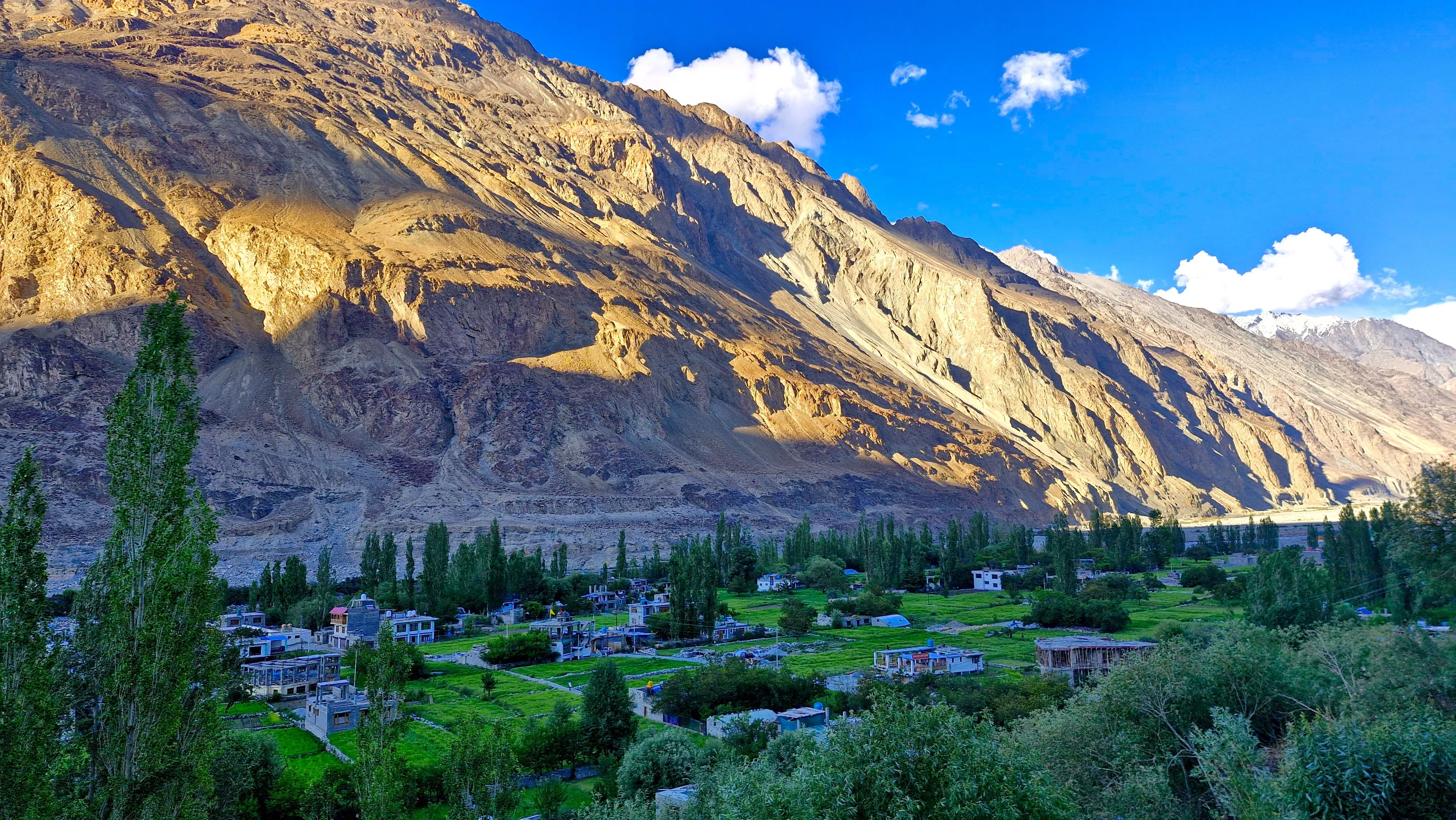
Four weeks of slow traveling and hitchhiking through Ladakh had taught me to expect very little.
A ride came when someone stopped. Dinner was whatever the family hosting me happened to be cooking. Plans dissolved with the weather, roadblocks, or the kindness of strangers. Somewhere along the way, I had convinced myself that travelling slowly also meant seeing more honestly.
Then I reached Turtuk.
The first thing I saw was a café advertising wood-fired pizza, cold-pressed juices and caramel frappes.
For a moment, everything I thought I knew about the village collapsed into that menu.
Three weeks of choosing buses over taxis, homestays over hotels and uncertainty over convenience had brought me here—to India's northernmost village, the last place where Balti language, cuisine and centuries-old traditions continue to survive. Yet the first image waiting for me looked like it could have belonged to Bali, Bir or any mountain town learning to market itself to travellers.
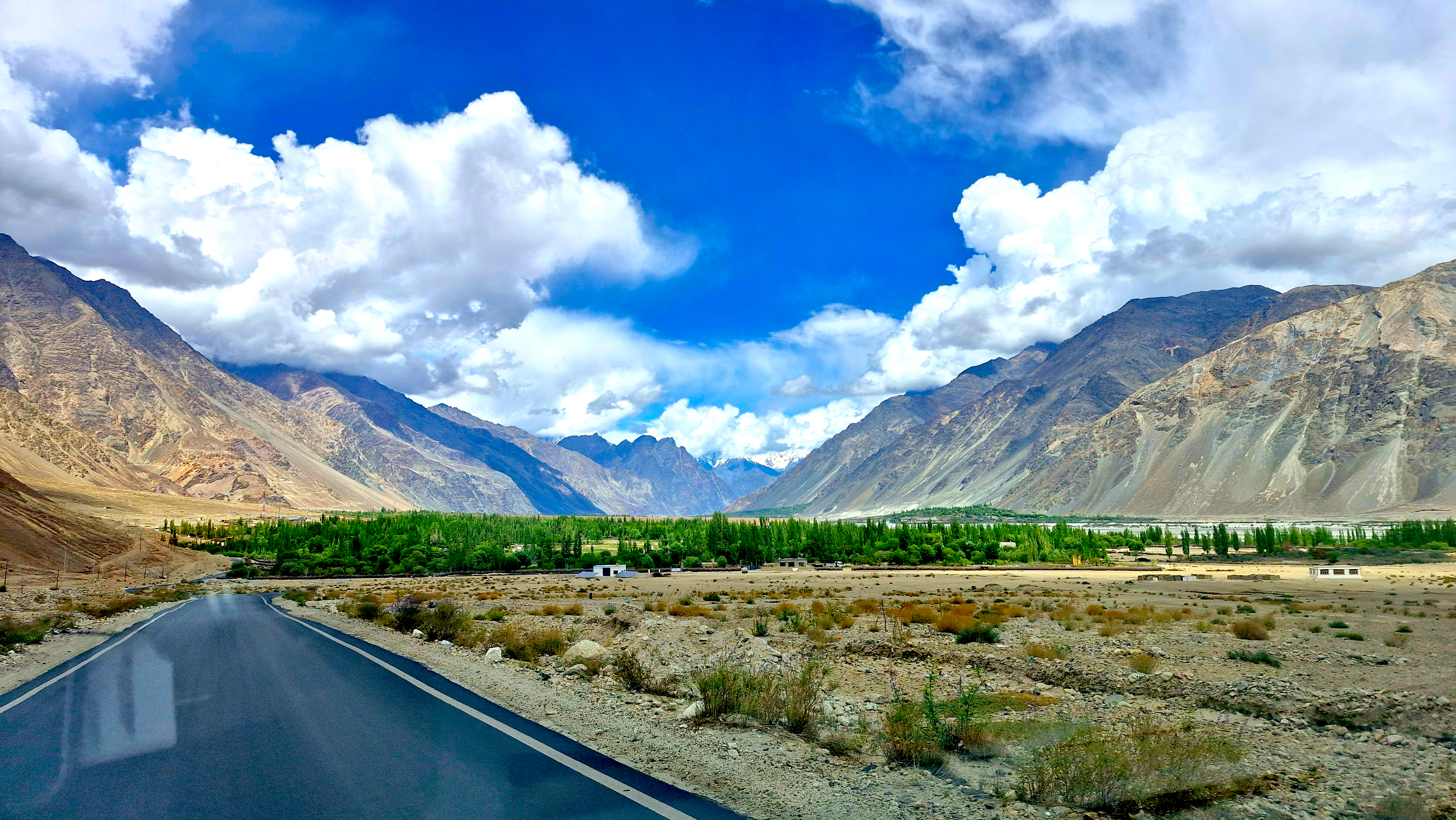 The road to Turtuk from Nubra Valley
A waiter placed a glass of juice on the table. I stared at it longer than I drank it.
What disappointed me wasn't the café itself. It was the speed with which I judged the village because of it.
Looking back, I realise that I had arrived carrying my own version of tourism.
Mine simply wore different clothes.
It would take a few days, countless conversations, an unexpected rainstorm and a 140-year-old Balti house before I understood that I had mistaken Turtuk's newest layer for its deepest one.
This is the story of what existed beyond the café road.
Salman greeted me with a steaming cup of kahwa before I had even taken off my backpack.
The warmth reached my hands before I had the chance to thank him.
After a day spent hitchhiking through the Nubra Valley, trusting strangers with each passing kilometre, the cardamom and saffron cut through the mountain cold with almost medicinal precision.
Other travellers had warned me that hospitality in parts of Ladakh had become polished by tourism.
Kind. Professional. Predictable.
No itinerary. No recommendations. No attempt to sell tomorrow's plans.
Just two cups of kahwa and the river flowing below us.
Only after a few minutes did I notice what felt different. He wasn't performing hospitality. He was practising it.
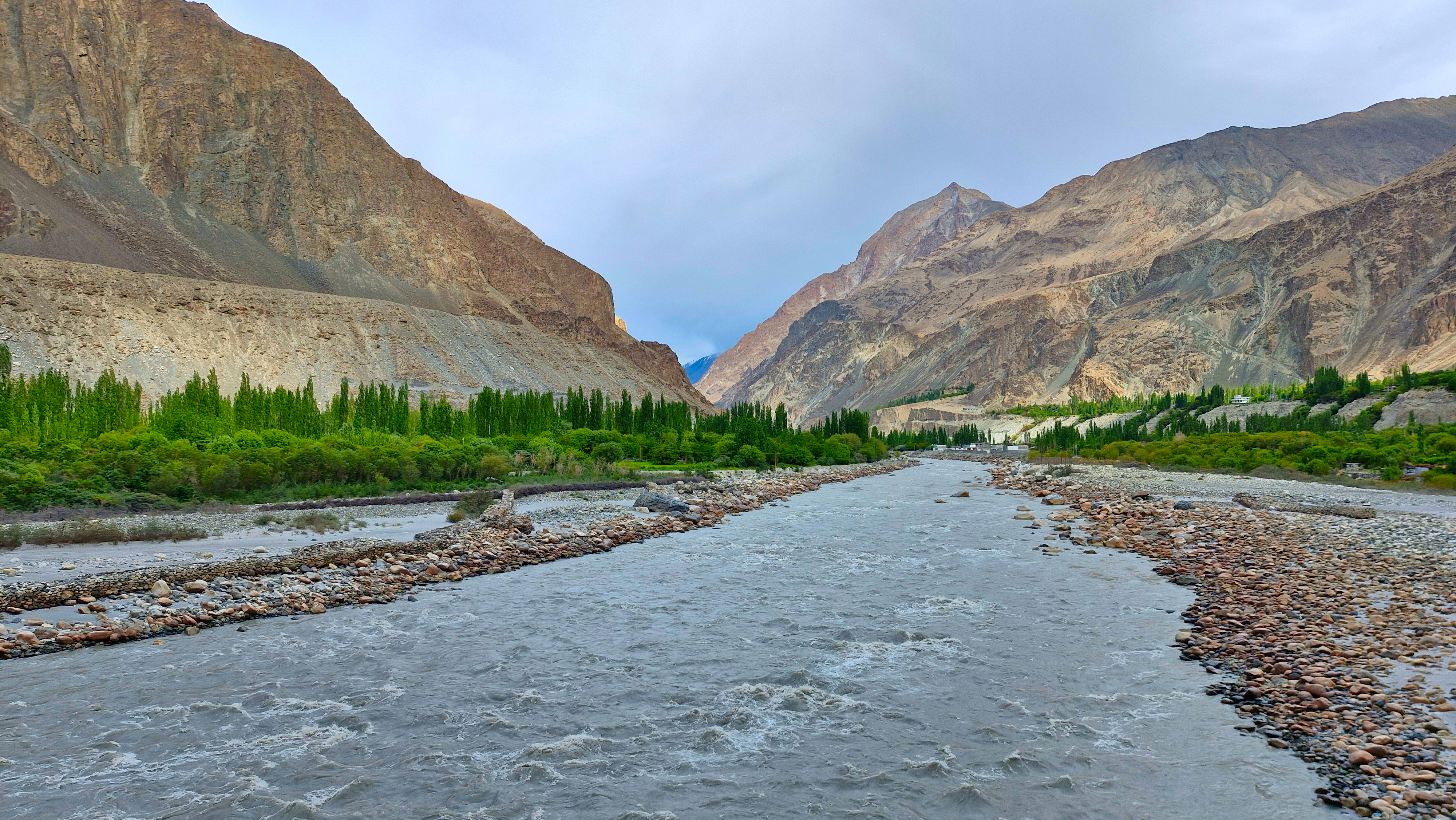 The Shyok River, Turtuk
The Shyok River curved through the valley beneath us, broad and grey beneath the late afternoon light.
When I asked about its name, Salman answered almost absent-mindedly.
"It means the River of Death."
The sentence invited another question.
I waited for the dramatic story that usually follows such names—flash floods, impossible crossings, legends designed to impress visitors.
None came.
He spoke about the river the way someone might speak about an elderly relative.
Conversation drifted naturally towards the village.
"Before 1971," he said quietly, "this wasn't India."
He didn't say it with politics. He said it with memory.
For Turtuk's older generation, borders are not abstract lines on maps but events that arrived unexpectedly and reorganised everyday life. One war placed the village inside Pakistan. Another moved it into India.
Maps changed. Mountains didn't. People simply woke up one morning in a different country.
I asked whether he still had relatives across the Line of Control.
For the first time since we'd begun talking, Salman paused.
His eyes followed the river instead of meeting mine.
Then, without answering, he reached over and refilled my cup.
The silence told me more than a sentence would have.
I didn't ask again. Partly out of respect. Partly because I sensed some stories belonged to the people carrying them, not the traveller collecting them.
Only much later would I realize how important that silence was.
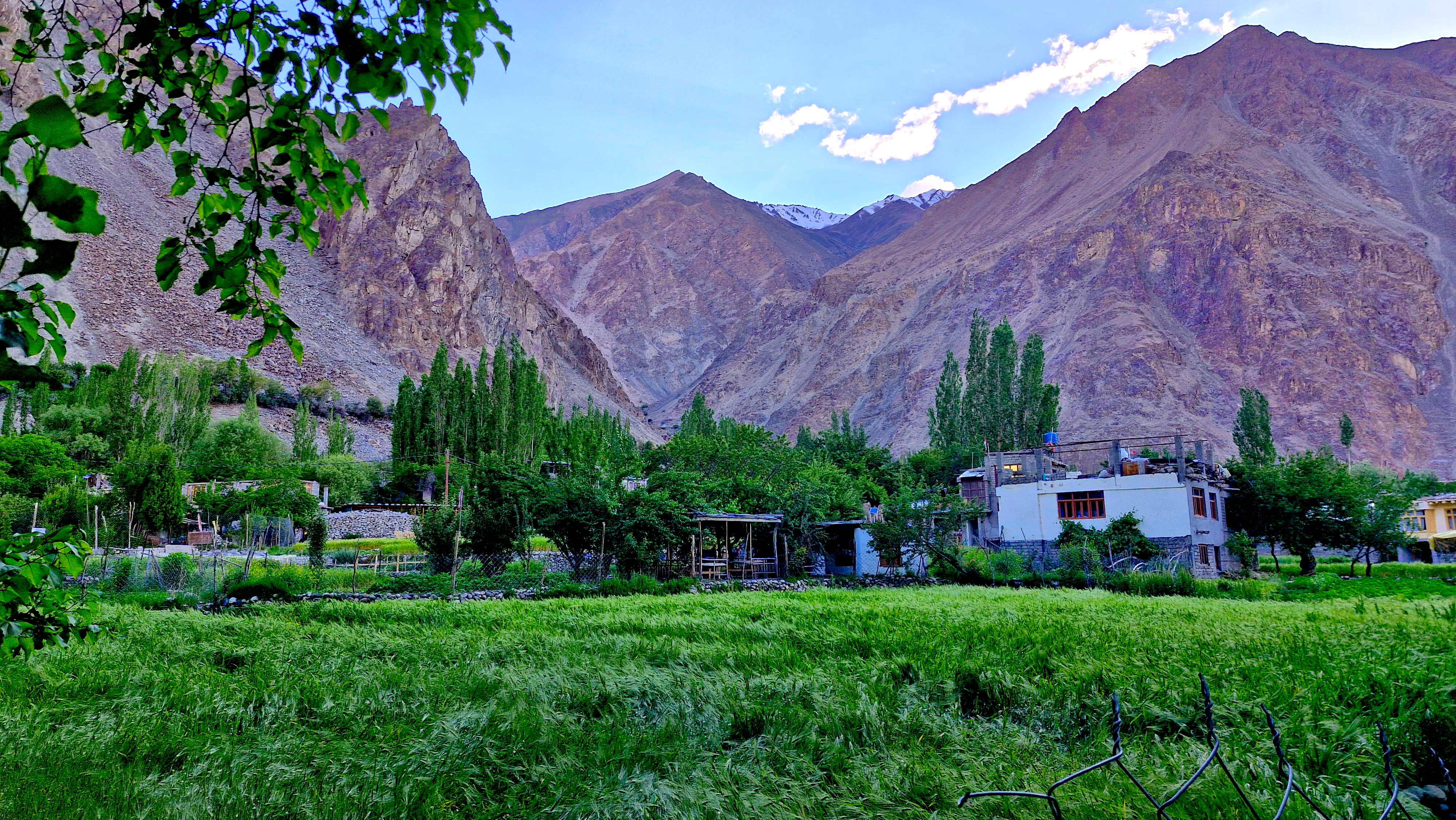 Farool village, Turtuk
Every account I'd read before coming here treated Turtuk as a footnote to itself — "the POK village India got back," an one-hour stop between Diskit's monastery and the sand dunes at Hunder.
The history got mentioned. The people, rarely.
Turtuk often appeared less like a living community than a geographical achievement—a place reduced to its coordinates and its strategic importance.
It felt strangely ironic.
For a village remembered because borders changed around it, very few stories seemed interested in the lives that continued after the headlines disappeared.
Crossing the wooden bridge into the older part of the village, the landscape shifted almost instantly.
The barren palette that had defined Ladakh for nearly three weeks gave way to terraces thick with barley, buckwheat and apricot orchards climbing patiently towards the mountains.
Water rushed through narrow stone channels beside every lane.
Children darted between mud-brick houses.
The Karakoram still dominated the skyline, but now they shared it with green.
Then I noticed something else.
Or rather, I noticed what wasn't there.
No prayer flags.
In almost every Ladakhi village I had passed through—from Leh to Diskit—strings of faded Buddhist prayer flags stretched across rooftops, bridges and mountain passes.
Here there were none. At first it felt like a small absence.
Later I realised it quietly explained almost everything.
Turtuk belongs culturally to Baltistan before it belongs to the version of Ladakh most visitors imagine.
It is a Muslim-majority Balti village in a district otherwise known for Tibetan Buddhism, carrying centuries of Central Asian influence that remain visible in its language, architecture and everyday life.
The absence of prayer flags wasn't a missing detail.
It was the first clue that I had crossed an invisible cultural border long before reaching the political one.
Walking through the narrow lanes, I found myself slowing down without meaning to.
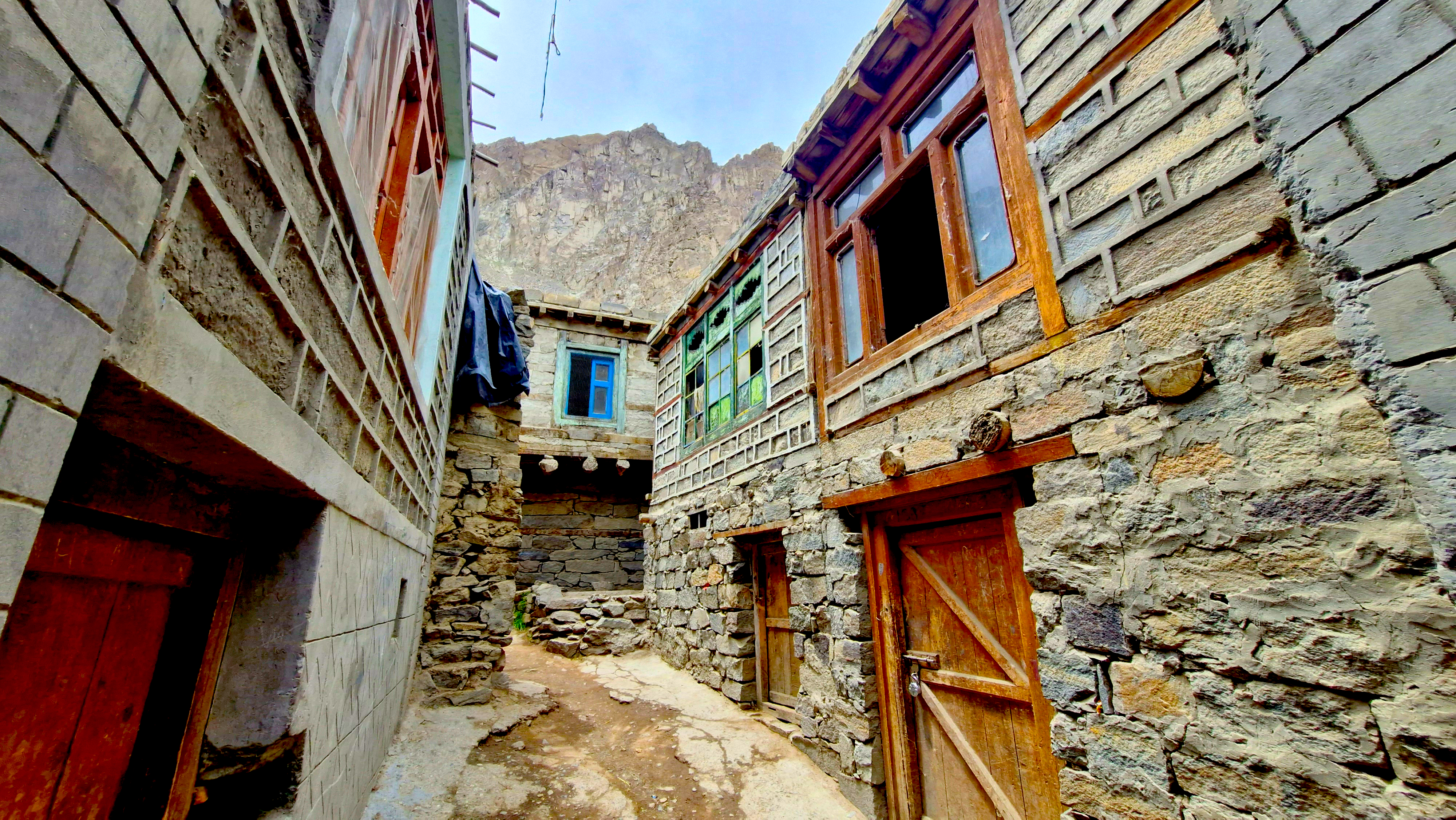 The inner lanes of Farool village, Turtuk
Stone walls carried the weight of generations.
Apricots lay drying on rooftops in bright orange clusters.
Water flowed somewhere close enough to hear but not always to see.
Doorways were low enough that I instinctively ducked, twice catching my backpack on wooden lintels carved long before either India or Pakistan existed in their present form.
The village seemed uninterested in announcing itself. It simply continued being what it had always been.
The more quietly I walked, the more it revealed.
Somewhere behind me, the café continued serving pizzas.
Ahead lay a conversation that would eventually introduce me to a word I had never heard before—a word that had quietly shaped this village for nearly four centuries.
I didn't know it yet. I had already begun seeing it everywhere.
The mountains stopped surprising me somewhere around the second week in Ladakh.
Faces didn't.
An elderly woman sat outside her doorway sorting apricots into shallow wicker baskets. Her features were unlike those I had grown accustomed to between Leh and Nubra—lighter eyes, a sharper nose, a face that seemed to carry traces of places much farther west.
For a brief moment I thought of Hunza. Of Gilgit.
Places separated from Turtuk by little more than mountain ranges, and by a border almost impossible to cross.
It was the first visible reminder that I had travelled into Baltistan long before I had travelled to India's edge.
History revealed itself here the same way conversations did. In fragments.
No two people narrated it exactly alike. One spoke of the Maqpon rulers. Another began with the Namgyals. Someone else skipped centuries altogether and started with the wars of 1948 and 1971.
The details shifted depending on who was speaking. The emotional truth never did.
Empires had come and gone.
The Maqpons.The Namgyals. The Dogras. The Sikhs, briefly.
Then the borders of India and Pakistan.
Through every transition, Turtuk remained what it had always been—a Balti village trying to continue ordinary life while history repeatedly rearranged the map around it.
For twenty-three years after 1948, the village belonged to Pakistan.
In 1971, it became part of India.
The mountains barely noticed. The people had no choice but to.
What fascinated me wasn't that rulers had changed. Because history is full of changing rulers.
What fascinated me was how the village itself had remained recognizably whole.
Everywhere I walked, I sensed a continuity that politics alone could not explain.
The old quarters of Farool and Yul unfolded like a maze. Stone lanes are barely wide enough for two people. Wooden balconies darkened by centuries of weather.
Apricots drying across rooftops in scattered patches of orange. Water slipping quietly through narrow irrigation channels before disappearing beneath the next house.
Nothing appeared preserved for visitors.
Everything appeared preserved because people still lived here.
The houses reflected that same quiet practicality. Tibetan foundations supported Kashmiri woodwork. Persian motifs met Central Asian craftsmanship.
Some homes were divided into separate living spaces for different seasons—summer, spring and autumn, winter—each responding to the realities of mountain life rather than aesthetic preference.
It wasn't architecture trying to impress anyone.
It was architecture shaped by survival.
The more time I spent walking those lanes, the more uncomfortable another thought became.
I arrived irritated by the café.
Now I found myself wondering whether I had been any less of a tourist than the people sitting inside it.
They came looking for pizza. I had come looking for authenticity.
Both of us had arrived carrying expectations of what the village should provide.
Only mine sounded more noble. I wasn't ready to answer that thought.
So I carried it with me.
The second surprise in Turtuk wasn't architectural. It was green.
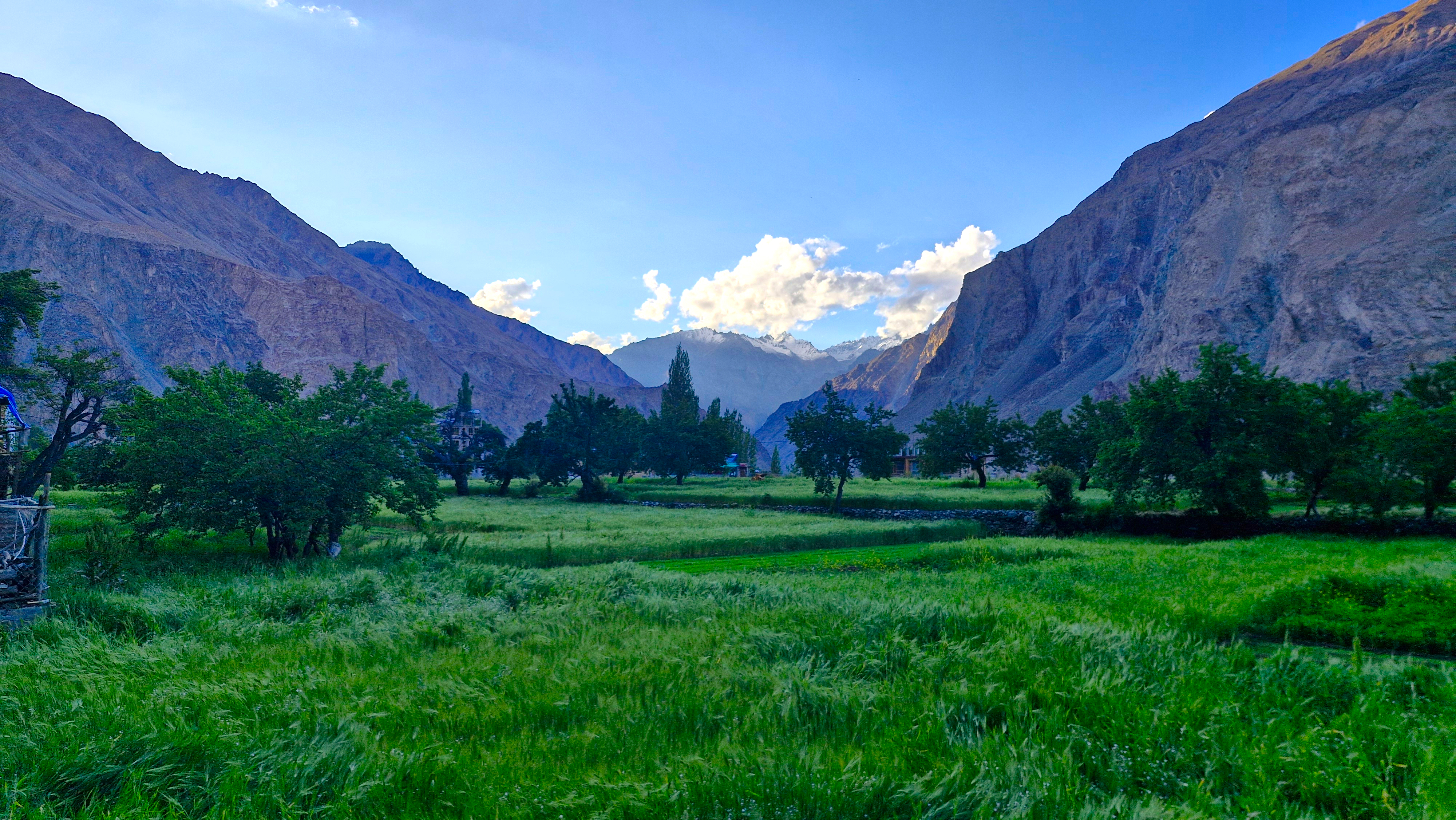 The green fields of Turtuk
After nearly four weeks of crossing Ladakh's high-altitude deserts, the valley unfolded into terraces so unexpectedly fertile that they almost looked borrowed from another landscape.
Barley swayed gently beneath the afternoon breeze. Buckwheat climbed the lower slopes. Apricot trees stretched across the valley floor.
Behind them, the Karakoram remained exactly as severe as ever. The mountains hadn't softened.
The people had simply learned how to live with them.
I stopped near a group of women working in one of the fields.
One of them smiled and beckoned me over before I had decided whether interrupting would be impolite.
Our conversation relied less on language than gestures. She pointed towards one crop after another.
Buckwheat. Barley. Sea buckthorn. Walnuts. Apricots.
Words travelled slowly between her Balti and my Hindi, but meaning rarely struggled.
When I asked whether everything was organically grown, she laughed. Not unkindly.
Just with the gentle amusement reserved for questions that make sense somewhere else.
"Of course," she replied.
The answer lingered with me long after we parted. In cities, organic food is marketed as an alternative.
Here, it was simply agriculture. The label existed because another way of farming had never truly arrived.
I realised I had asked a city question in a village that had never needed one.
Food became my easiest way of returning to the same conversations. Every morning began differently from the one before it.
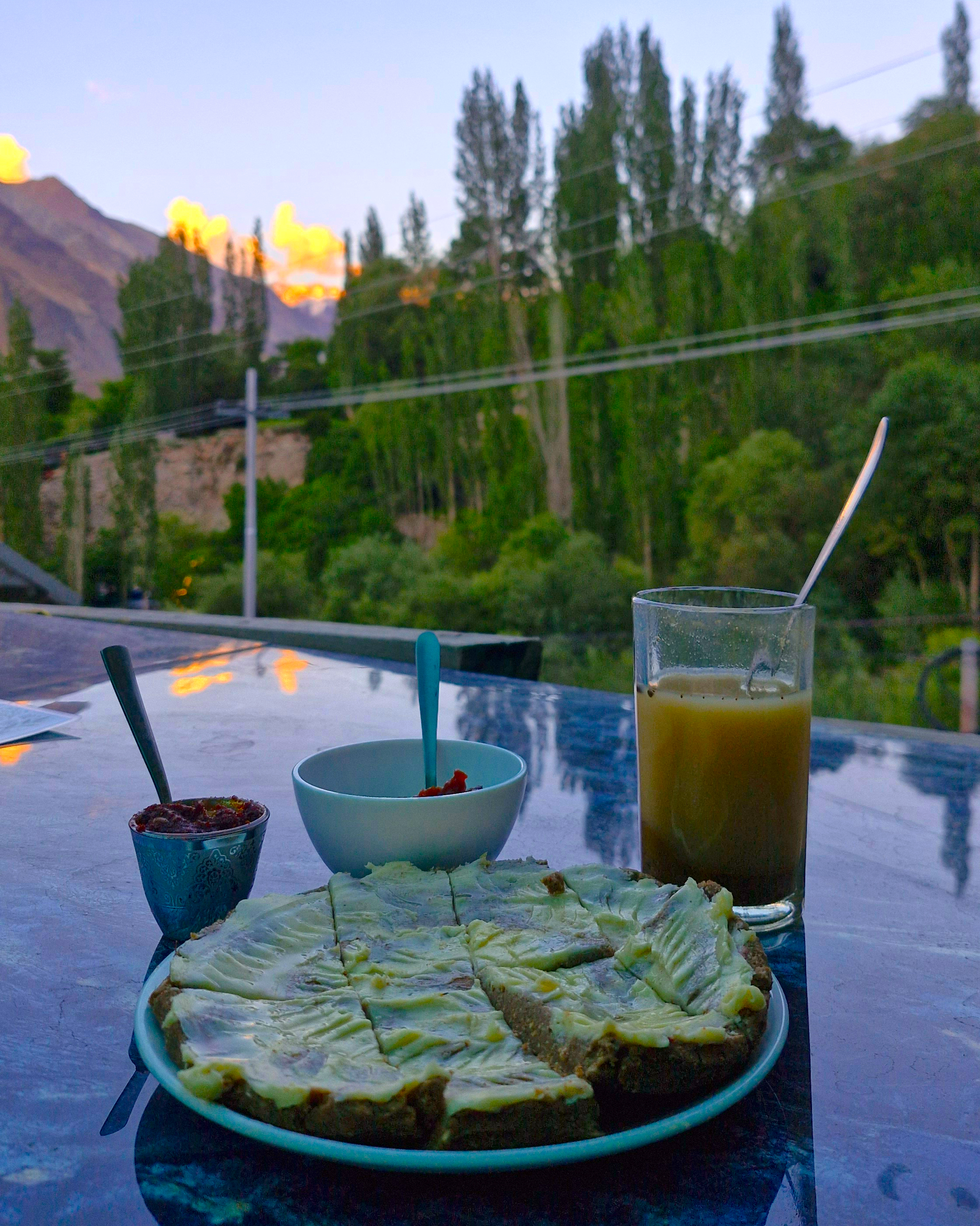 Introduction to the Balti Cuisine at Begum Kitchen
Sea buckthorn tea.
Marzan—roasted barley flour folded into warm milk with yak butter.
Flavours that felt unfamiliar only until they didn't. Travel has a quiet way of recalibrating certainty.
The first bite asks questions. The third usually answers them.
Most evenings ended at Begum's Kitchen. Ashraf recognised me by the second visit. Abida by the third no longer asked what I wanted to eat. She asked whether I had eaten enough.
The distinction mattered. Hospitality here seemed to begin long before menus entered the conversation.
The mutton curry arrived slowly, cooked for mountain winters rather than restaurant timing.
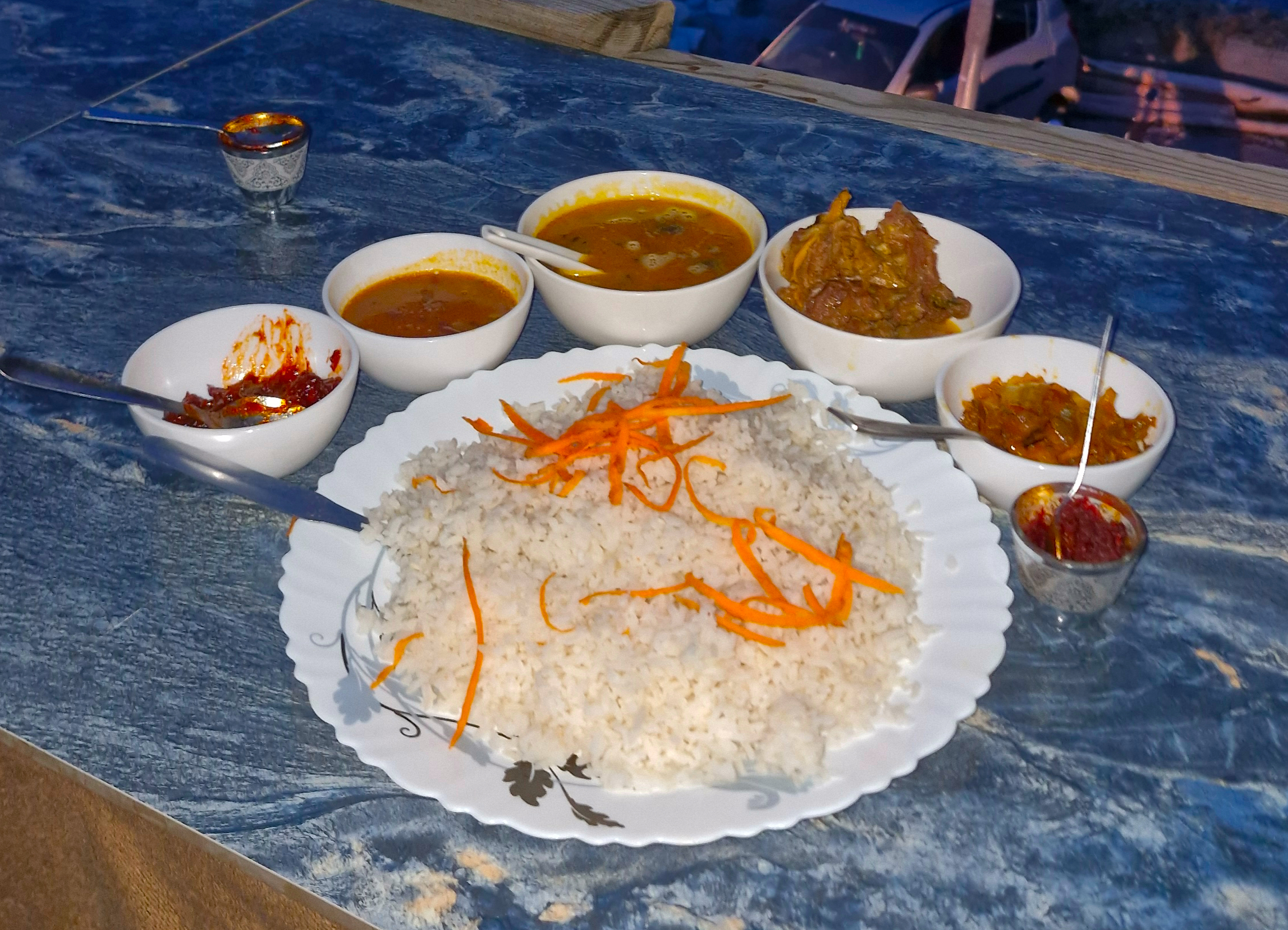 The sumptuous meal prepared by Abida at Begum Kitchen
Fresh buckwheat bread followed, served with yak butter and apricot jam made from fruit grown a few hundred metres away.
Beyond the wooden railing, the Shyok rolled steadily through the valley.
Behind the kitchen, someone laughed. The Karakoram caught the last light of the day.
Once, instinctively, I reached for my camera. Then I stopped.
Not because I wanted to prove I was "living in the moment."
Travel has a habit of turning even restraint into performance.
Some memories simply become sharper when left undocumented.
It was during my third dinner that Abida mentioned, almost casually, the women's collective she had helped establish.
There was no carefully rehearsed story. No appeal for admiration.
She spoke about it as though she were describing another ordinary part of village life.
Something needed doing. So they did it.
The collective had grown steadily over the years, creating livelihoods around local produce and traditional Balti food while allowing more women to remain rooted in Turtuk instead of seeking opportunities elsewhere.
I asked what had made such an initiative possible. She looked faintly puzzled.
"If everyone helps," she said, "why wouldn't it be?"
The answer was so uncomplicated that I almost missed its significance.
Back home, meaningful work often began with discussions about obstacles.
Here, it appeared to begin with participation.
Walking back through the old village that evening, I noticed details I had ignored before.
A basket of apricots left outside a neighbour's house without concern.
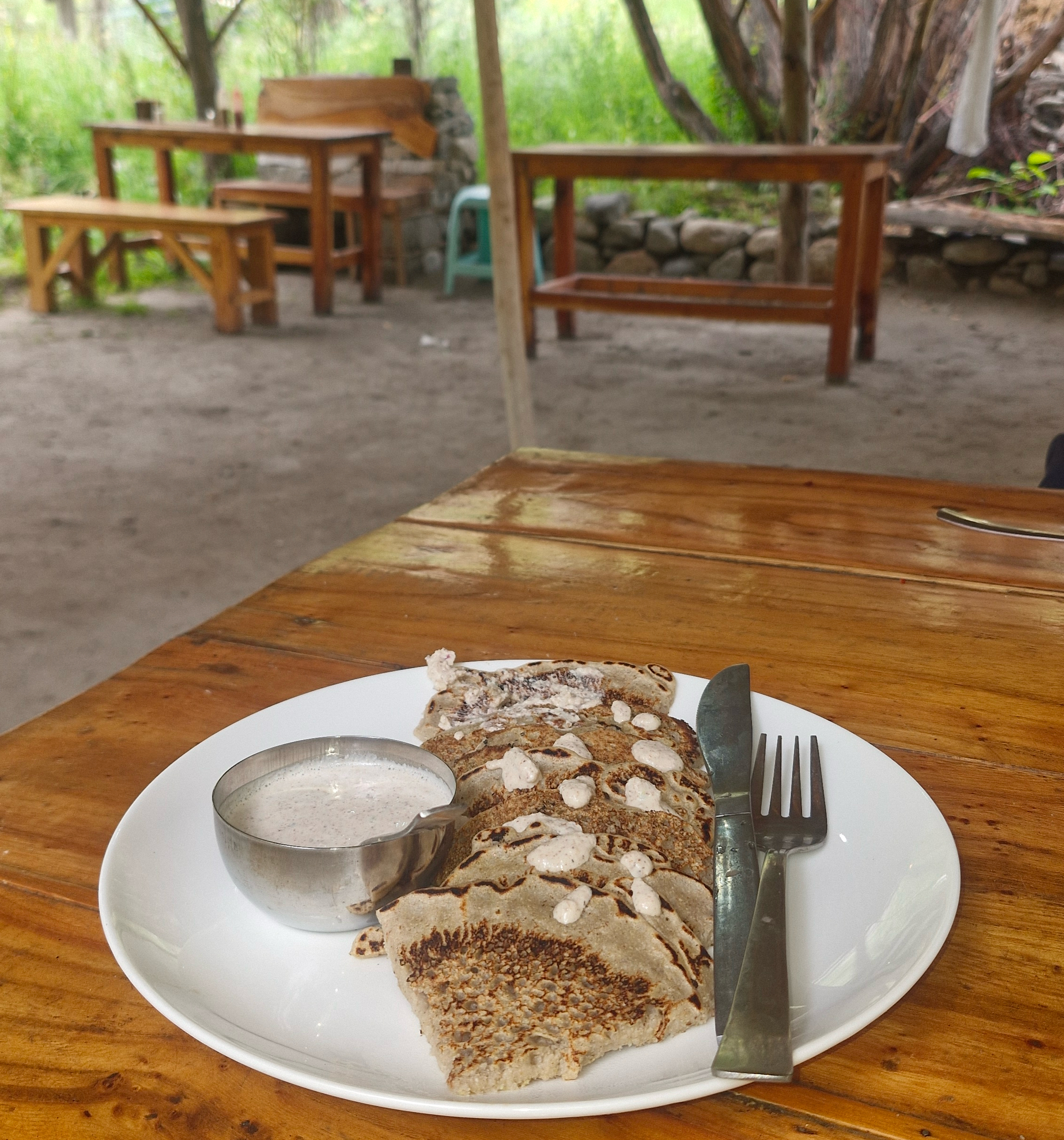 Buckwheat Pancakes
Two men repairing an irrigation channel together. Children carrying bundles of firewood far larger than themselves while adults watched with quiet amusement rather than alarm.
None of it felt extraordinary.
Perhaps that was precisely why it mattered.
Communities rarely endure because of grand gestures.
They survive because small acts become habits, repeated often enough that no one remembers when they first began.
By the time I reached my homestay, I realised I had been witnessing the same pattern ever since Salman welcomed me with a cup of kahwa.
I simply didn't have a name for it yet.
The next afternoon, an unexpected rainstorm would finally give me one.
I found the house because of the rain.
The trail I had been following climbed beyond the village towards a small waterfall, winding through apricot orchards before dissolving into loose rock. Halfway up, the sky darkened. The first drops fell without warning, sending me back the way I had come.
Just before the entrance to the old village, I noticed a weathered sign I had walked past earlier.
Late Seth Ghulam Haider Ashoor House.
Its wooden doorway stood open.
I stepped inside as the rain settled over Turtuk. For the next hour, the weather belonged outside.
The house carried its own silence.
Stone walls held the coolness of another century. Timber beams, darkened by generations of wood smoke, crossed a ceiling built long before electricity reached the valley. Light filtered through small windows designed to keep winter out rather than invite the view in.
The woman looking after the house greeted me warmly.
She had grown up in Turtuk and spoke fluent Hindi, unusual enough in the village that conversation came easily. She moved through the rooms without haste, not reciting history but remembering it.
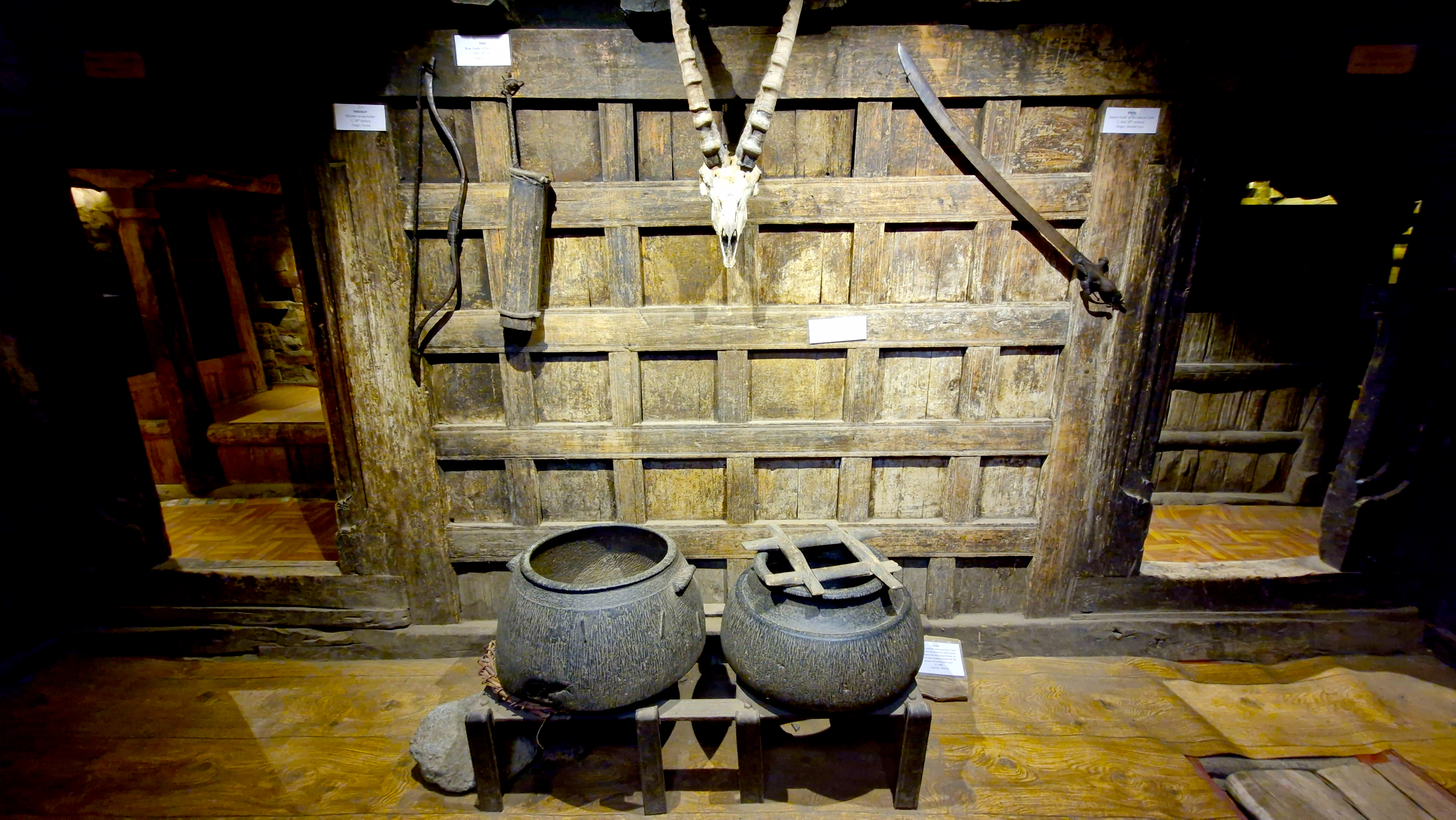 Inside the house of Late Seth Ghulam Haider Ashoor
The first room she showed me was the Duknang, the centre of family life.
A sunken hearth occupied the middle of the room, where generations had gathered through winters that could last half the year. The walls, she explained, had once displayed silver bowls, carved utensils and ceremonial vessels—not locked away as valuables but arranged openly for visitors to see.
"Wealth," she smiled, "lived with the family."
Beyond it lay the Zoot, the household granary.
Grain was stored here carefully enough to survive the winter, enough for the family and, when needed, enough to share.
Below that was the Tagra, where livestock sheltered during the coldest months. Their body heat rose naturally into the living quarters above, warming the house without wasting a single resource.
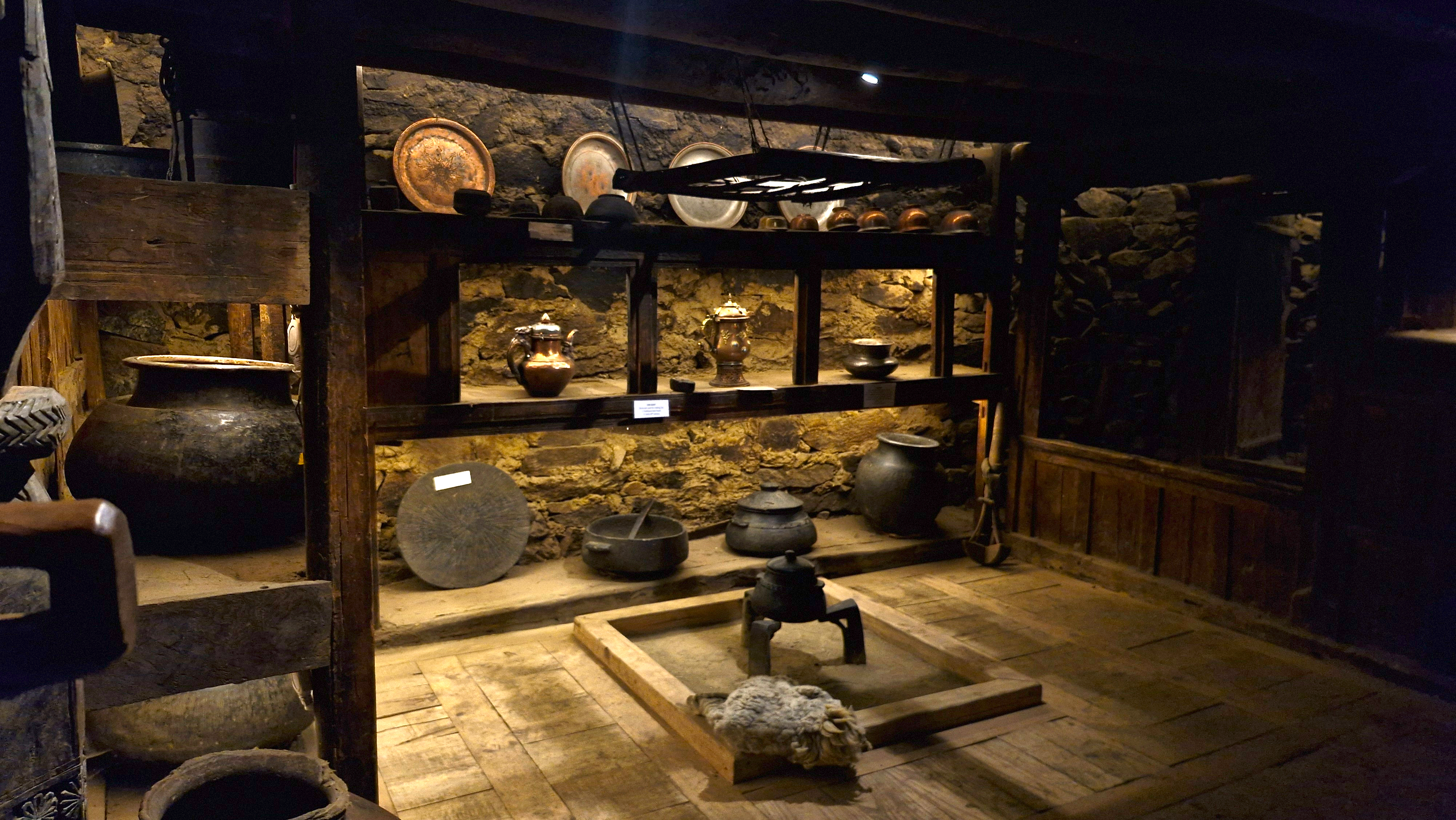 The Kitchen layout
Nothing here felt ornamental. Every room had first solved a problem.
Beauty came later.
As the rain continued outside, our conversation drifted away from architecture.
She spoke about growing up in Turtuk during the 1990s, when life revolved around harvests, neighbours and the changing seasons. Agriculture shaped the rhythm of the village. Days repeated themselves often enough that, from the outside, they might have seemed uneventful.
She smiled as she described them.
Then she spoke about change. Roads improved. Visitors arrived.
Fields slowly gave way to cafés and homestays wherever families could spare the land.
"Tourism became another crop," she said. There was no bitterness in her voice. Nor was there celebration. Only observation.
Change, she seemed to suggest, was neither good nor bad by itself.
The real question was what survived it.
Eventually the conversation reached the border. Perhaps it always does in Turtuk.
She spoke of cousins living across the Line of Control—family she knew through stories rather than memories, weddings she would never attend, funerals she could never mourn.
She paused beside one of the small wooden windows.
Beyond it, the Karakoram disappeared into mist.
"They're somewhere beyond those mountains."
For a long moment, neither of us spoke. The silence felt more truthful than anything I might have said.
Then she said something I have carried with me ever since.
"Humlog Hindustani hai... par fir bhi alag hai na." (We're Indian. But we're still different?)
She wasn't questioning where she belonged. She was describing what belonging felt like.
The Balti language spoken at home. Customs that predated the border.
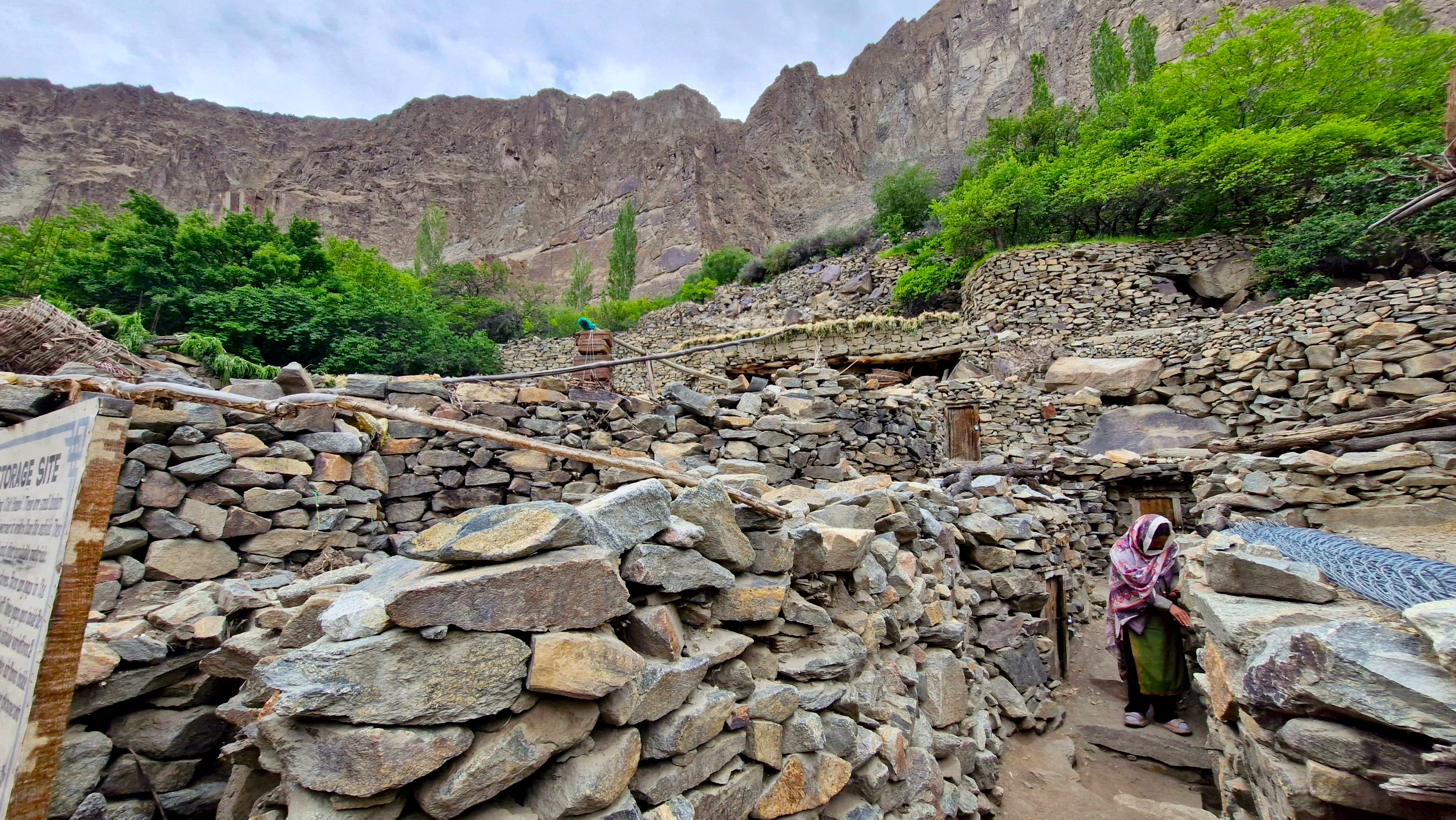 The lady showing their traditional cold storage site
Faces that invited second glances once they travelled beyond Ladakh.
The quiet experience of belonging completely to a country while still being asked, without words, to explain yourself.
Until that afternoon, I had never considered anonymity a privilege. I had spent most of my life moving through India without anyone questioning whether I belonged.
She had not.
Before I left, the conversation turned to something far more ordinary.
Mobile phones. Reliable internet had only recently reached the village.
When I first saw a 5G signal in Turtuk, I had welcomed it. It meant easier maps, quicker messages, fewer reminders that I was travelling at the edge of connectivity.
She saw something else.
Would neighbours still wander into each other's homes unannounced?
Would children continue spending evenings outdoors instead of staring into separate screens?
Would conversations slowly become shorter?
She wasn't rejecting technology. She was wondering what might quietly disappear alongside it.
Only then did everything I had experienced over the previous few days settle into place.
Salman's effortless welcome. The farmer laughing at my question about organic food.
Abida speaking about her women's collective as though helping one another required no explanation.
Neighbours repairing irrigation channels together. The baskets of apricots left outside unattended.
I had been seeing the same philosophy everywhere. I simply hadn't known its name.
Kinmo.
Not a programme. Not a slogan. Not nostalgia preserved for visitors.
A way of understanding that a community survives only when its people refuse to think of themselves as separate from it.
The word did not teach me something new.
It gave a name to everything I had already witnessed.
Walking back through the village after the rain, another thought stayed with me.
Everything I had heard inside that house—her cousins beyond the border, her sentence about belonging, her quiet fears for the future—would eventually become part of this story.
People who would never visit Turtuk would read her words. I wondered what that exchange demanded of both of us.
Travel writing often asks places to become stories.
I am still learning how to make sure the stories never become smaller than the places themselves.
The next morning I climbed to the small monastery overlooking the village.
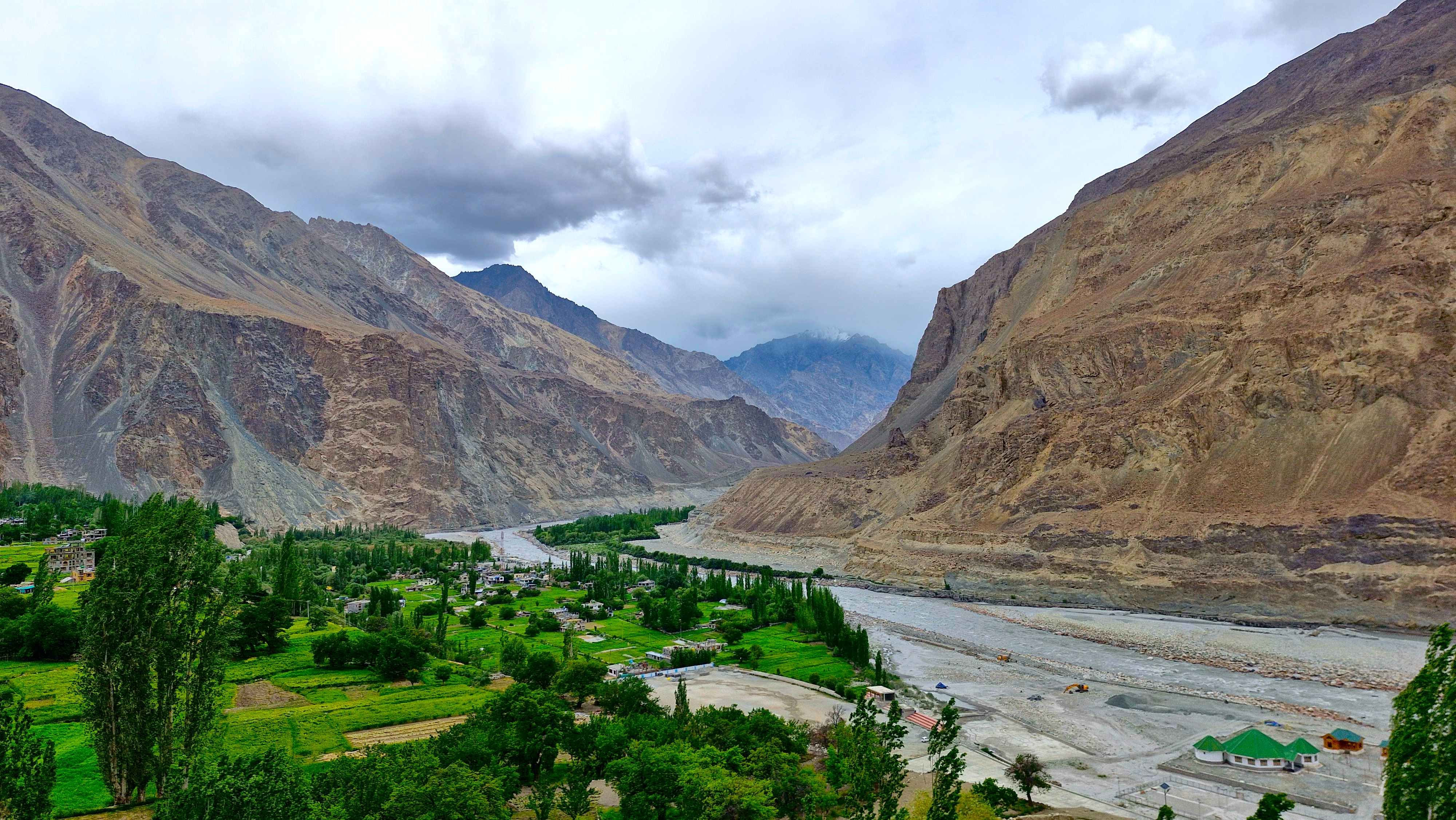 Turtuk village viewpoint from the Monastery
From there, Turtuk finally revealed itself as a whole. Apricot orchards stitched together narrow terraces. Stone houses blended almost seamlessly into the mountainside.
The Shyok cut through the valley before disappearing north towards a border invisible from where I stood.
Only now did I understand why Salman had spoken about the river so differently.
A river named for death. Yet everything around it insisted on life.
Children crossed the bridge carrying footballs. Smoke drifted from kitchen chimneys.
Women gathered the last baskets from the fields.
Somewhere below, someone was almost certainly ordering another pizza.
A few hundred metres away, grain still rested inside granaries built generations before either India or Pakistan existed.
For the first time since arriving, I stopped seeing those two worlds as contradictions.
They belonged to the same village. Only to different moments in its history.
The road out of Turtuk climbed steadily above the valley until the village disappeared behind the mountains.
The last thing I saw wasn't the café. It wasn't a monastery. It wasn't even the Shyok.
It was a cluster of apricot trees catching the first light of morning.
For a brief moment they seemed suspended between the mountain and sky.
Then the road turned. The village was gone.
The questions, however, travelled with me.