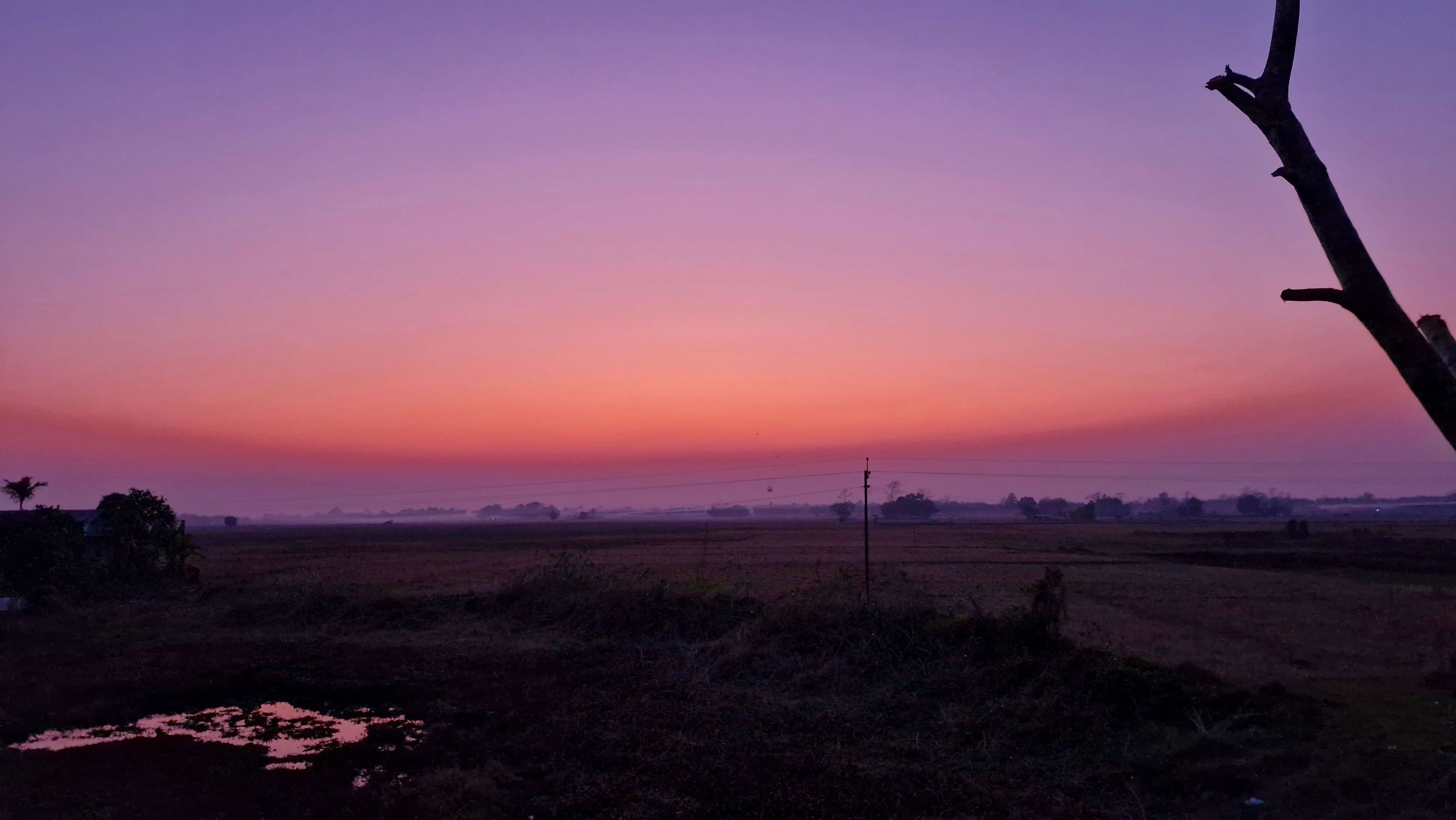
19 Apr, 2026
Last Updated: 21 Apr, 2026
I always heard Majuli island described in the language of superlatives.
A colleague's wedding in Jorhat. My flight home the following evening. One spare day between the two, which is not quite enough time for anything serious and exactly enough time for something impulsive. A search engine returned its results with the confidence of someone who had already been: world's largest river island, the mighty Brahmaputra, Neo-Vaishnavite cultural complex, mukha workshops. GPT assembled an itinerary in seconds. One night, two days, every box ticked.
I booked the only available hostel online on the go, packed nothing extra, and left the next morning for Nimati Ghat. A footnote to a wedding trip. A responsible use of a spare day.
Ended up staying for a week.
The shared tempo from Jorhat Town to Nimati Ghat filled quickly with people who clearly made this journey regularly — bags of provisions, bundled packages, the easy silence of a route well-known. I found a seat beside two elderly women heading to a Satra for an event. Within ten minutes, they had taken it upon themselves to prepare me properly.
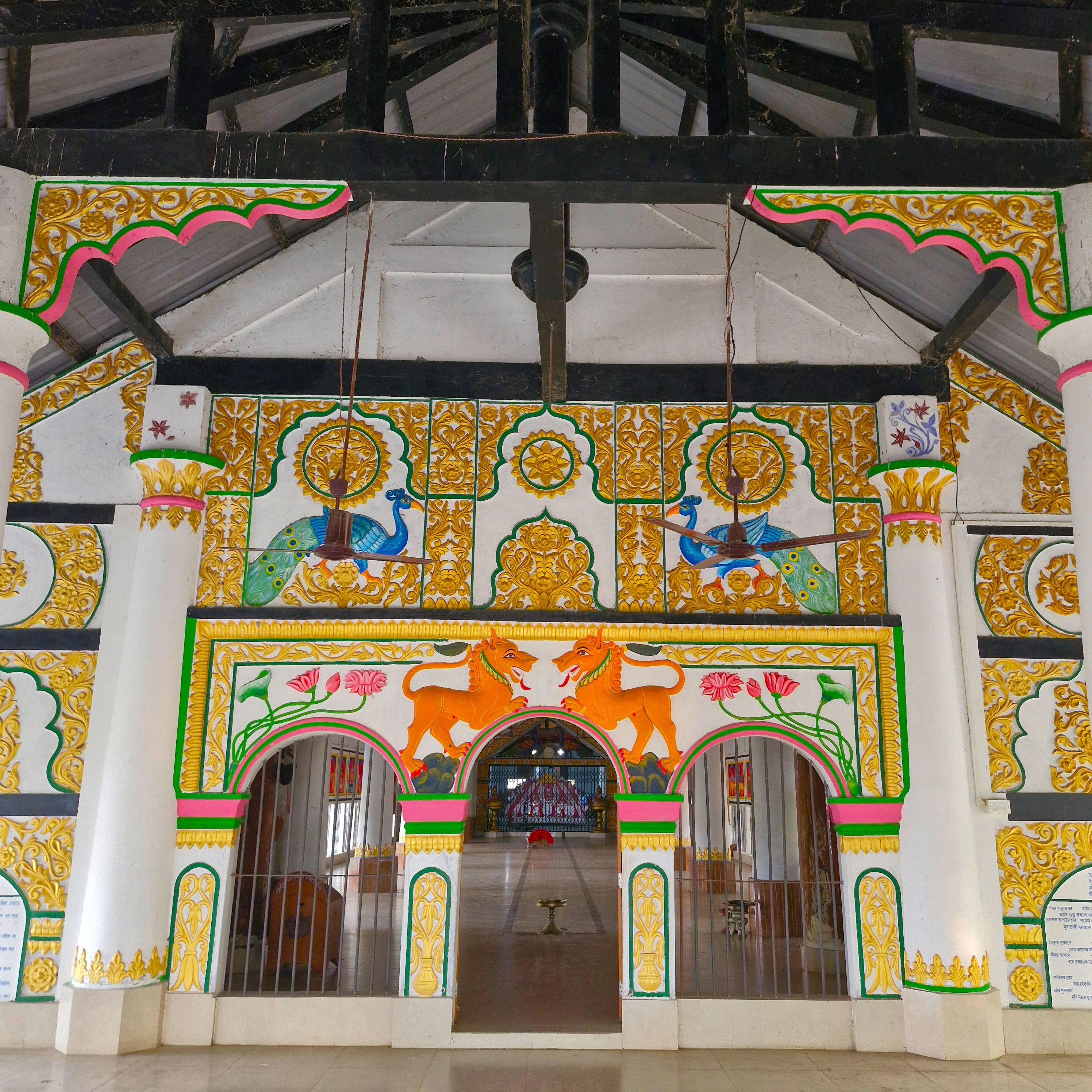 Sri Sri Uttar Kamalabari Satra
Srimanta Shankardev, they explained, was a 15th-century saint-scholar who reshaped Assamese spiritual and cultural life entirely — his Neo-Vaishnavite movement, centred on devotion, art, and community, spread through Assam via the Satras, monasteries that became simultaneous keepers of music, drama, craft, and philosophy. Majuli became the epicentre of that tradition. Each Satra on the island had its own specialisation — one known for the Bhaona drama, another for mukha-making, another for its particular style of Borgeet devotional song. I wrote nothing down. There was something about receiving this in a moving vehicle from two women who had no reason to tell me any of it that felt like it should be received as given — in motion, without notes.
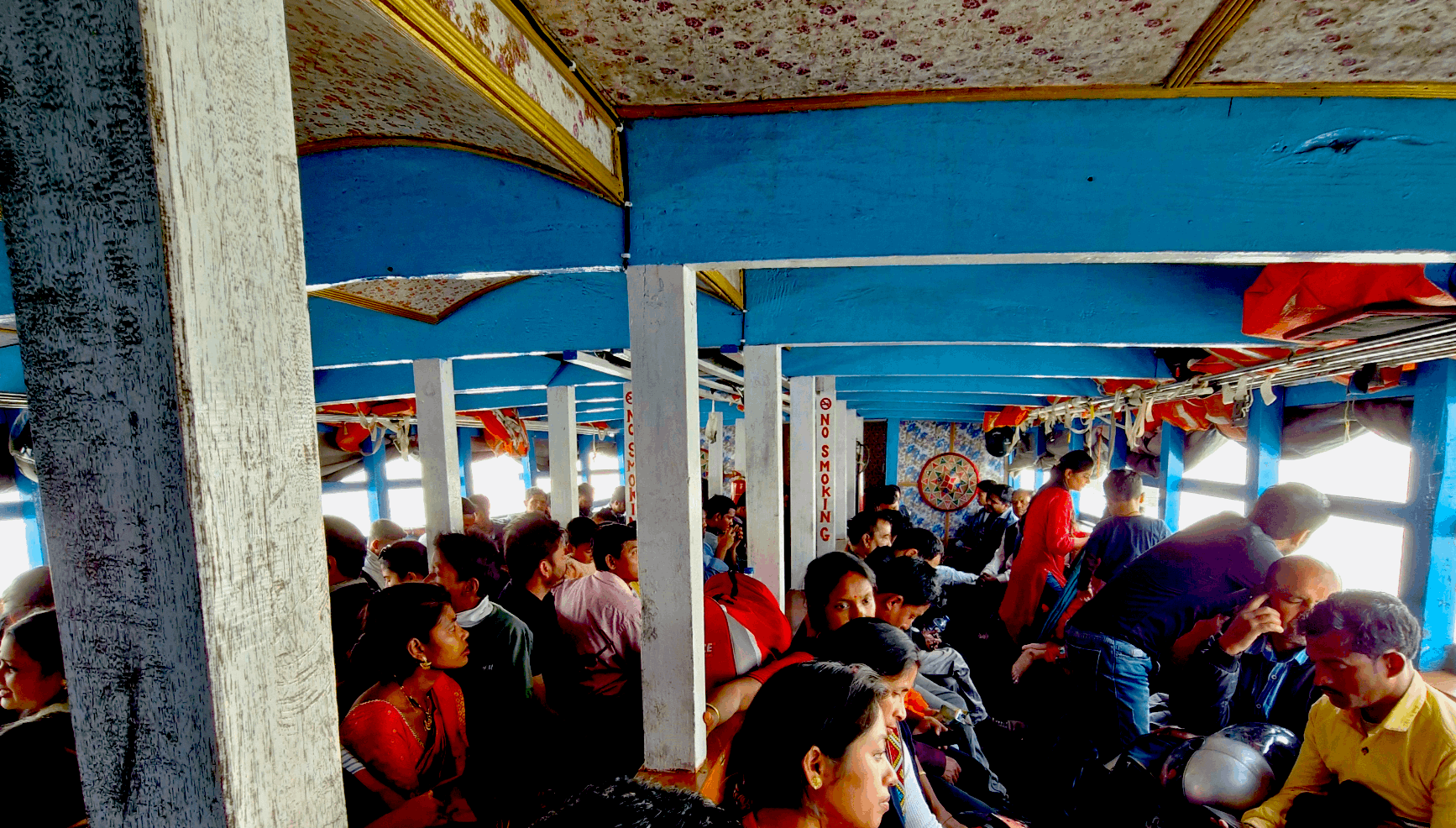 The packed ferry enroute Majuli from Nimati Ghat, Jorhat
At Nimati Ghat there were no announcements, no designated terminals, no signage designed for the uncertain. I kept pace with the co-passengers. A ₹20 ticket appeared in my hand. I boarded a wooden ferry already packed to its logic — passengers below, motorcycles and cars on the upper deck arranged with the pragmatic geometry of long practice.
The Brahmaputra began modestly. Banks visible on both sides, the water its signature tea-brown, the afternoon sun direct and warm. Then, around twenty minutes out, one bank simply ended. On the left, the water became horizon. Not a wide river anymore. Something closer to a sea that hadn't decided what it was yet.
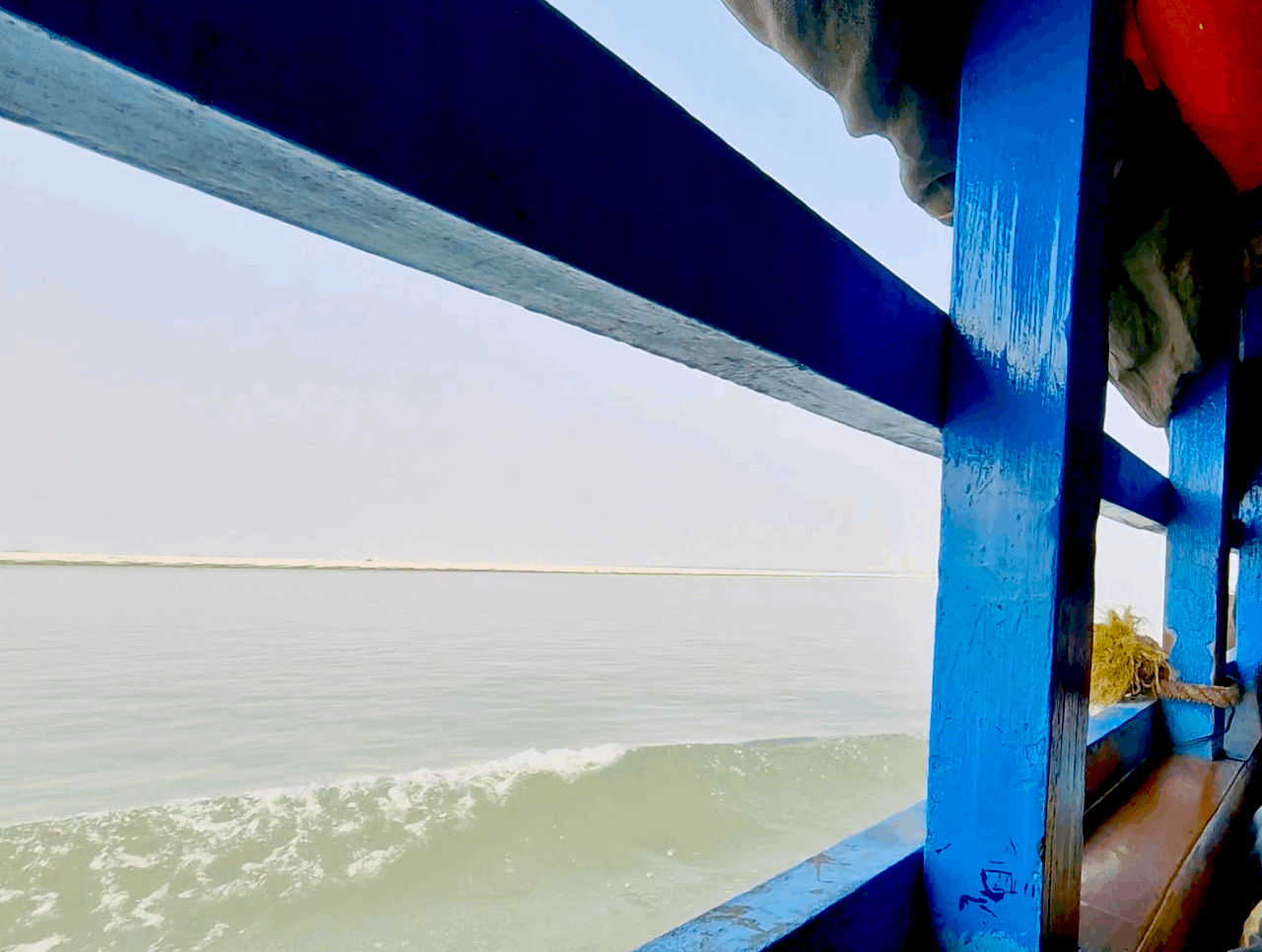 The ferry sailing upstream on the mighty Brahmaputra river
A river dolphin surfaced and was gone before I could decide if I had seen it.
The February breeze had an edge to it — cold enough to clarify, warm enough to let you stay at the railing. Someone nearby pointed out that winter was the Brahmaputra at its most composed. The rainy season, they said, was another matter entirely. The air horn sounded twice. Afolamukhi Ghat. We had arrived at a place that only exists as a functioning entry point for half the year — the Kamalabari ghat comes to life when the rains come and reshape the island's geography enough that this one goes under.
The island, I was already understanding, lives on seasonal terms. Not ours.
A shared magic gari — the local term for a shared cab — carried me from the ghat toward my hostel. The elevated road ran through fields that went on longer than fields in cities are permitted to go. Mustard yellow in some stretches, green in others, the occasional cluster of bamboo, and then more fields. Packs of houses appeared at intervals — elevated above the ground on stilts, some by two feet, some by considerably more.
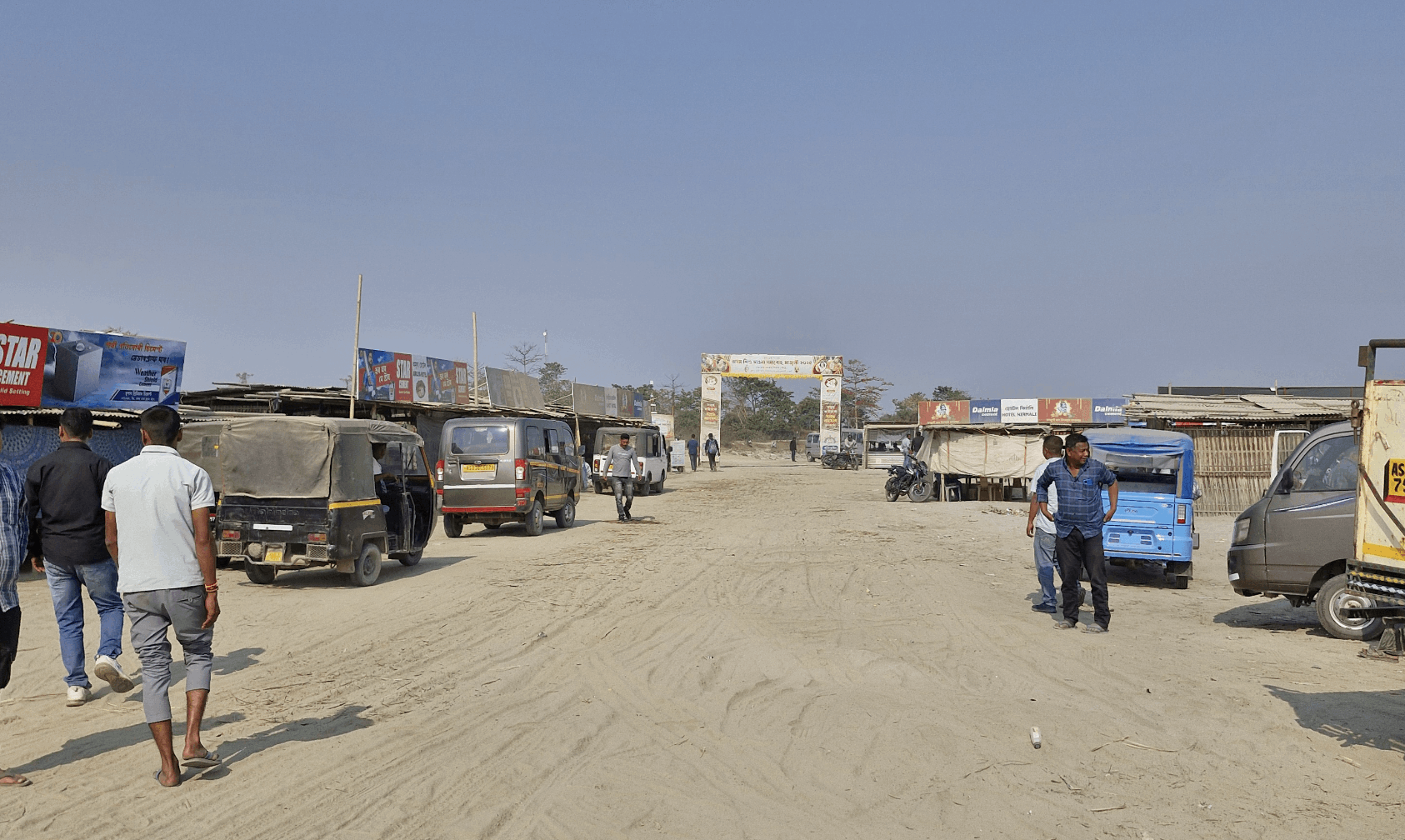 The shared magic (taxi) stand at Afolamukhi Ghat, Majuli
I asked the driver why.
He said it the way people say things that have long since stopped being remarkable to them: most of Majuli floods every rainy season. The areas near the river go under first, then the water spreads inward. The raised foundations are not architectural choice — they are institutional memory, built into every structure on the island. Chang ghors, the locals call them. Each one had a boat somewhere on the property. Not a decorative one. A working one, maintained for the months when the road outside would be underwater and the boat would be the road.
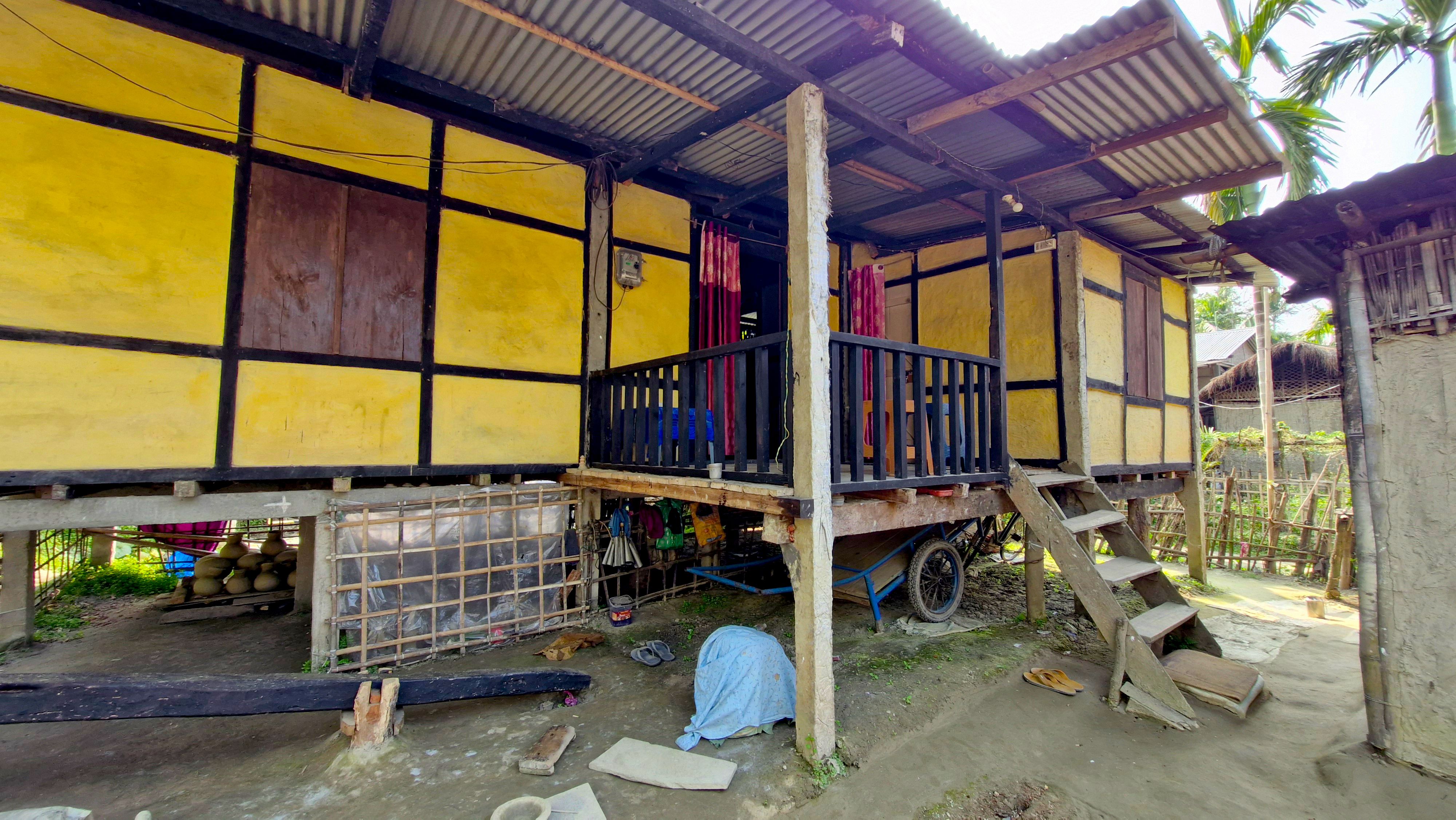 A chang ghor (elevated house)
The island had spent centuries learning to live with what the river brought, because it had no choice — and perhaps because the river also brought everything that made it worth living on.
In that afternoon light — the fields golden, the air still, a heron motionless at the edge of a paddy stretch — it was difficult to picture any of it underwater. That was the particular trick of Majuli in February: it wore its abundance so completely that the annual erasure felt abstract. Theoretical. Something that happened to other months.
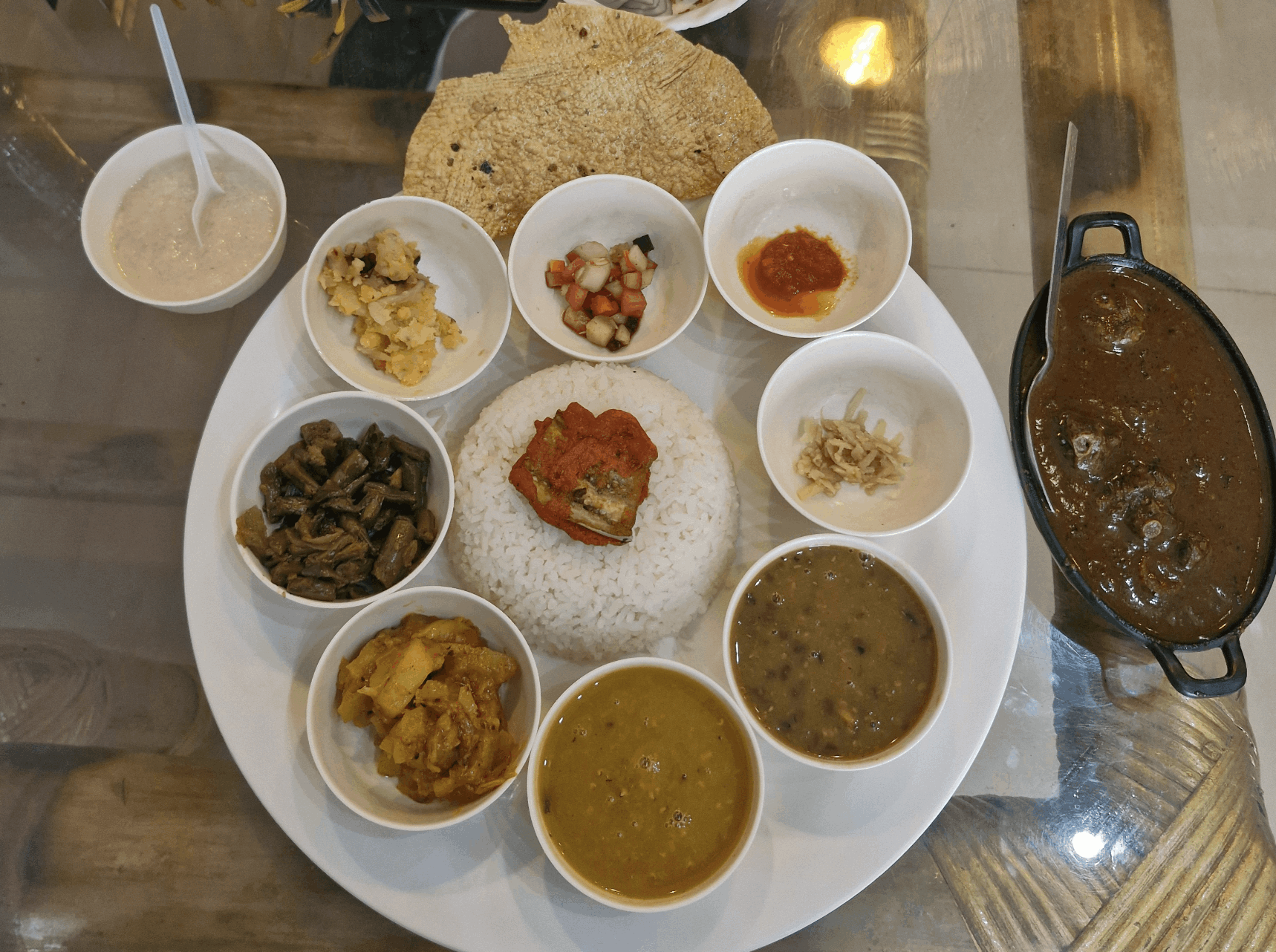 The full-course Assamese meal
The driver, unprompted, pulled over at a local eatery before dropping off at the hostel. A recommendation delivered with the authority of someone who eats here every trip — not a suggestion, an instruction. What arrived was an Assamese thali that made the journey feel, suddenly, worth it on its own terms: small grain rice, dal thin and properly salted, aloo pitika (local version of mashed potato), greens, and then two dishes that stopped the conversation entirely — masor tenga, the signature sour fish curry with its broth the colour of weak tea and its flavour the colour of something much stronger, and a black sesame duck curry that had clearly been made by someone who knew what duck could become when given enough time and enough sesame. I ate everything. I sat for a while after. It was, I realised, exactly the right speed at which to arrive somewhere.
I reached the hostel and slept through the remainder of the afternoon entirely — which, Arnab our host later told me, was the appropriate local response to any first afternoon on the island.
What woke me was sound. Not an alarm. Not a conversation. A low, rhythmic chanting drifting across the fields from the Samaguri Satra directly across the road — the evening naam, the daily prayer that the monastery has held without interruption for as long as anyone on the island can say. The light outside was in its final register: that particular dusk colour that happens for about twelve minutes and then is over.
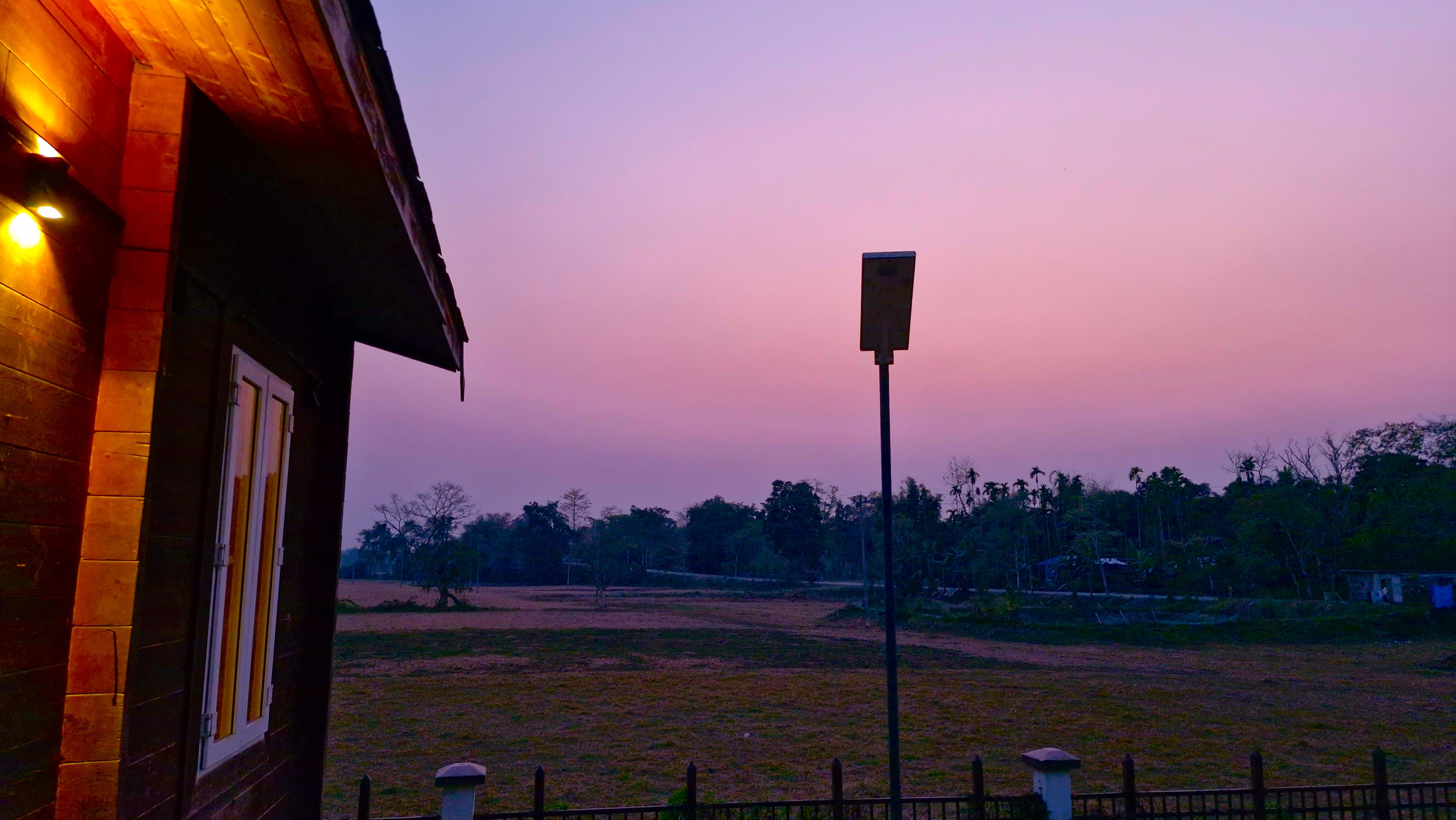 Shades of dusk from the hostel compound
I stood at the window for a while, listening to a prayer I didn't understand across a field I couldn't see the end of. It was, without announcement or effort, one of the more complete moments I have had while travelling.
Arnab, our host, appeared shortly after to mention — with the casual timing of someone who had clearly done this before — that it was Shivratri, and that a Bhaona was being performed in a nearby village that evening. He said it the way he said most things: without preamble, with the quiet assumption that of course you would want to go, because why wouldn't you.
Arnab was roughly my age, which I mention only because it explained something — the ease of the week, the way conversations moved between folklore and opinion and back again without ceremony. He had the same allergy to the curated and the packaged that I did. His instinct, consistently, was toward the thing that was actually happening rather than the thing arranged for visitors to see. I trusted his recommendations completely after about the first hour, which is faster than I usually trust anyone's.
I said yes before he finished the sentence.
What I did not say was that by 9:30pm, parked outside a village in the dark, I was quietly reconsidering.
By 8:30pm, Majuli usually indulges into snooze mode. Lights off, roads empty, the island returned to the kind of quiet that cities spend considerable money trying to simulate. Arnab drove us through it — past darkened fields, past the occasional lit window, sharing local folklore and the slow rhythms of island life.
Then the village appeared, and it was very much awake.
Food stalls, tamul stalls — paan, as the rest of India calls it — crowds gathering at the edges of a temporary stage, children running between adult legs, the warm cross-smell of mustard oil and incense and winter night. This was not a curated cultural programme. This was a village event that happened to be cultural, which is an entirely different thing.
I will admit, quietly, that somewhere between 9:45pm and 10pm, I had already begun composing my exit. I was tired. I had been travelling for days. The performance hadn't started. I had seen theatre before, I told myself — I knew roughly what this would be, I had the shape of it already in my head, I could leave after twenty minutes and have seen enough for a sentence in a notebook. This is the particular failure mode of experienced travel: the assumption that you already know what something is before it has had the chance to show you.
At 10pm exactly, the khol sounded.
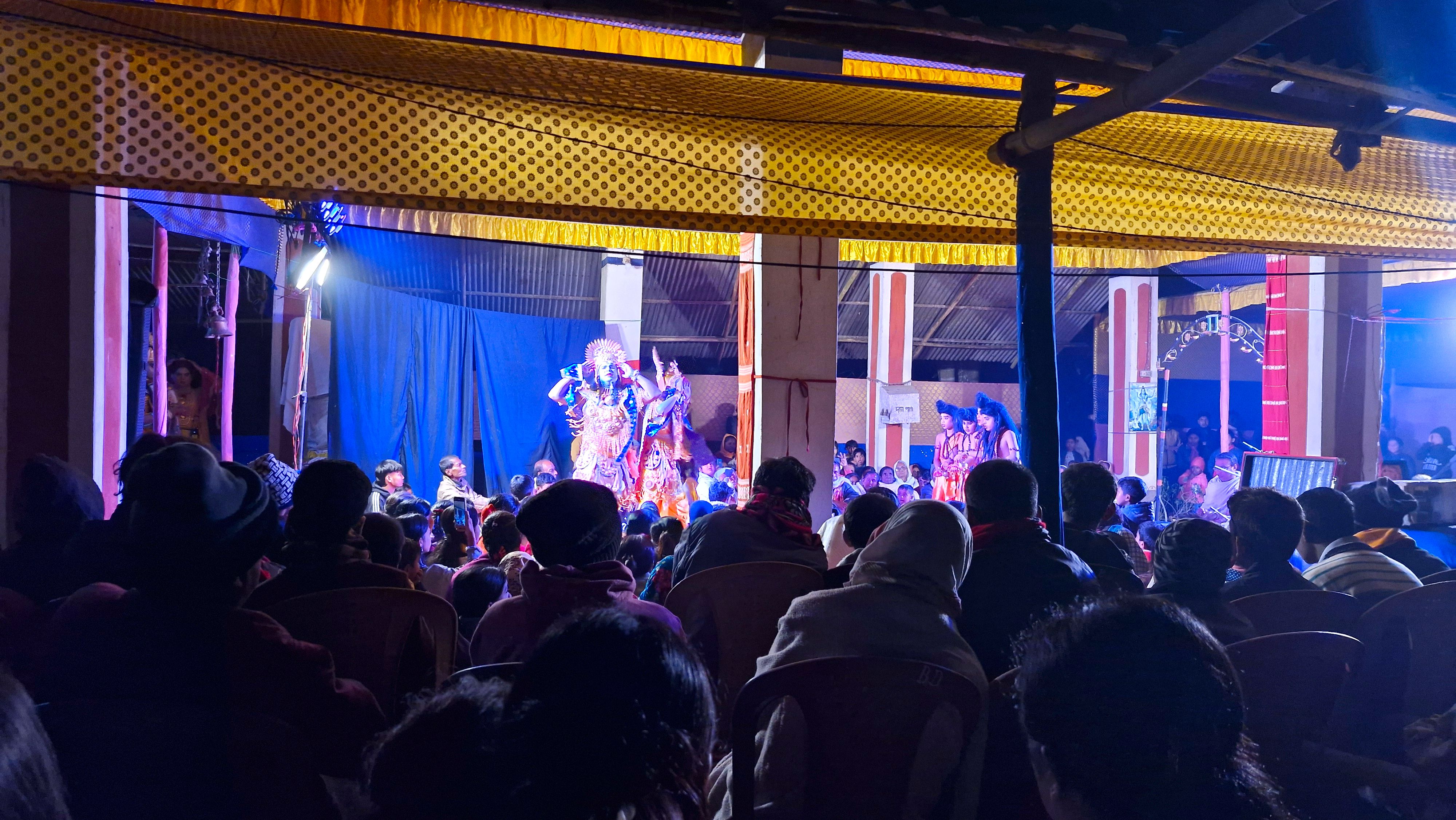 The Bhaona Performance
The two-headed drum that Shankardev himself codified as the voice of the tradition — followed by the taal, the cymbals, and the bahi, the flute. The Bhaona had begun, and within ten minutes every sentence I had been composing in my head about leaving was gone.
Bhaona is a performance tradition Srimanta Shankardev created in the 15th century as an audio-visual medium for spreading the messages of Neo-Vaishnavism across all communities, regardless of caste or literacy. The plays — Ankiya Nats — draw from Hindu mythology, enacted by Bhaoriyas accompanied by Gayans who sing and Bayans who play. Every character across five centuries of tradition is played by a man. The roles are inherited through lineage, trained over years, and considered devotional practice rather than performance in any theatrical sense.
The audience that night was, as Arnab had predicted, eight to eighty. A grandmother to my left seemed to know every cue before it arrived. A child in front of me fell asleep standing up and did not fall. The performance would run until 2 or 3 in the morning. Nobody appeared to consider this unusual.
I stayed until well past midnight. The cold had settled fully by then. Nobody left.
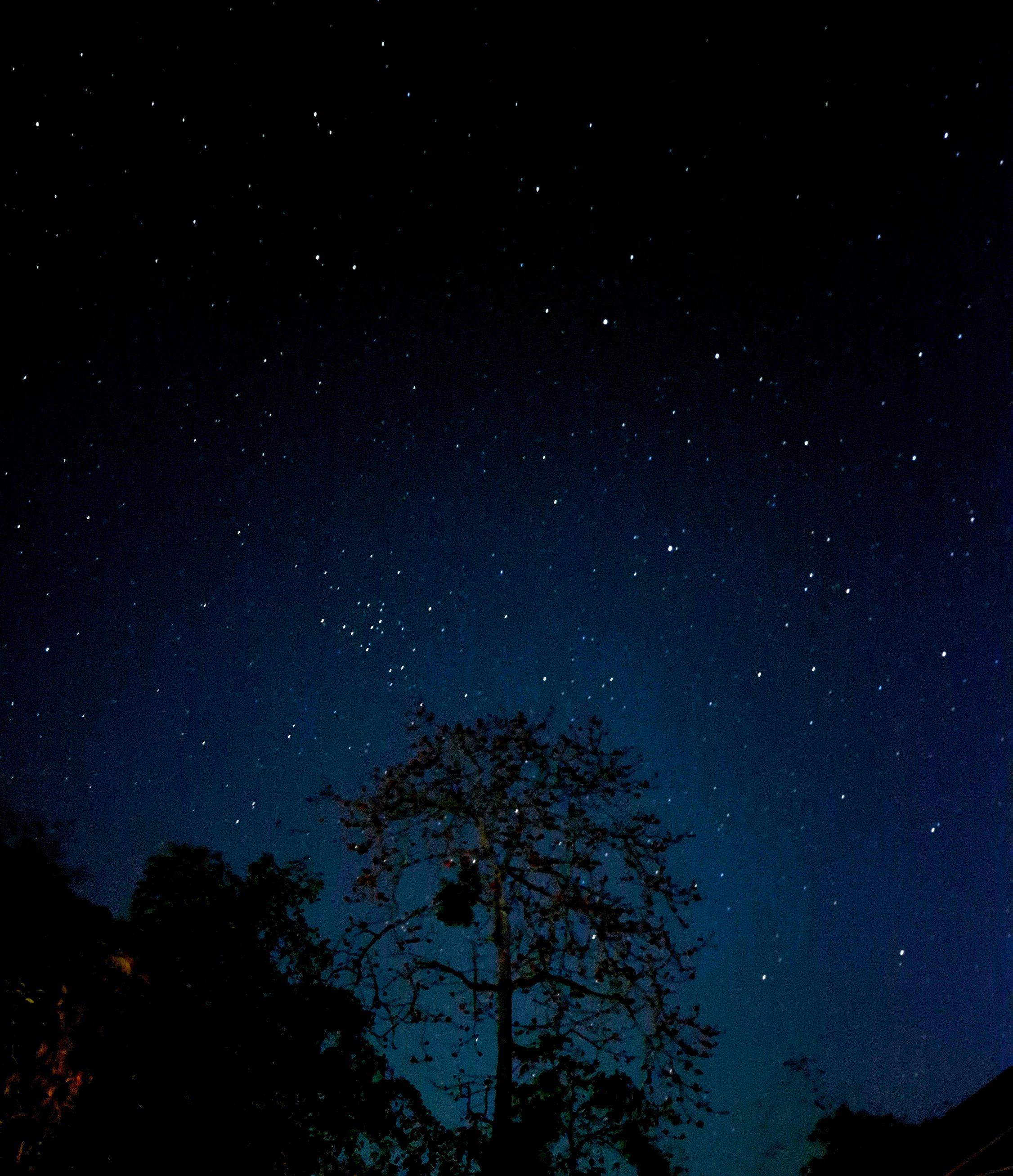 Midnight stargazing in Majuli
Walking back to the hostel, the performance still in our heads, we were mid-conversation — someone recreating the entrance of a particular masked figure, someone else arguing about the drummer's tempo — when one of us looked up and stopped talking.
The sky above Majuli at that hour, in February, with no artificial light for kilometres in any direction, was not what skies usually are. We stood on a desolate stretch of road and did not move for a long time. No plan. No blankets. Just a patch of dark asphalt and the kind of sky that cities have quietly removed from the available inventory of human experience. We sat down eventually, on the road itself, which felt like the only honest response.
The cold was considerable. Nobody mentioned it.
I had arrived that morning chasing a one-day itinerary.
It was now 2am and I was sitting on a road looking at stars.
What more, I thought — genuinely, without irony — can a place offer in this short a time? I did not yet know that the island had a full answer prepared, and that it would take a week to deliver it.
Arnab, characteristically, used the stargazing as an opportunity. We were already awake. The sunrise was in four hours. He said this in the tone of someone for whom this is a reasonable sentence. We agreed, in the manner of people who have temporarily lost the ability to say no to a place.
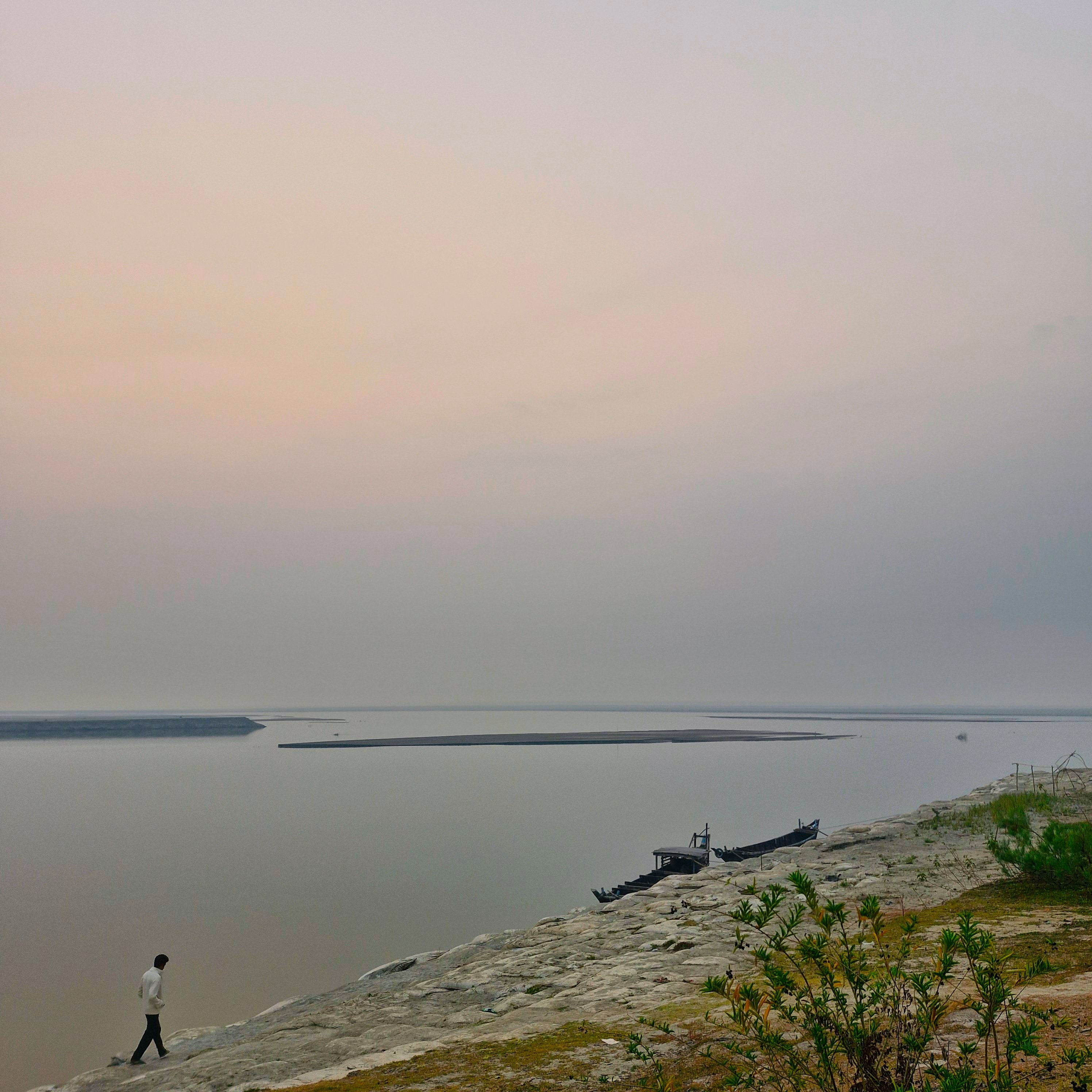 The failed sunrise attempt on the banks of Brahmaputra river
The sunrise, when it came, came behind clouds — the sky diffusing rather than declaring, the light arriving sideways and orange rather than in any of the dramatic configurations we had been imagining. We stood at the riverbank anyway, slightly cold, slightly ridiculous, entirely glad. On the walk back I noticed stacks of large logs arranged along the bank. Arnab explained without being asked: during the rains, when the Brahmaputra rises and churns, uprooted trees travel with the current. The island collects what the river deposits. The logs become fuel, furniture, the beams of raised chang ghors.
In a city, inconvenience is emergency. Here, resilience had been refined into something that looked, from the outside, almost like abundance.
We reached the hostel as the rest of the world was waking up, slept until the afternoon announced itself loudly enough that ignoring it became difficult, ate whatever time of day brunch qualifies as when it follows a sunrise and precedes a sunset, and got back in the vehicle.
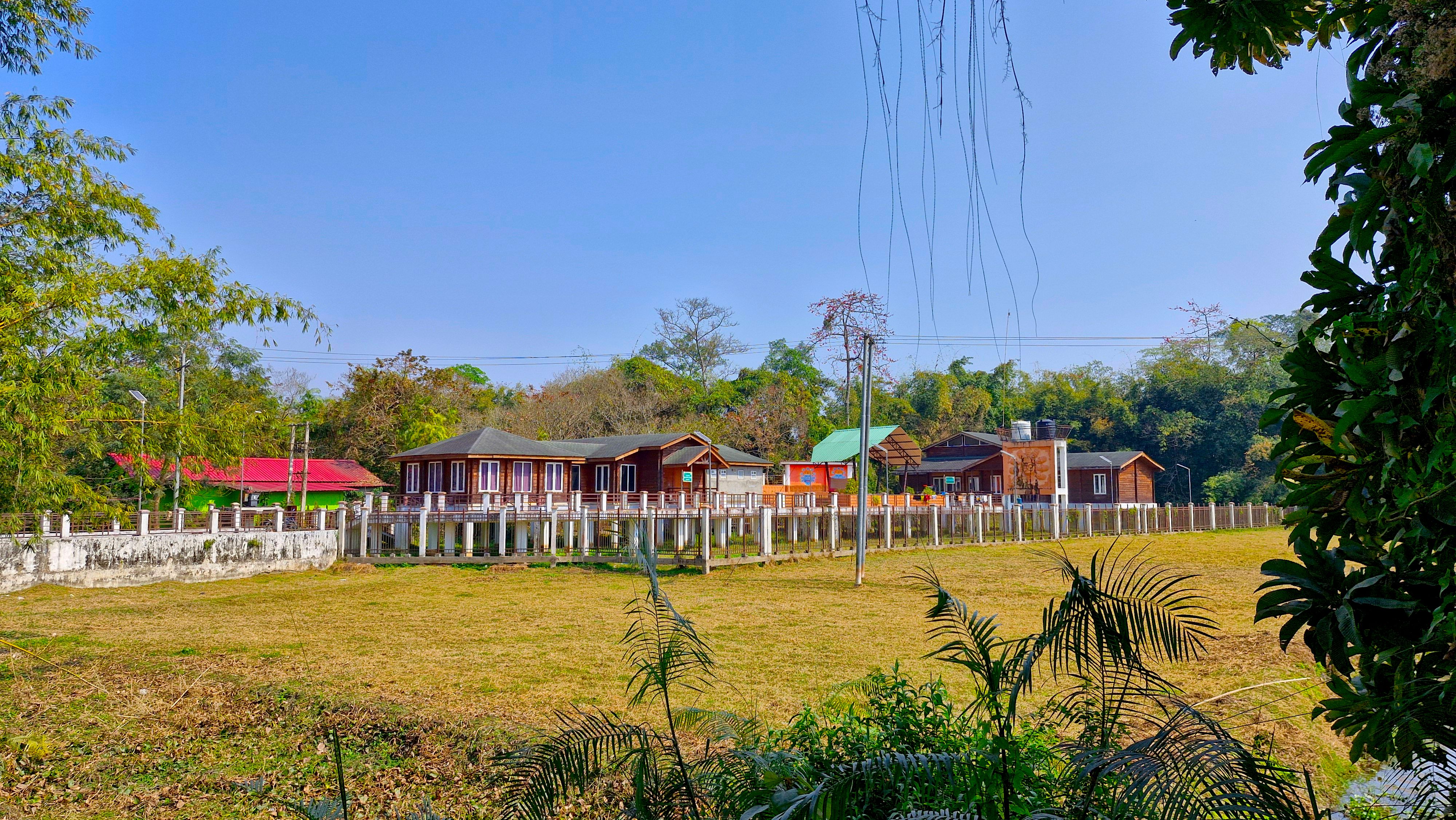 Majuli Backpackers Inn, the hostel where I stayed
By early afternoon, a loose group of us had formed with the unspoken agreement of people who travel alone and briefly enjoy not doing so: no particular plan, one rented vehicle, the island as the itinerary.
The road to the Mising village in Jengraimukh was lined with Palash trees (Sacred tree) in full February bloom — flame orange against the green of the fields and the pale winter sky, the kind of colour that stops conversation mid-sentence.
The Mising — one of Assam's largest indigenous communities — are a riverine people, their lives historically built around the Brahmaputra's rhythms in ways that make the rest of us look like we merely live near water. Their chang ghors stand on bamboo stilts. Their relationship with the river is one of sustained negotiation, not resistance.
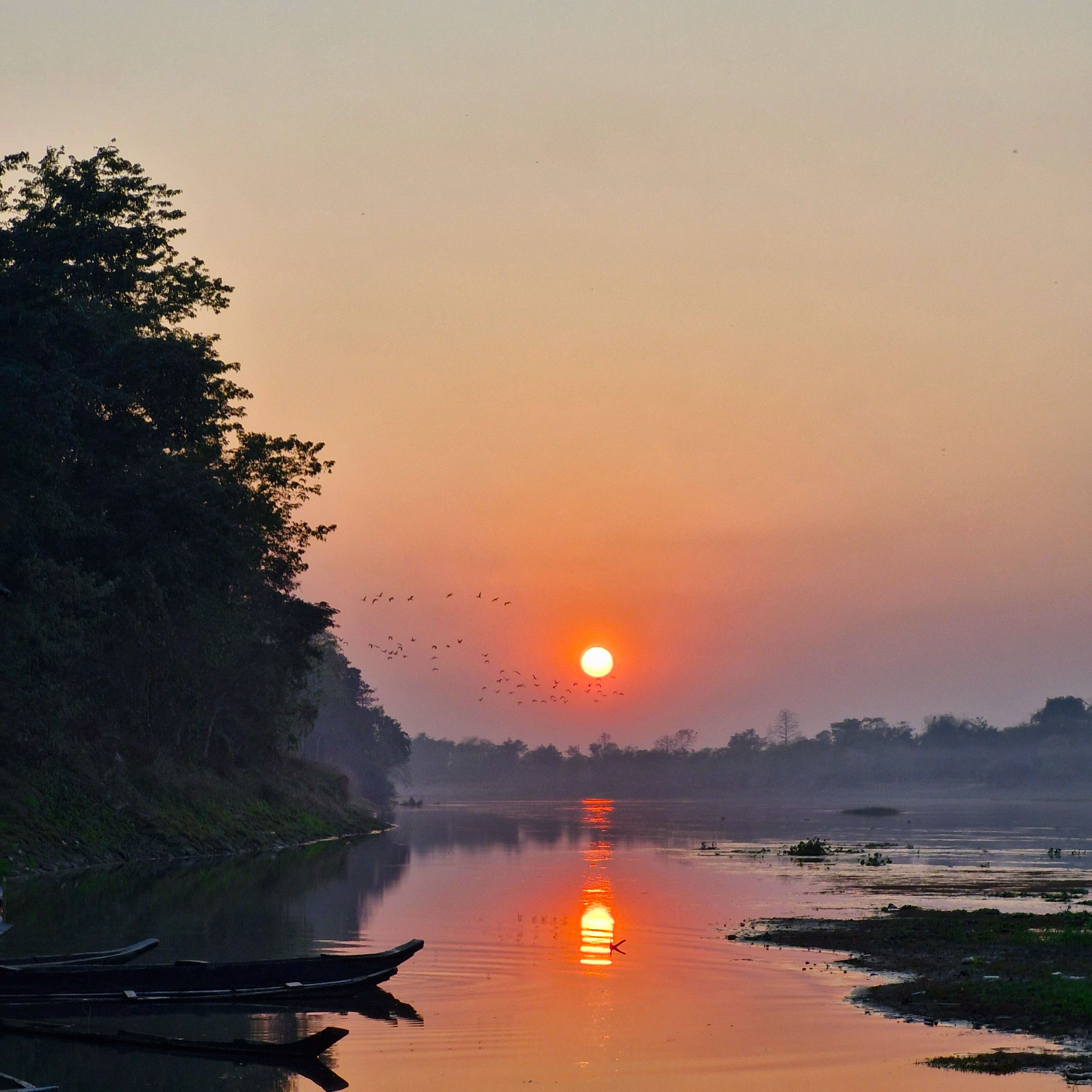 Sunset on Kherkutia River, Majuli
We arrived in the late afternoon and ended up staying for the sunset — sitting by the banks of the river as the light went, the Palash still visible at the field's edge, the water taking on whatever colour the sky decided to be. It was the kind of ending a day earns rather than plans. The kind you only get when you stopped having a plan some hours earlier.
Someone in the village mentioned, with no particular emphasis, that the Ali-Ai-Ligang festival was in four days.
Ali means root and seed. Ai means fruit. Ligang means to sow. Together, the name describes the act of planting — not as agriculture, but as ceremony. An invocation of the earth's willingness to give back what is trusted to it.
The group looked at each other.
I looked at my flight ticket and cancelled it without regret (happens rarely).
Sometimes no plans are the best plans. The version of me that followed the GPT itinerary back to the airport would have left Majuli knowing its labels. The version that stayed learned something closer to its actual texture.
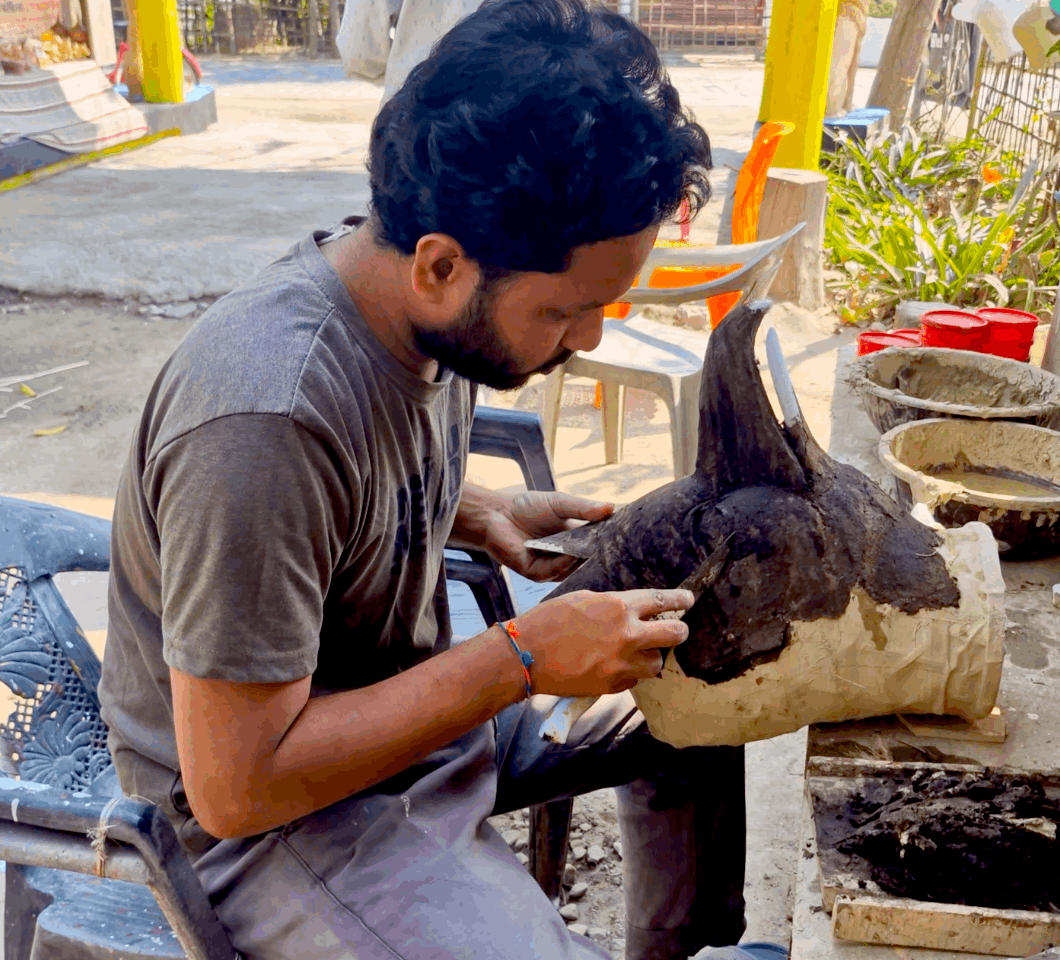 The mukha (mask) making in progress
At the gate of the Samaguri Satra mukha workshop, a craftsman in his early thirties sat working on a mask in progress — a Garuda, its beak already decided, its eyes not yet. He was applying a mixture of clay and dung to the bamboo frame with the focused economy of someone for whom this motion has become a muscular memory. He didn't stop when we arrived. He registered us, continued working, and began talking.
The mukha — the mask — is the visual soul of the Bhaona tradition. Some are life-sized. Some towers at ten to twelve feet, worn simultaneously as head and torso by the performer inside, the whole structure animated by a single body. Made from bamboo skeleton, layered with clay, shaped by hand over days, painted with natural pigments that read differently under stage light than in daylight. The craft has existed on this island for five centuries. It received a GI tag recently. It had a purpose long before it needed recognition.
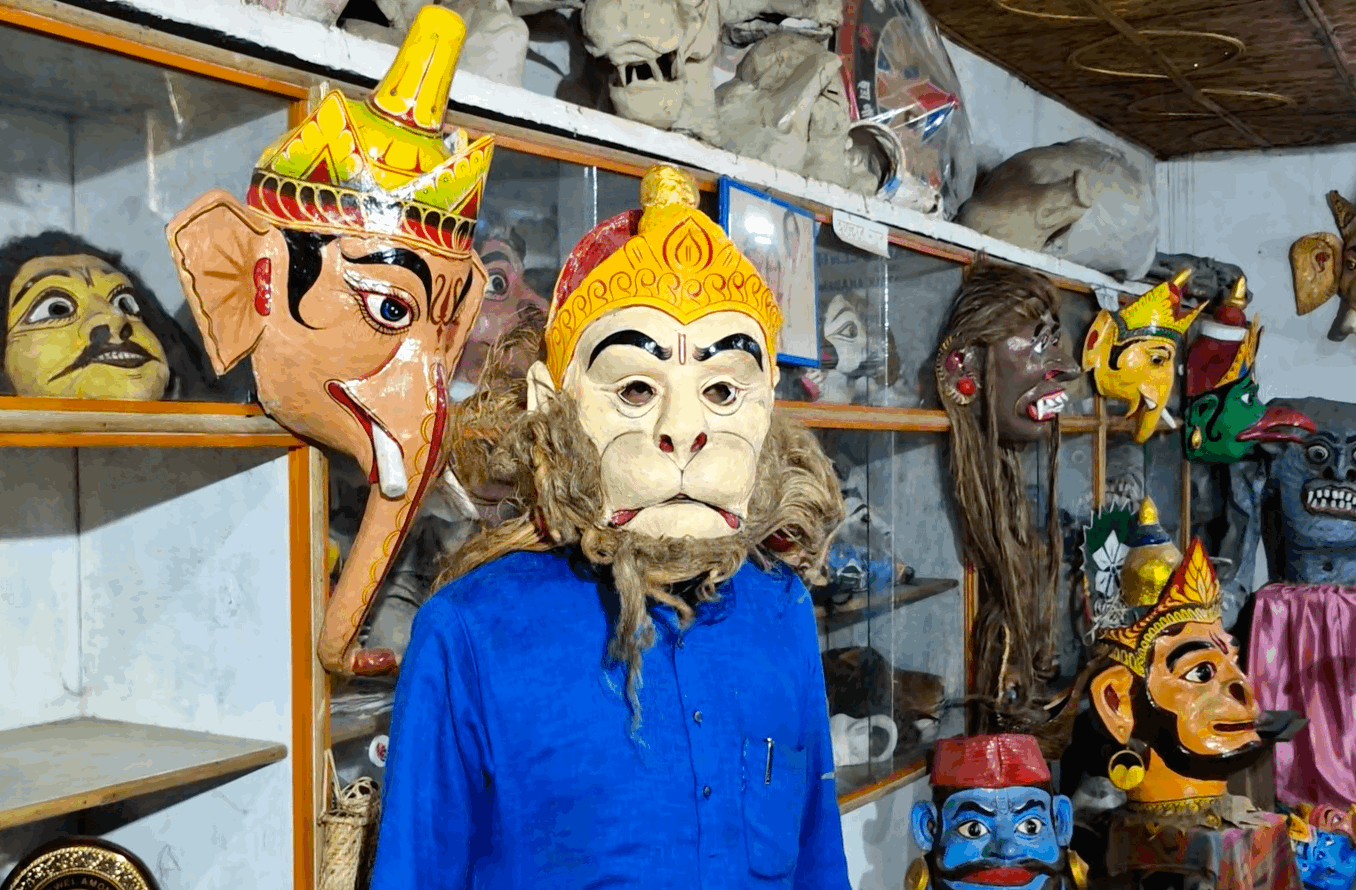 Inside the Mukha museum
He walked us through the small museum adjoining the workshop — masks mounted on walls, some of them twenty years old, their colours holding in ways that synthetic paint would not. The micro-details were the thing that stopped you: the particular curl of a demon's lip, the geometry of a crown rendered in bamboo and cloth, a pair of eyes that had been looking out from a mask for two decades and had not stopped being alive. Each one had taken weeks. Each one had been worn in performance and then preserved.
I asked him, eventually, about younger generations taking up the craft.
He kept his eyes on the Garuda. Said that fewer were coming to learn. That the income was uncertain, the process slow, the market indifferent to the difference between a hand-made mukha and a factory approximation. That the tradition was surviving — but the word he used, surviving, was doing a lot of quiet work in that sentence.
We left the workshop in the way you leave places that have given you more than you came for — without quite knowing how to account for it.
At Salmora gaon, Majuli's pottery village, we found her under her chang ghor — a woman in her fifties, sitting on the ground in the shade of her stilt house, giving shape to a tekeli, an earthen pot, with a coordination of hands and feet so practised it looked effortless and was certainly not.
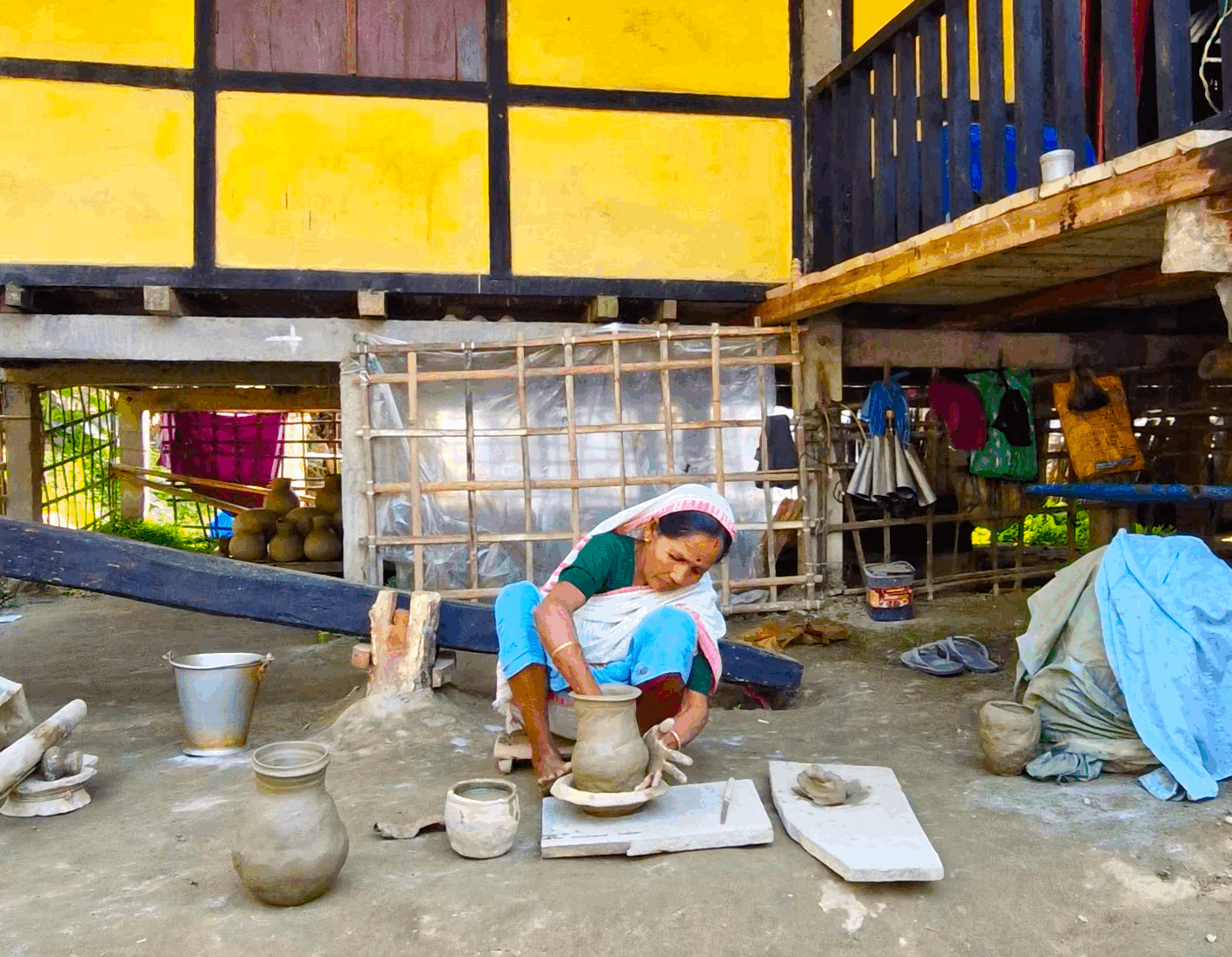 Pottery artisan in Salmora gaon, Majuli
The wheel moved. The clay rose and thinned. Her hands corrected almost without touching.
She talked while she worked, the way people do when the work doesn't require their attention to pause for conversation. The clay, she said, comes from the Brahmaputra's banks — deposited fresh each season by the same river that floods the village annually, that has taken land from the island for decades, that the chang ghors around us were built specifically to survive. The river gives them their raw material and threatens their homes in the same breath. The pot being shaped under her hands existed because the flood had come and left its clay behind.
That duality — the Brahmaputra as provider and destroyer, sustainer and eraser — sat in the shade of that stilt house more plainly than I had felt it anywhere else on the island. It wasn't a metaphor here. It was the texture of a Tuesday.
The industry itself, she mentioned, was struggling. Automation elsewhere had made machine-made alternatives cheaper. The market for hand-thrown tekeli was smaller than it had been, the margins thinner, the younger generation less interested in a craft that returned so little for the time it asked.
The potter's wheel was still turning. The question of how much longer was present in the conversation without being spoken.
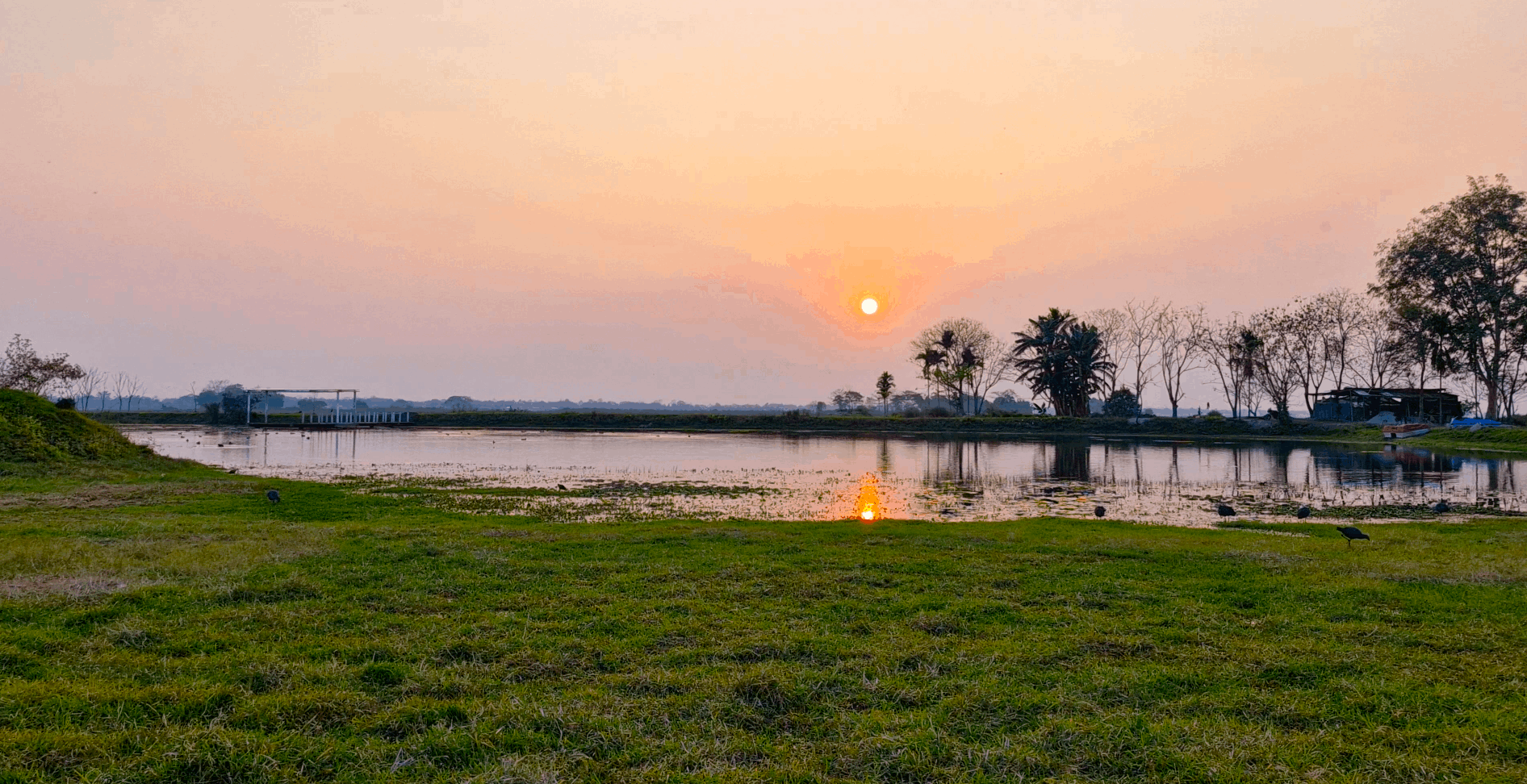 Sunset at Oudubi, Majuli
The sunset at Oudubi was a recommendation from a local friend — offered casually, the way people offer things they consider obvious. I went once and understood immediately why it had become obvious to them.
The road runs elevated through riverine wetlands that open into fields on either side — an unbroken expanse in both directions, the kind of landscape that makes you aware of sky in a way that cities have engineered out of daily life.
In the late afternoon, farmers were walking their cattle back from a long day of grazing, the animals unhurried, the farmers unhurried, the whole procession moving at the pace the light was also moving. Water buffaloes stood in herds at the wetland's edge, entirely unbothered by the changing hour. A Hargila — the Greater Adjutant Stork, enormous and deliberate — swooped low over the water and came up with a fish, already swallowing as it climbed back into the air.
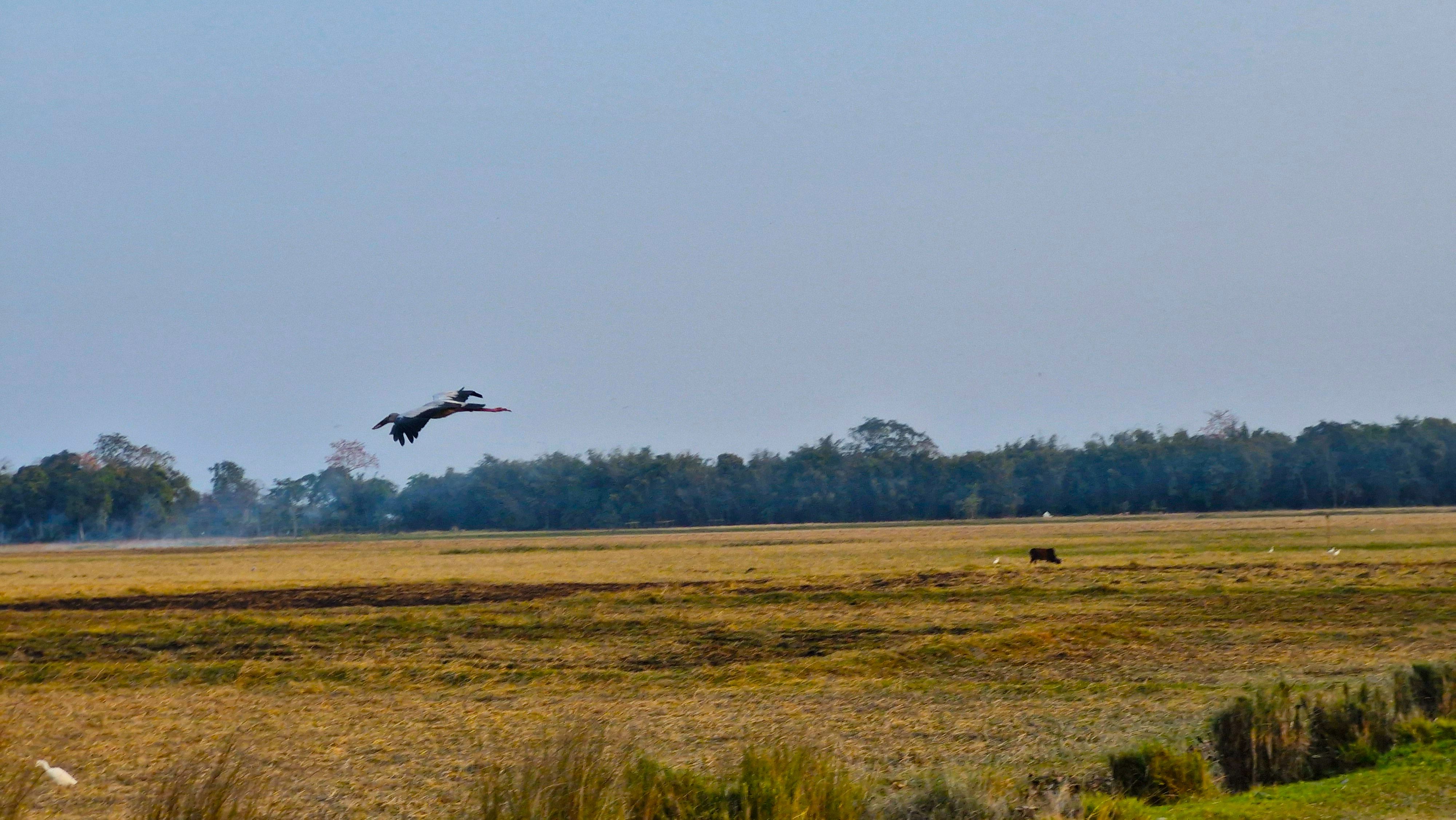 A Hargila (Greater adjutant stork) in action
Then the dusk colours arrived and everything else became secondary.
There was no chaos in any direction. No sound that was not made by something alive. The air was the kind of cold-clean that you breathe differently — slower, more deliberately — because it seems wasteful not to. By the time the last light went, something in me had also gone quiet: not emptied, but settled. The way a room feels after a long conversation has finally found its point.
I went back every evening for the rest of the week. It became the fixed point around which each day arranged itself. I will be grateful for that recommendation for longer than I can currently estimate.
The mud-fishing happened because we were doing nothing and the locals found this professionally offensive.
A few of them arrived at the hostel campus, saw a group of travellers in various states of horizontal leisure, and within minutes had communicated — across a language gap that hand gestures and expressions of mild exasperation bridged adequately — that we were coming with them.
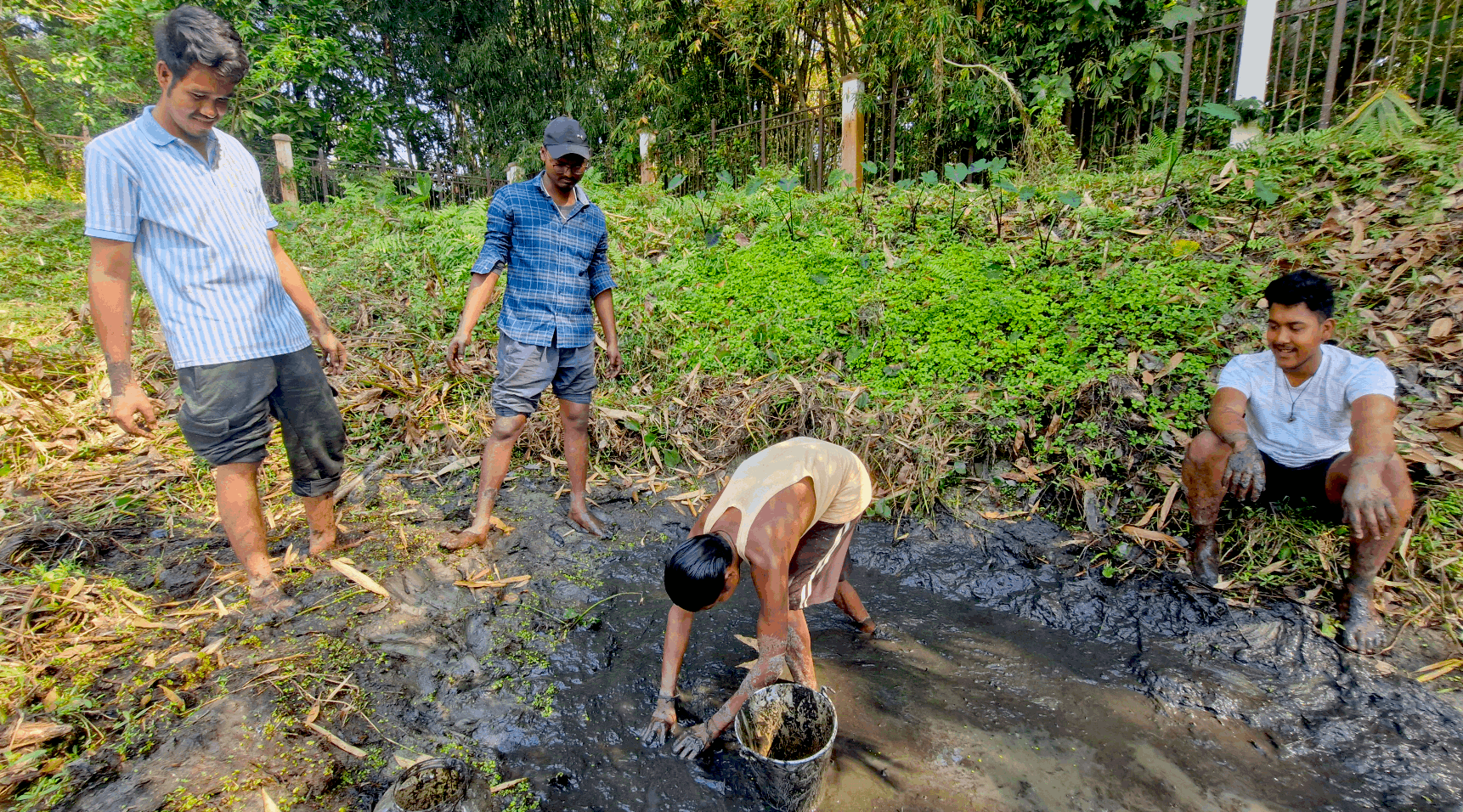 Mudfishing in progress
Catfish, it turns out, live in the shallow muddy channels that the island's wetlands produce in abundance. Catching them involves wading in and working by feel, which sounds straightforward and is not. The locals moved through the mud with the fluency of people who have done this since they were old enough to be allowed to. We moved through it like people discovering, in real time, that mud has opinions about being disturbed.
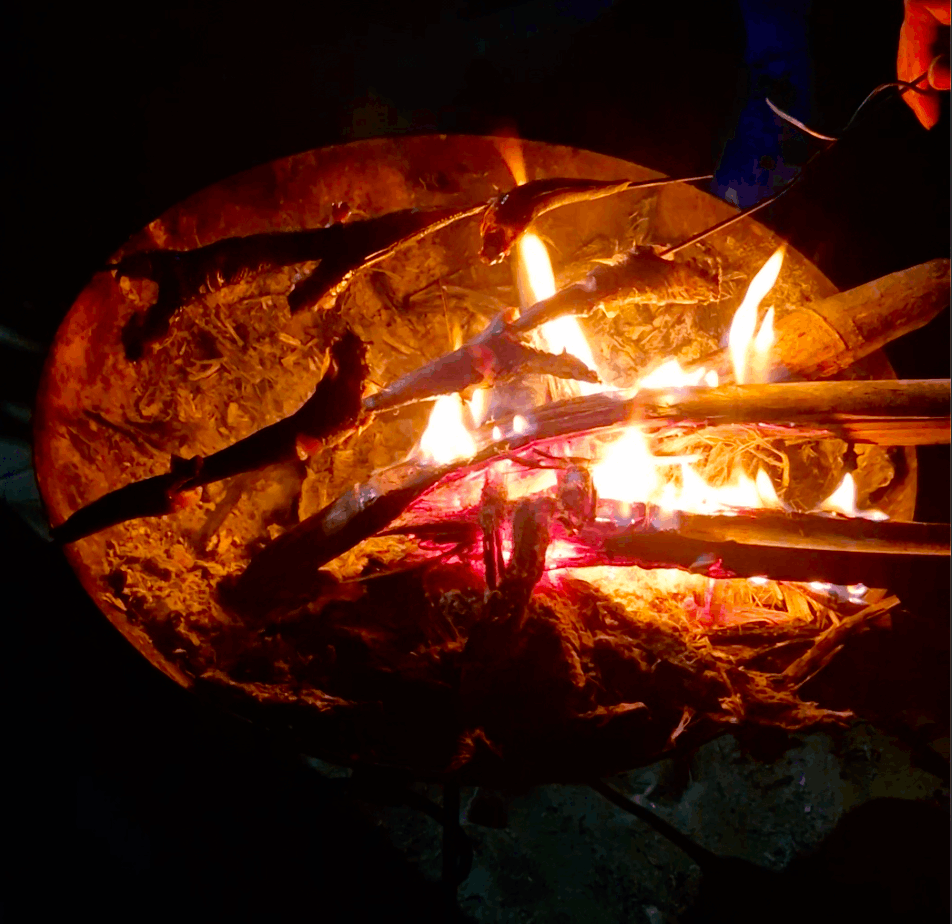 Catfish roasting in progress
We were stung. We caught nothing. The comedy of our technique — if it could be called that — was clearly the highlight of the afternoon for everyone present, including eventually ourselves.
That night, the catch the locals had actually made went on the bonfire. We ate it together. The fish tasted better than it had any right to, probably because of everything that had preceded it.
The quietest morning of the week was the one we spent at a villager's house watching the gamusa being made.
The gamusa — the traditional Assamese towel-cloth of white cotton with its signature red border — is present at every ceremony, offered as a mark of respect, as woven into Assamese identity as anything can be. What I didn't know, before that morning, was what it sounded like being made.
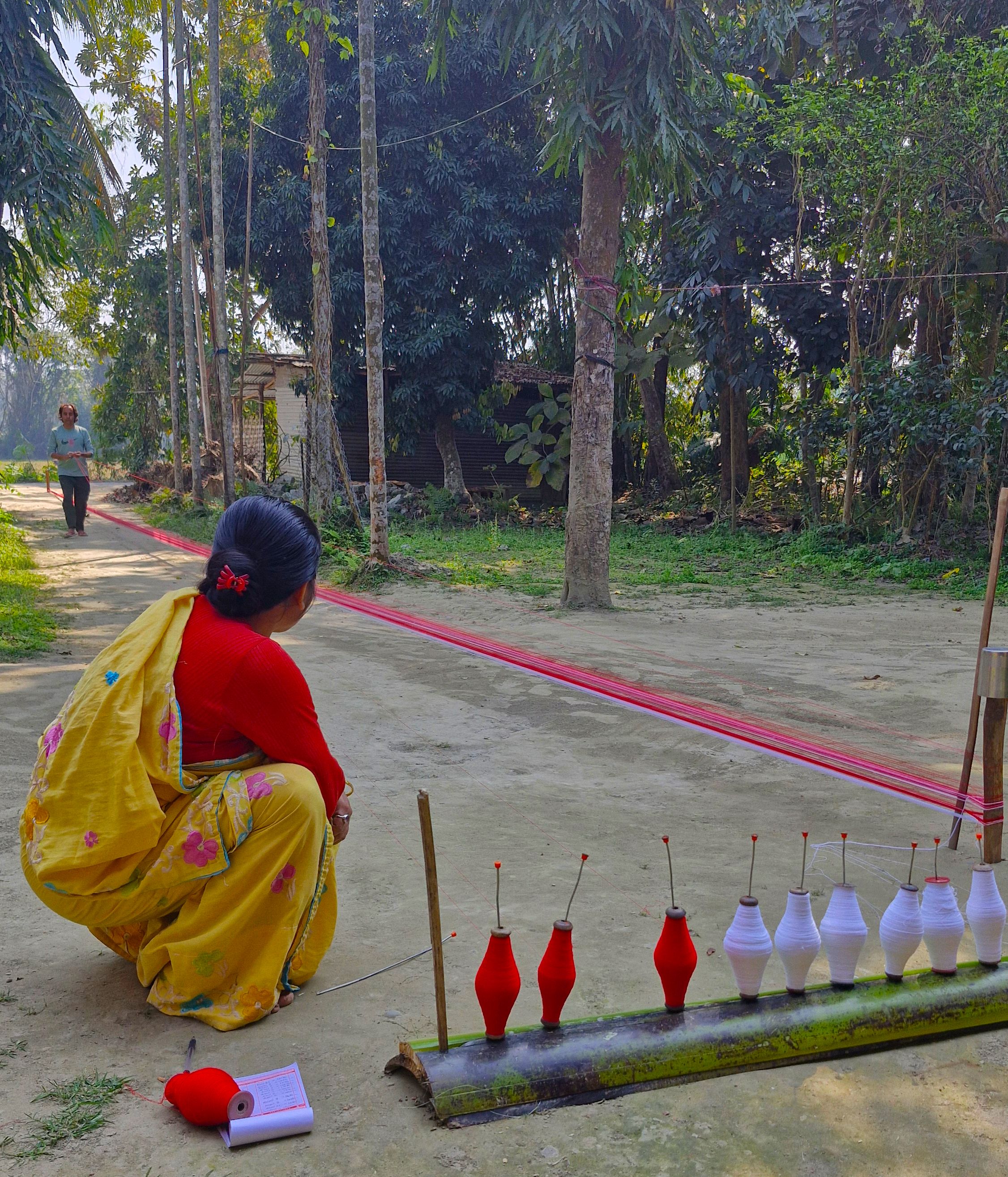 Gamusa making in a local's home at Majuli
The first stage of the process had been laid out in the compound — bobbins of white and red thread arranged in long parallel lines across the lawn, strung between stakes, running the length of the yard. The house was lined with betel nut palms and shal trees, and the compound was dappled and cool. The woman of the house moved between the lines of thread with the unhurried focus of someone for whom this is simply Tuesday, adjusting tension here, checking a bobbin there, the whole arrangement producing a low, rhythmic sound as the thread moved — a kind of collective hum, the bobbins in unison, the sound of a thing being slowly and deliberately made.
It was not a performance. There was no explanation offered, no context provided for our benefit. She was making a gamusa. We were there. That was the complete nature of the situation.
I thought about Majuli's pace — the naam crossing the fields at dusk, the Bhaona audience that stayed until 3am, the ferry that runs on seasonal logic rather than convenience, the island that floods every year and rebuilds itself from the river's debris. And this: thread strung across a lawn, a sound like quiet breathing, the slow accumulation of something that would end up being given away at a ceremony, to mark a moment, to say: you matter enough for this.
The hum of the bobbins is the sound of the island's identity keeping itself alive. Not performing. Not curating. Just continuing.
The morning of the Ali-Ai-Ligang festival arrived in colour.
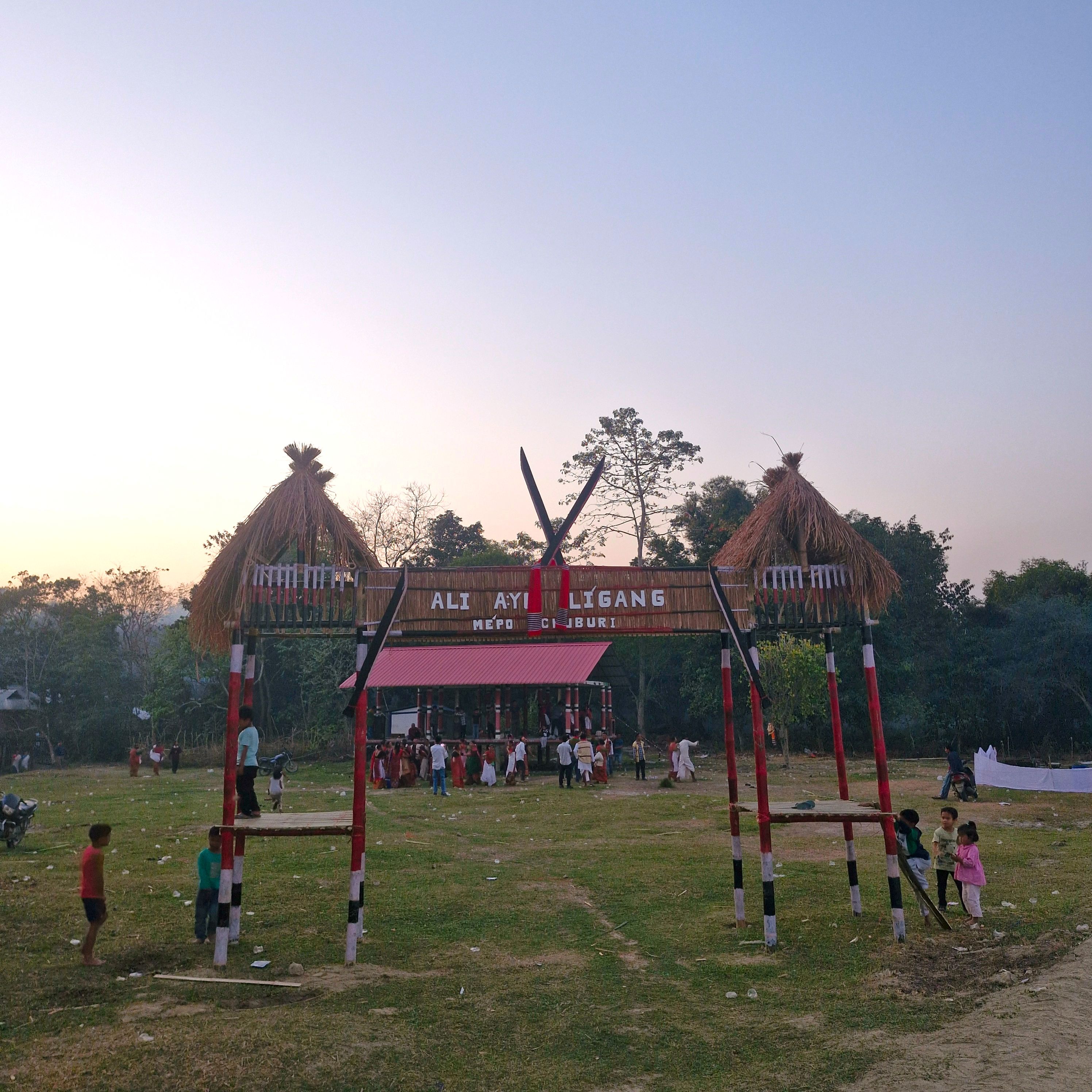
Seven solo travellers from different parts of India — strangers to each other a week ago, loosely bound by the island's particular gravity — made their way to the banks of the Kherkutia river where the Mising community had gathered. We arrived, in the most honest terms, as uninvited guests at someone else's most important day of the year.
They fed us before we had introduced ourselves.
The ceremonial sowing of seeds came first — a ritual addressed to Donyi Polo, the sun and moon gods of the Mising tribe, an invocation for the agricultural year ahead. Then the Gumrag dance: young men and women moving in patterns the festival had been teaching for longer than anyone present could trace, to the rhythm of the sifung flute and the gungang, the jaw harp that produces its sound from inside the musician's mouth. The traditional attire — Ege and Ribi Gaseng on the women, Gonro Ugon on the men — was hand-woven, geometrically precise, worn with the ease of clothing that belongs to the body rather than the occasion.
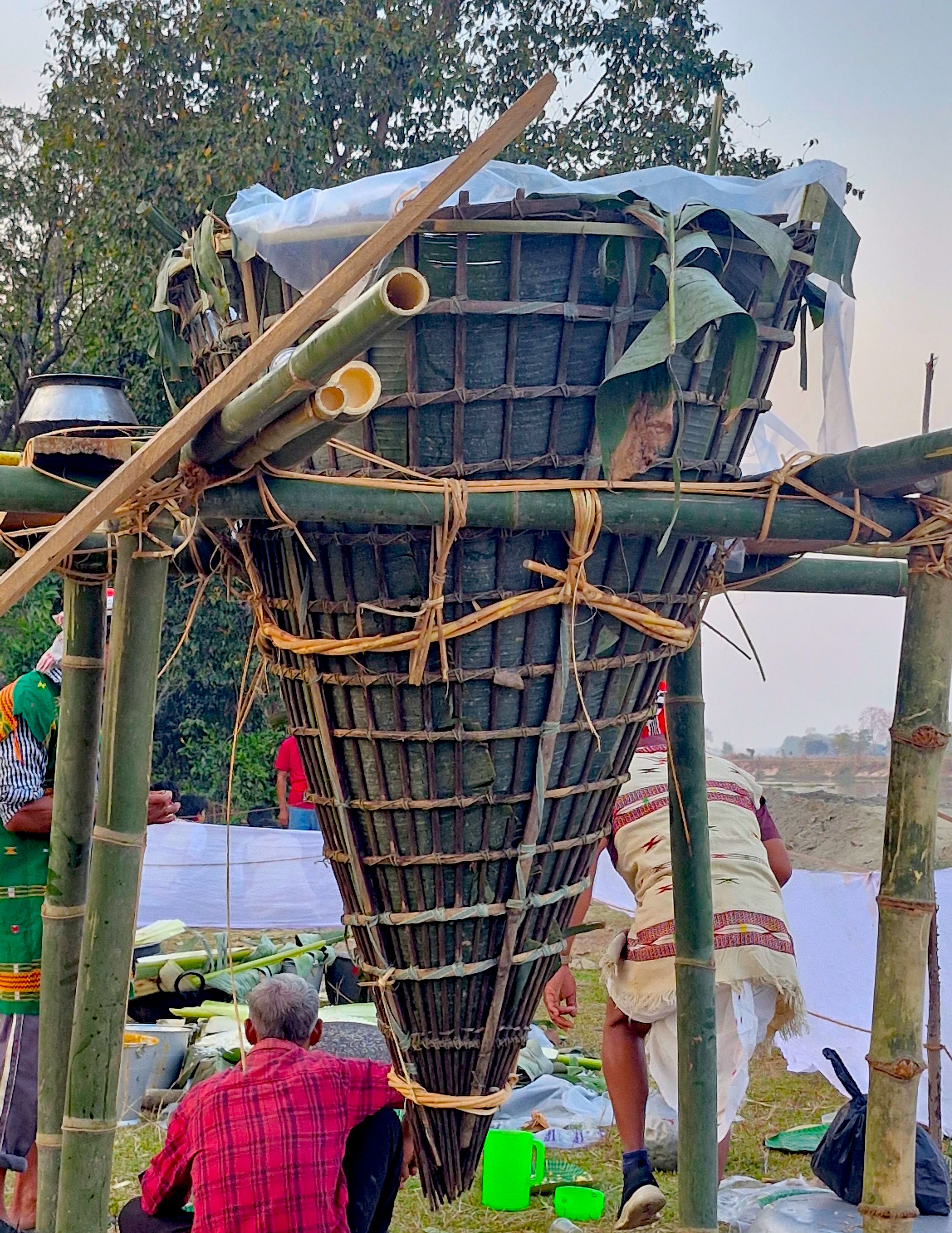 The giant Apong(Rice beer) fermentation casket
Then the Apong appeared. The rice beer, brewed in two varieties — Nogin and Poro — was offered with a hospitality that left no room for polite declining. One of the Mising elders caught me attempting to nurse my glass and said something I didn't need translated: an empty glass, on such occassions, was not acceptable. He was not joking. I stopped nursing.
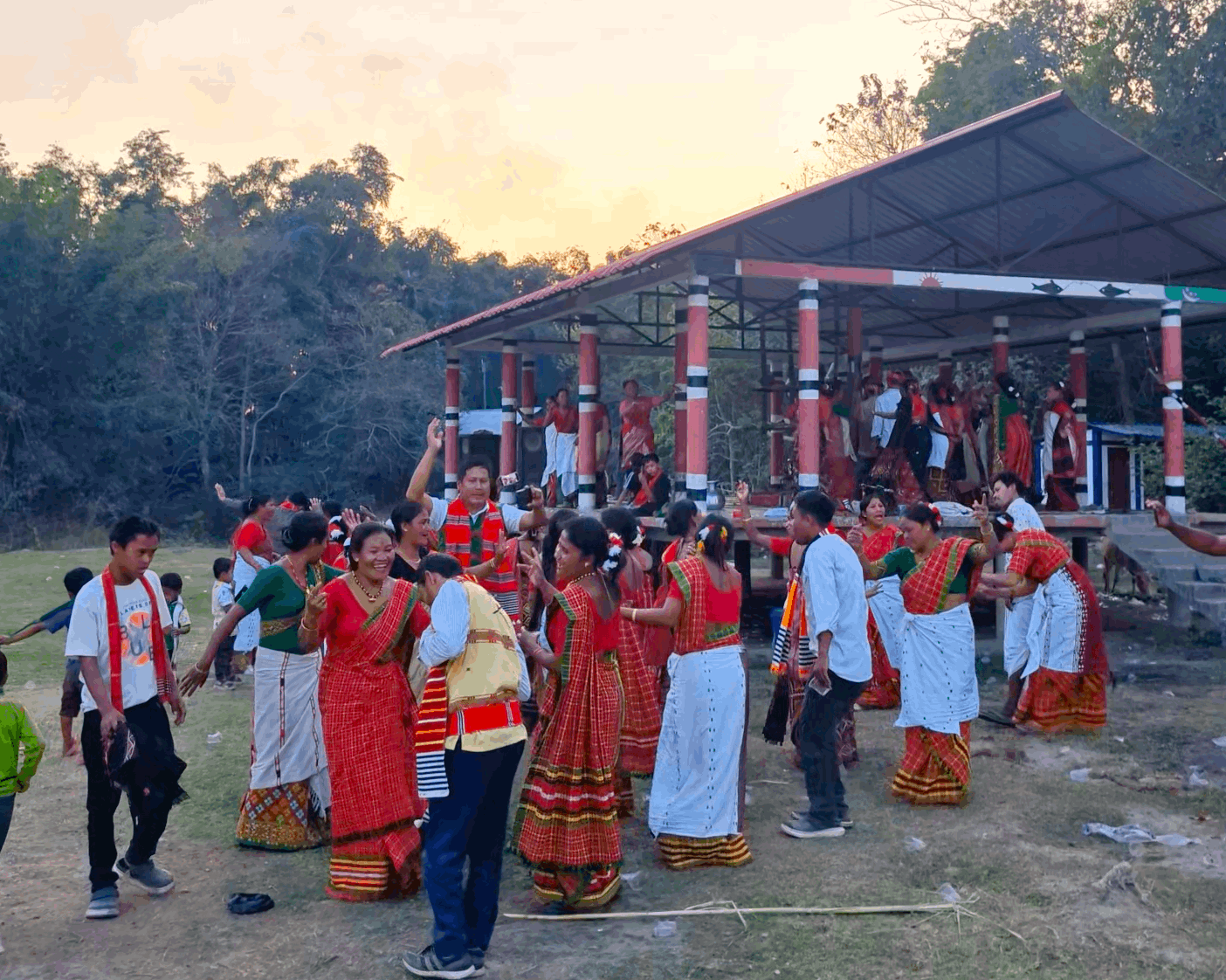 The traditional dance of the Mising community
At some point — I couldn't tell you exactly when, because the afternoon had stopped being organised into moments — we were dancing. Not performing the dance, not approximating it from a respectful distance, but actually inside it, our feet finding the rhythm by a process of surrender rather than learning. The Mising around us encouraged this with a warmth that had no transaction behind it. We were guests who had shown up uninvited and been made to feel, with complete sincerity, that our arrival had improved the day.
In cities, human connection increasingly comes with terms and conditions. Here, on the banks of the Kherkutia, seven strangers were absorbed into a community's most sacred celebration without being asked for anything in return.
I have been welcomed in many places while travelling. I have not often been welcomed like that.
Here is what the superlatives don't tell you.
Majuli island was approximately 1,250 square kilometres in 1950. It is now less than half that size. The Brahmaputra erodes several square kilometres annually. More than 200 villages lost. Entire Satras relocated or swallowed. Some surveys suggest the island could cease to exist within a generation. The 1950 earthquake widened the river's channels and accelerated what followed — slow enough that it generates no sustained attention, slow enough that you can visit in February, find it beautiful, and leave without knowing the landmass is disappearing in real time.
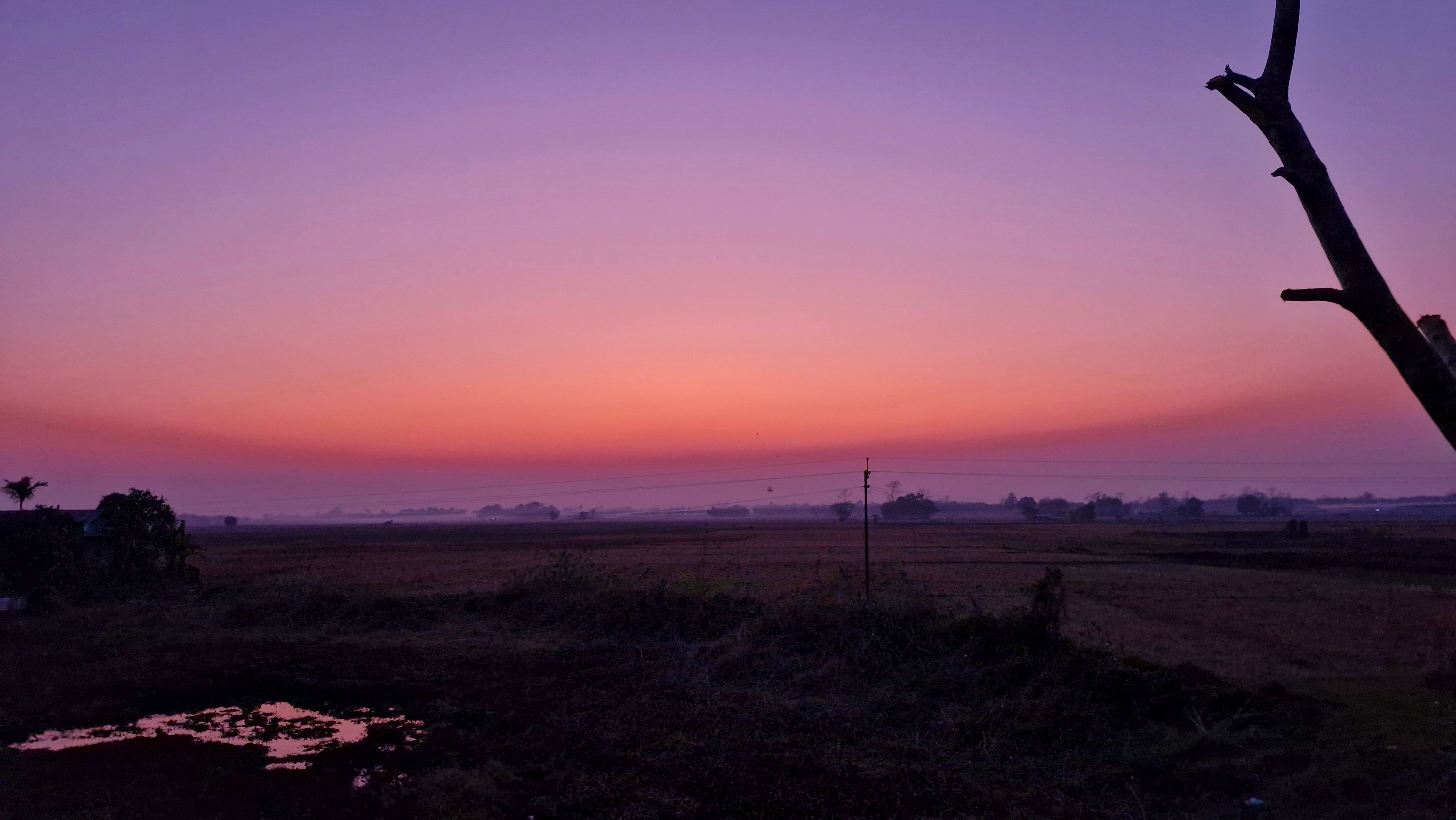 Evening hues in Majuli
But the river is only part of the threat now. The proposed bridge connecting Majuli to the mainland would end the ferry's filtering logic — the hour-long crossing that reminds you that you are entering something different, something that operates on different terms. A bridge means year-round unregulated access. It means the island becomes just another place on the way to somewhere else.
The luxury resorts have already begun arriving — concrete footprints on silt-based, flood-prone land that has survived precisely because it was allowed to remain porous. Every resort that bypasses the local homestay economy extracts revenue without returning it. The bridge, the resorts, the footprint of visitors who arrive with curiosity and leave without asking what they cost — these are not inevitable. They are choices.
On an island where the chang ghor's elevation above flood level is the architecture of survival, where the potter's wheel runs on river-deposited clay and nothing else, where the ecology of the wetland sustains the Hargila and the migratory birds and the catfish the locals wade in to catch — concrete footprints are not neutral. Every unregulated construction on this silt-based, flood-prone land adds weight and rigidity to a landscape that has survived for centuries precisely because it was allowed to remain porous, yielding, alive to the river's terms.
The mukha maker in his early thirties, working on the Garuda at the workshop gate, is producing objects of extraordinary craft for a tradition whose practitioners are thinning. The woman at the potter's wheel in Salmora gaon is shaping clay that the same river deposits and destroys in alternating seasons. The Mising community dances on the banks of a river that their own chang ghors are built to survive. All of them are living with the full knowledge of what the Brahmaputra is doing — and making something from it anyway. What none of them signed up for is also absorbing the consequences of what unthinking tourism adds on top of that.
The bridge, the resorts, the footprint of visitors who arrive with curiosity and leave without asking what they cost — these are not inevitable. They are choices. And the first condition for making better ones is knowing the island is more fragile than the superlatives suggest.
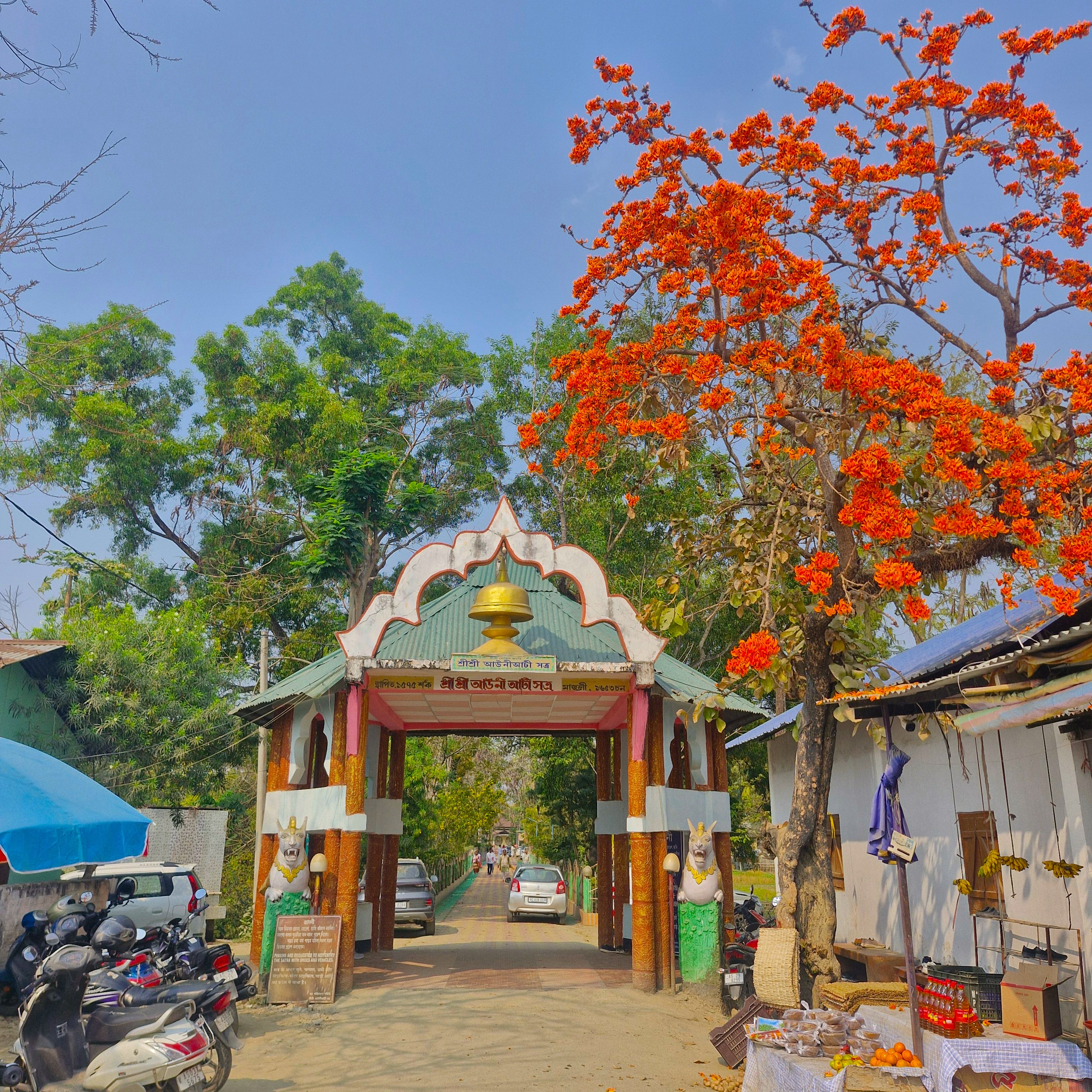 Sri Sri Auniati Satra, Majuli
That is the story of Majuli the search engine did not return. Not because it is hidden, but because it is inconvenient — and inconvenience rarely makes it into an itinerary.
I went to Majuli chasing the largest river island label. That label is accurate and misleading simultaneously, because it implies permanence. The island is the world's largest river island the way a sandcastle is the largest structure on a beach — which is to say, for now, in conditions that are not in its favor. Conditions that include the river. And increasingly, us.
The return ferry went downstream, which meant it moved faster — the Brahmaputra carrying it rather than the engine fighting against the current. The crossing that had taken an hour on the way in took less than forty minutes on the way out. I watched the scenery appear in reverse order: the ghat, the fields, the distant bank, and then — the horizon closing. The side that had become open water on the crossing in, that had made the river feel like a sea, now resolved back into a bank. The river narrowed. The mainland appeared. The island receded.
I thought about who else was on the ferry — not that week, but in general. The day-trippers who had come for the mukha photo and the Satra checkmark. The ones who had been on the island for six hours and were satisfied they had seen it. The ones who would post the sunset at Oudubi, without knowing what the Hargila is called locally, without having heard the bobbins in the gamusa yard or the silence after the elder watched the day-trippers leave.
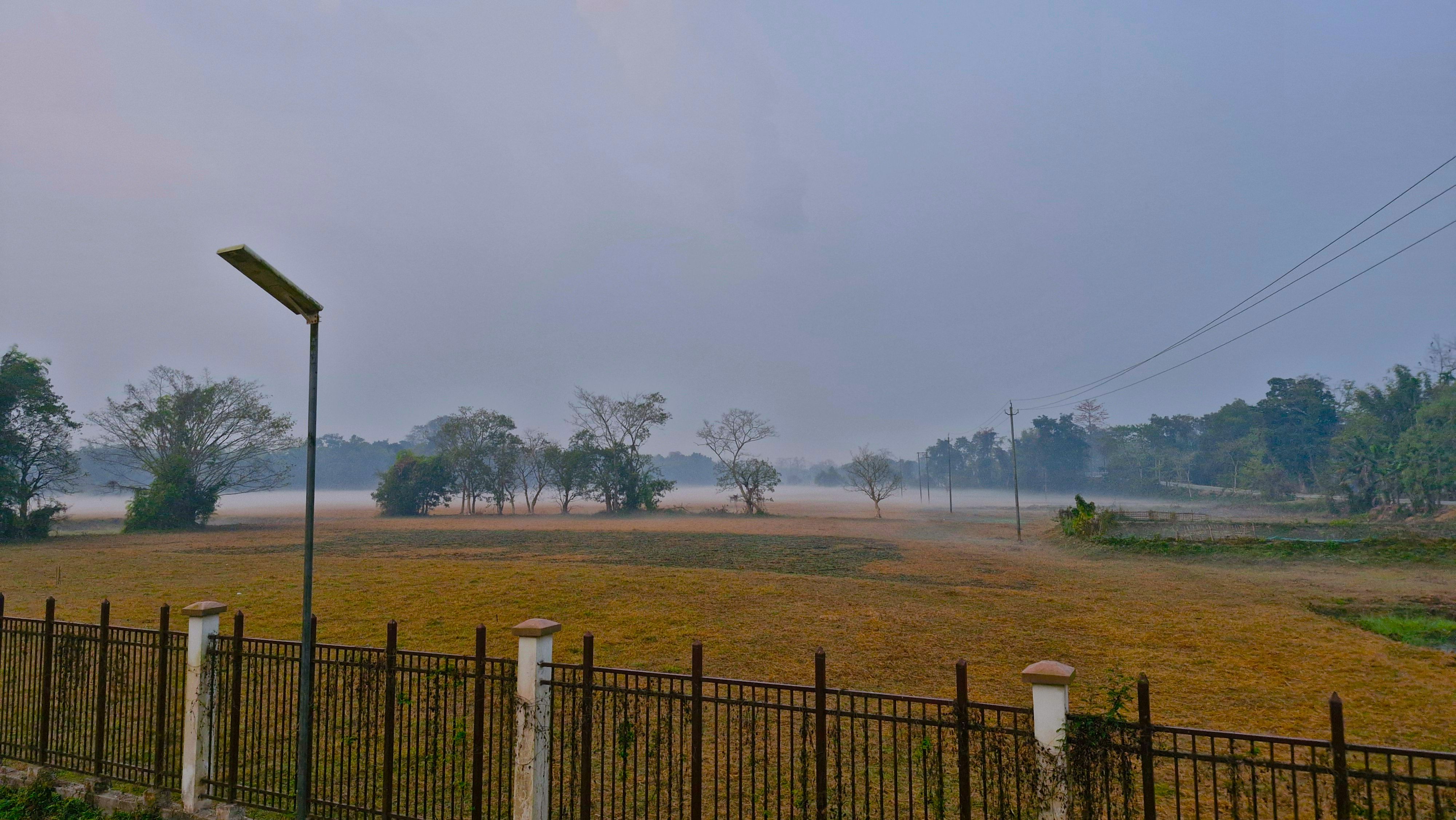 A slow morning in Majuli
I was lucky. I had time, Arnab as a host, and a group of strangers who shared same bandwidth. I had a spare day that became a week, which is the kind of arithmetic that only certain places can perform on you.
What about the rest? What happens when the bridge comes, and the ferry's filtering logic disappears, and the six-hour version becomes the standard version, and the island becomes just another place on the way to somewhere else?
The prayer will still cross the fields from Samaguri Satra every evening.
The mukha maker will still work at his bench, the Garuda's eyes not yet decided.
The Mising will sow their seeds again next February, on the first Wednesday of Phagun.
The river will continue its work through every monsoon between now and then.
But whether anyone is watching — whether the visitors who come will stay long enough to understand what they're looking at — that part is not the island's to decide.
I don't know how to solve it. I know that the first condition for solving anything is that the people passing through must actually understand what is at stake. And so I am writing this down, in the best way I can, and hoping it reaches someone on a ferry who still has time to slow down.