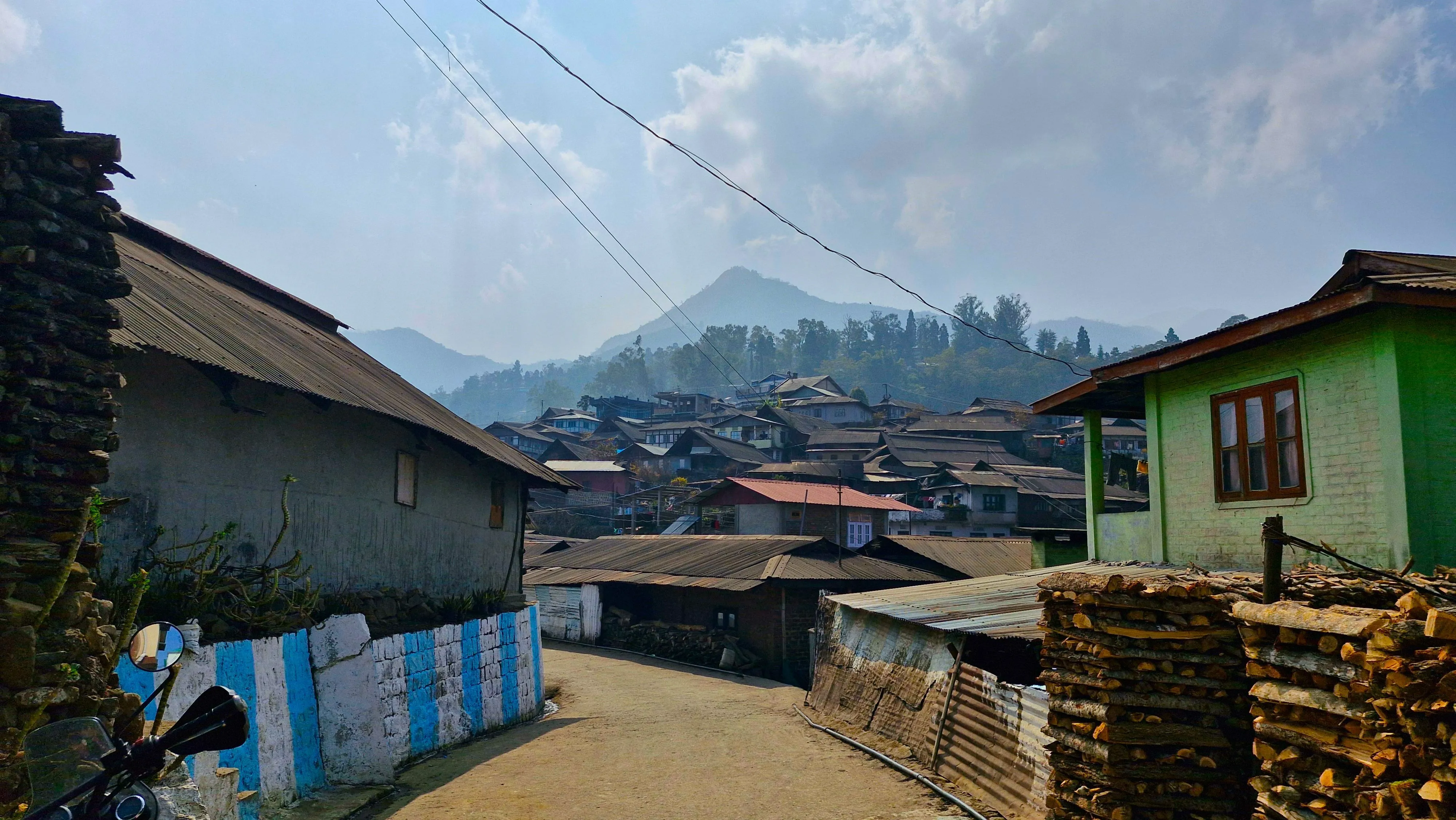
Within half an hour of arriving, I was back at my two-wheeler, helmet in hand.
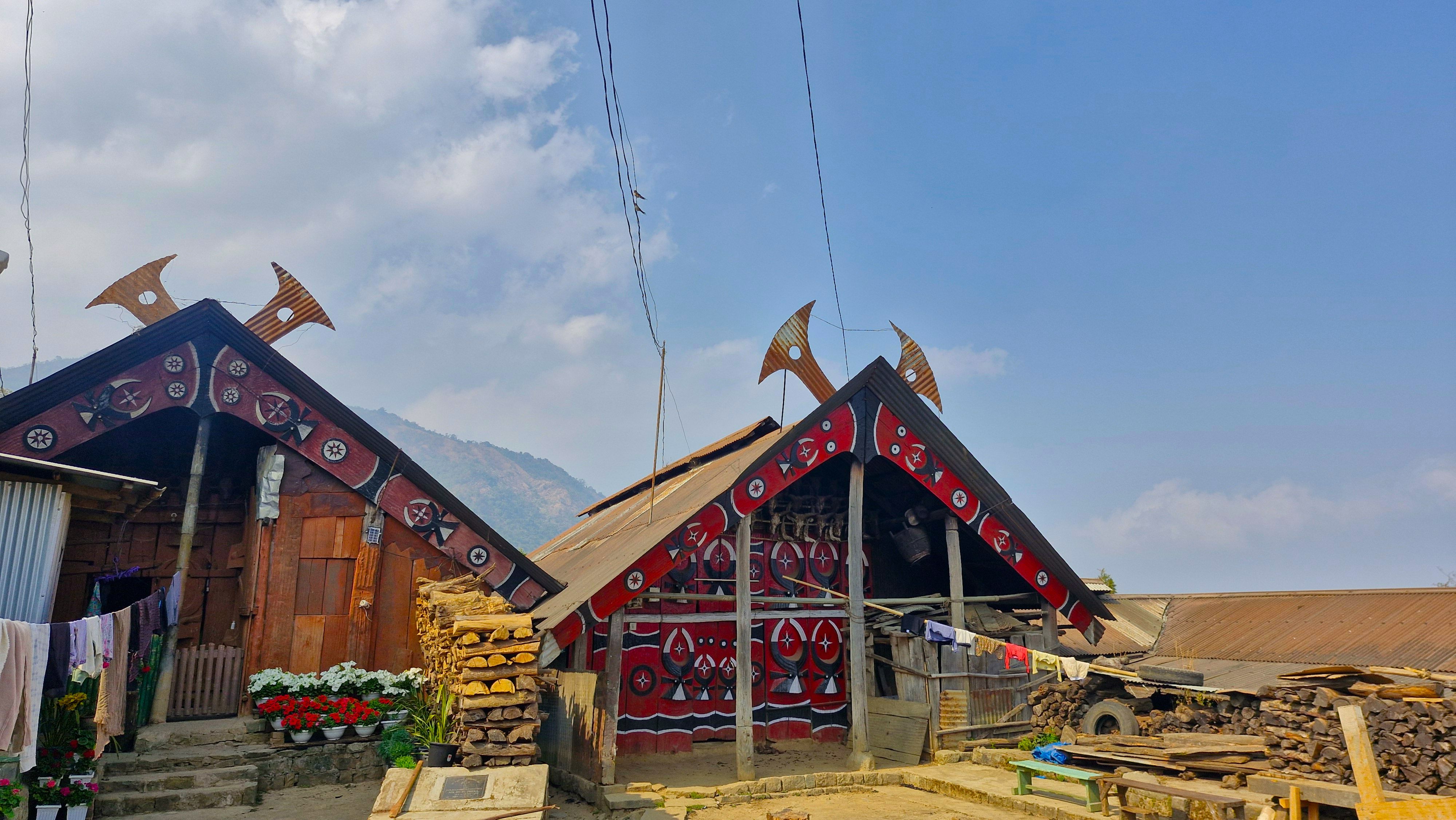
I'd done the walk. Seen the main lane. Registered couple of the red and black colored houses — photographed the carved mithun skulls and horned rooflines without the faintest idea what any of it meant. About thirty minutes south of Kohima, Kigwema sits quietly in the foothills of Mount Japfü. The ridgeline behind it held a stillness that could mean anything.
I had already decided, somewhere on the ride down, that it would be nothing.
So far, it had obliged.
Then an old man on a porch looked up while finishing up his lunch.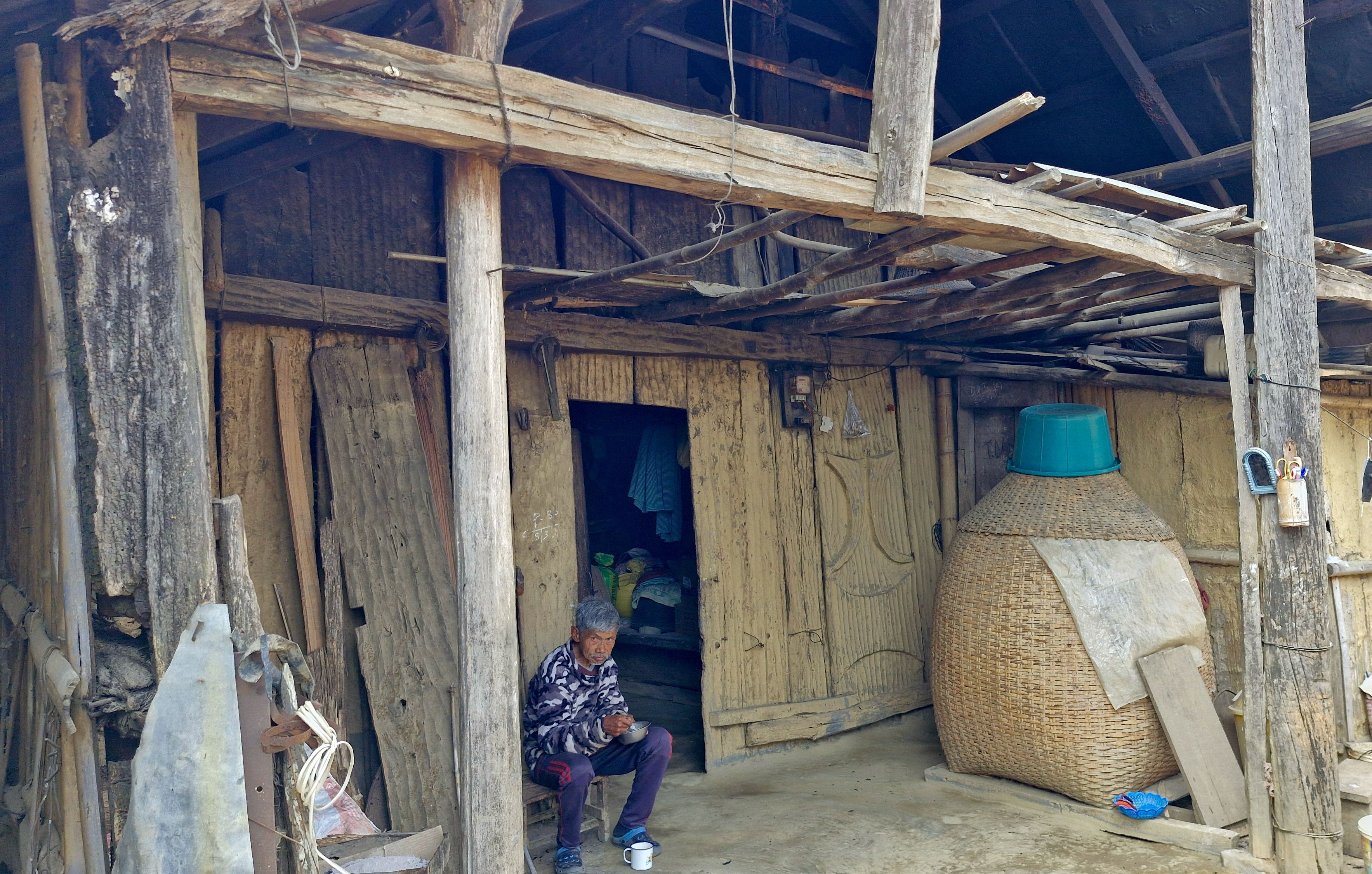
He was in his seventies, sunbathing in the easy way of someone who has nowhere else to be — and knows it. He said something in Angami. I didn't understand the words, but I caught the tone.
A question.
I said the village was nice.
He tilted his head slightly.
Not quite.
Then he gestured toward the houses and raised an eyebrow. Had I seen inside one?
I hadn't. He read that immediately and stood up. Motioned toward his door.
What followed was a conversation held almost entirely through gesture and goodwill — my barely Nagamese vocabulary collapsing into Bengali more often than not, neither of us entirely sure the other had understood, both of us proceeding anyway.
Some things carry across.
I left my helmet on the seat and followed.
I almost didn't.
Not because I was in a hurry.
Because I thought I had already understood the place.
I bent at the threshold and stepped in. Dark. Low-ceilinged. The smell of woodsmoke so deeply set into the walls it felt less like a scent and more like the house itself exhaling.
My eyes watered slightly before they adjusted.
At the centre sat the hearth.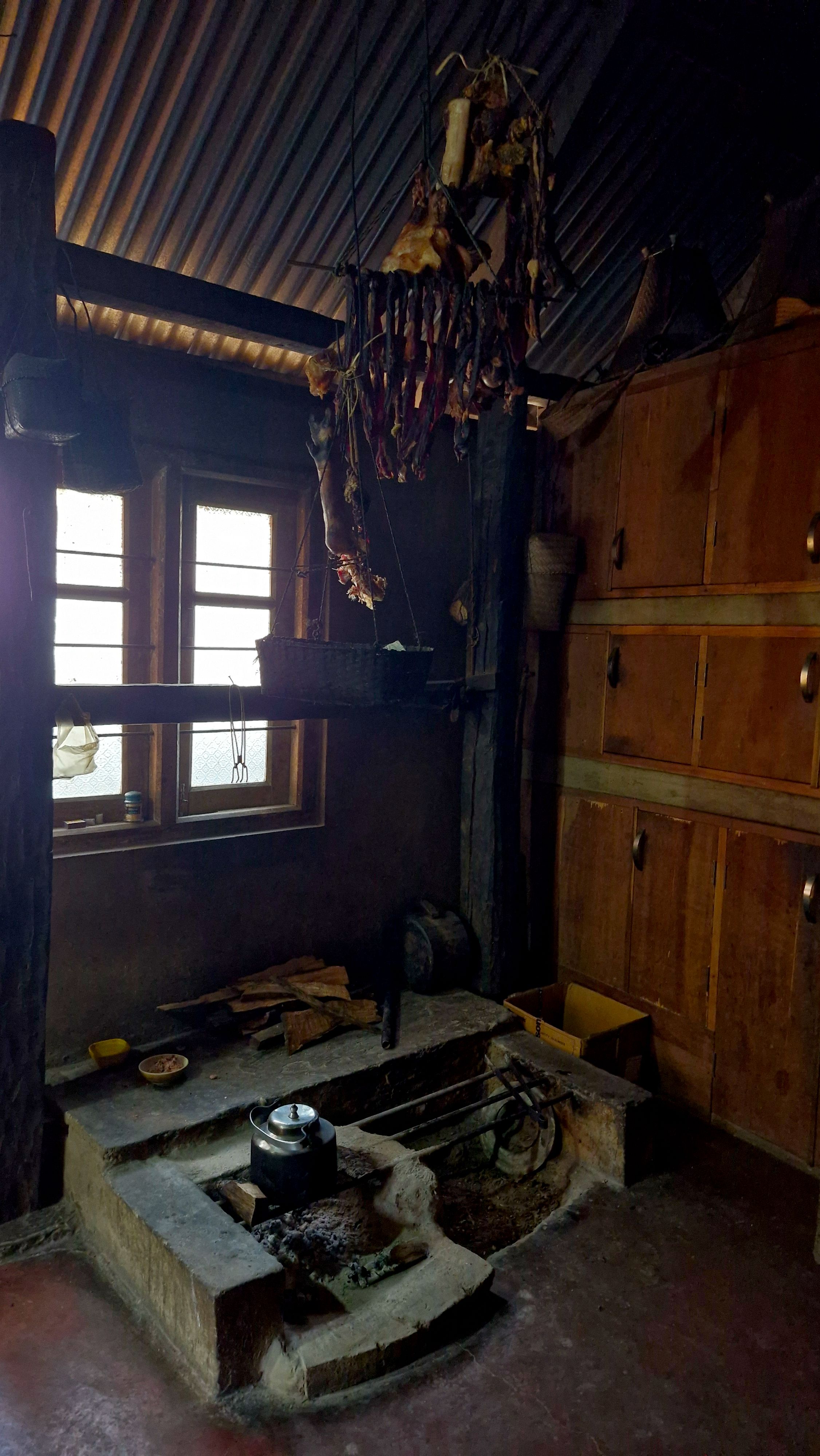
Not in a corner. Not tucked away. The actual centre of the room — fire going at mid-morning as if it had never really gone out.
Above it hung the kichu — a bamboo rack layered with intent: drying meat on one level, corn and herbs on another, firewood closest to the flame. Smoke moved through it slowly.
Doing its work.
No one directing it.
He said a word — Amiphokiboh — and gestured around.
The hearth room.
Everything else arranged around it.
Along one wall, large woven baskets held grain. Inside the house.
The grain doesn't leave the home. It never has.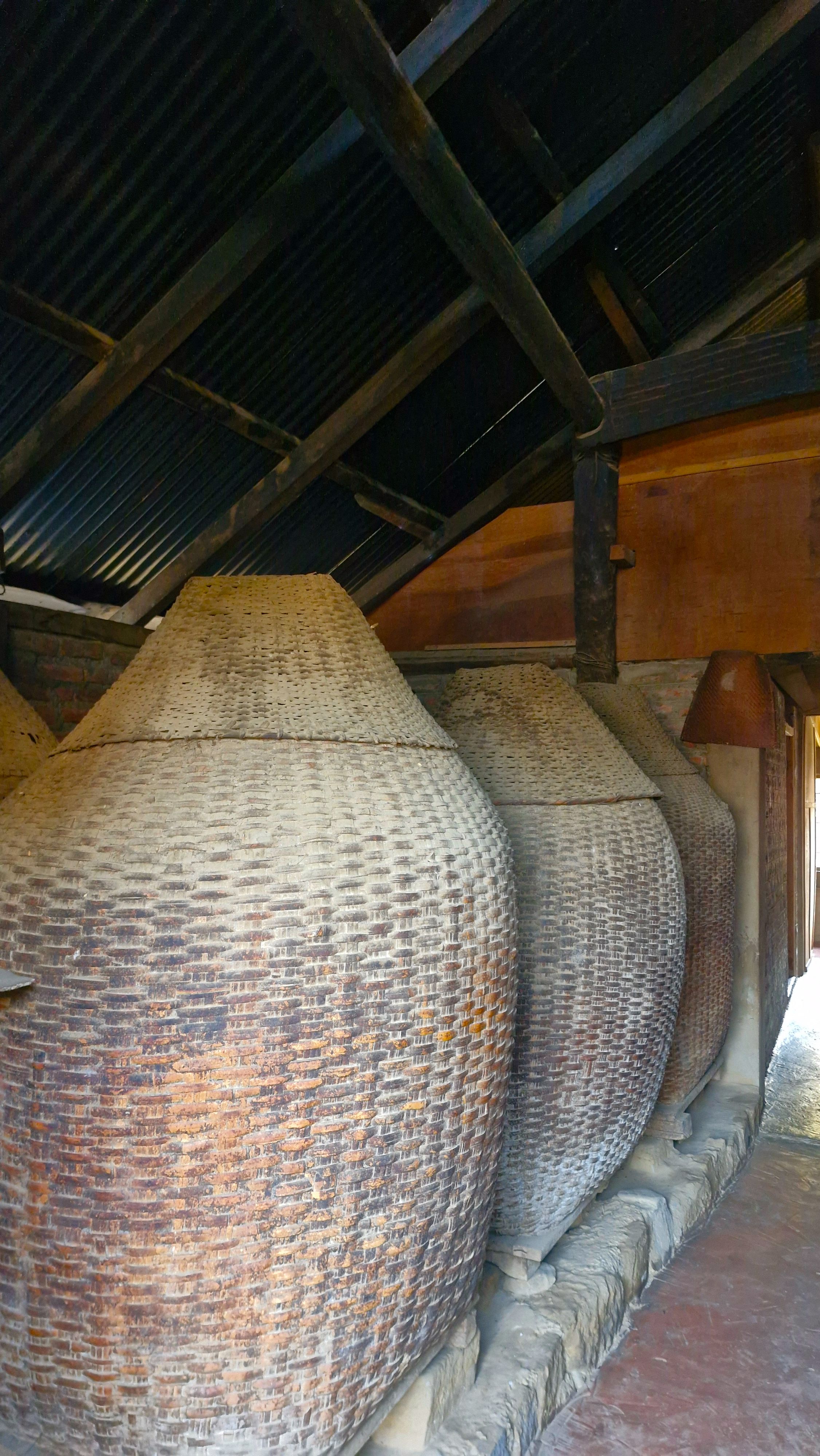
He watched me take it in. He didn't explain.
Outside, he kept walking.
I followed.
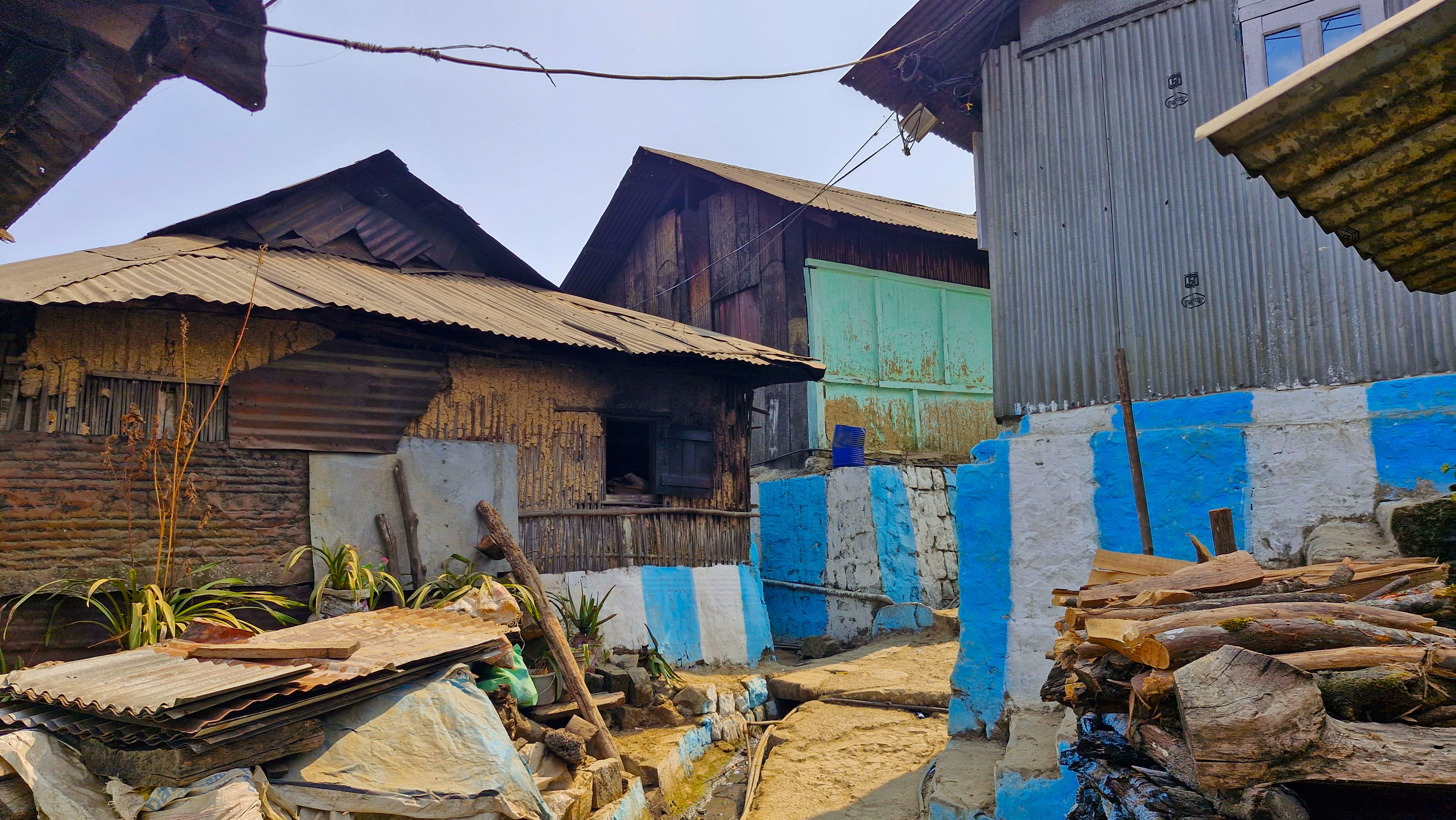
The inner bylanes of Kigwema are painted in blue and white — cool and enclosed where the houses lean inward, brighter where the space opens up.
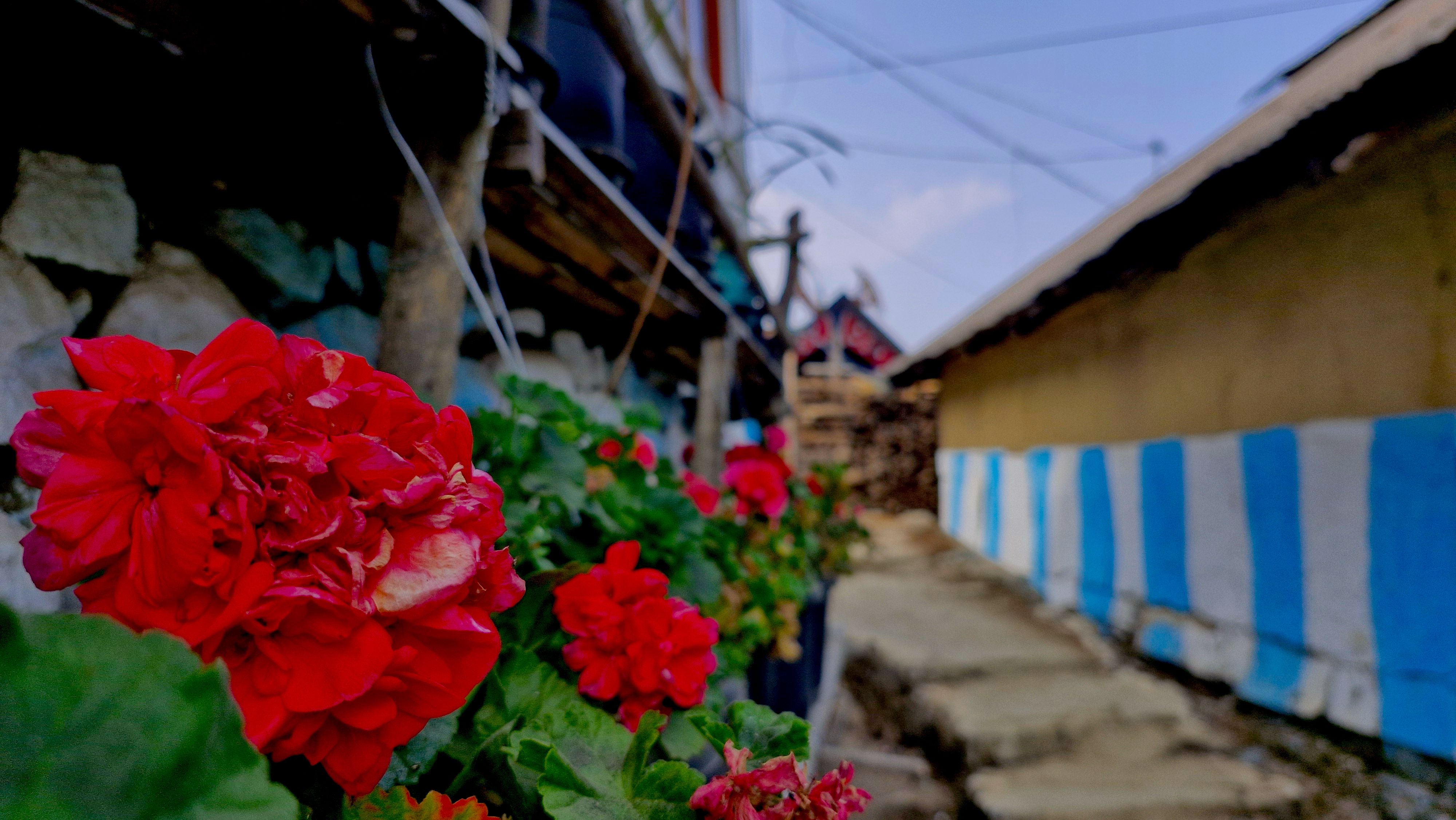
Red flower pots lined the doorways and windowsills. Not arranged. Just there.
Deeper in, mud-houses had firewood stacked head-high against their walls — split, ordered, a season already accounted for.
A group of children came running through, splitting around us without breaking stride, laughter trailing behind them.
One of them stopped.
His grandson. James.
Peeled away from the pack, home from school, recruited on the spot as translator. The group of three continued walking, and suddenly the afternoon had a different shape to it.
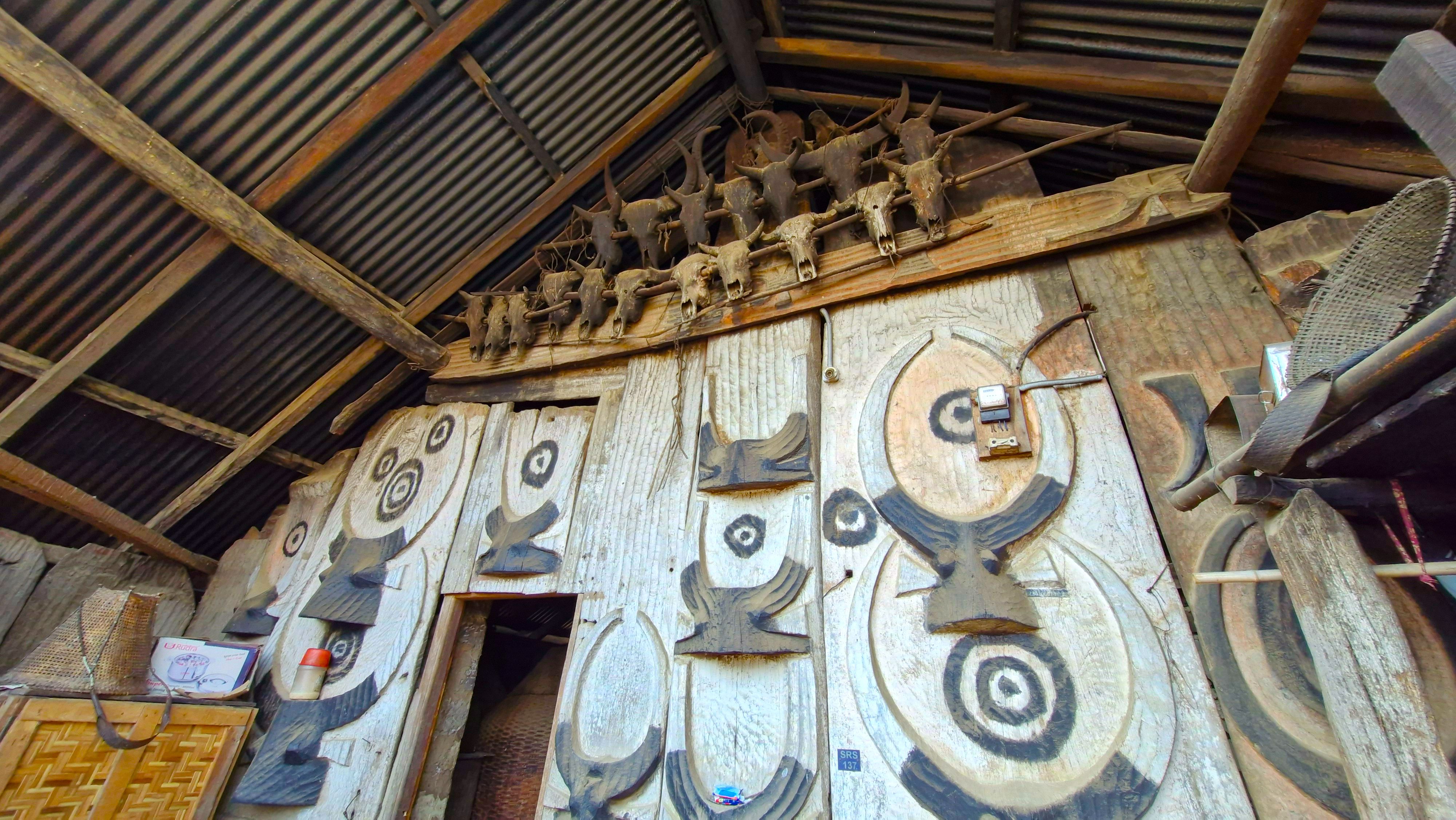
We stood in front of a house I had photographed earlier — the same carved roofline I'd shot without understanding what I was looking at. The old man spoke. James translated. The kikie — the horned wooden structure at the roof's apex — was not decorative. It was earned. To raise one, a family must host a feast for the entire village. The mithun skulls mounted below are records. Each one marking something given. A house here is not just lived in.
It is remembered.
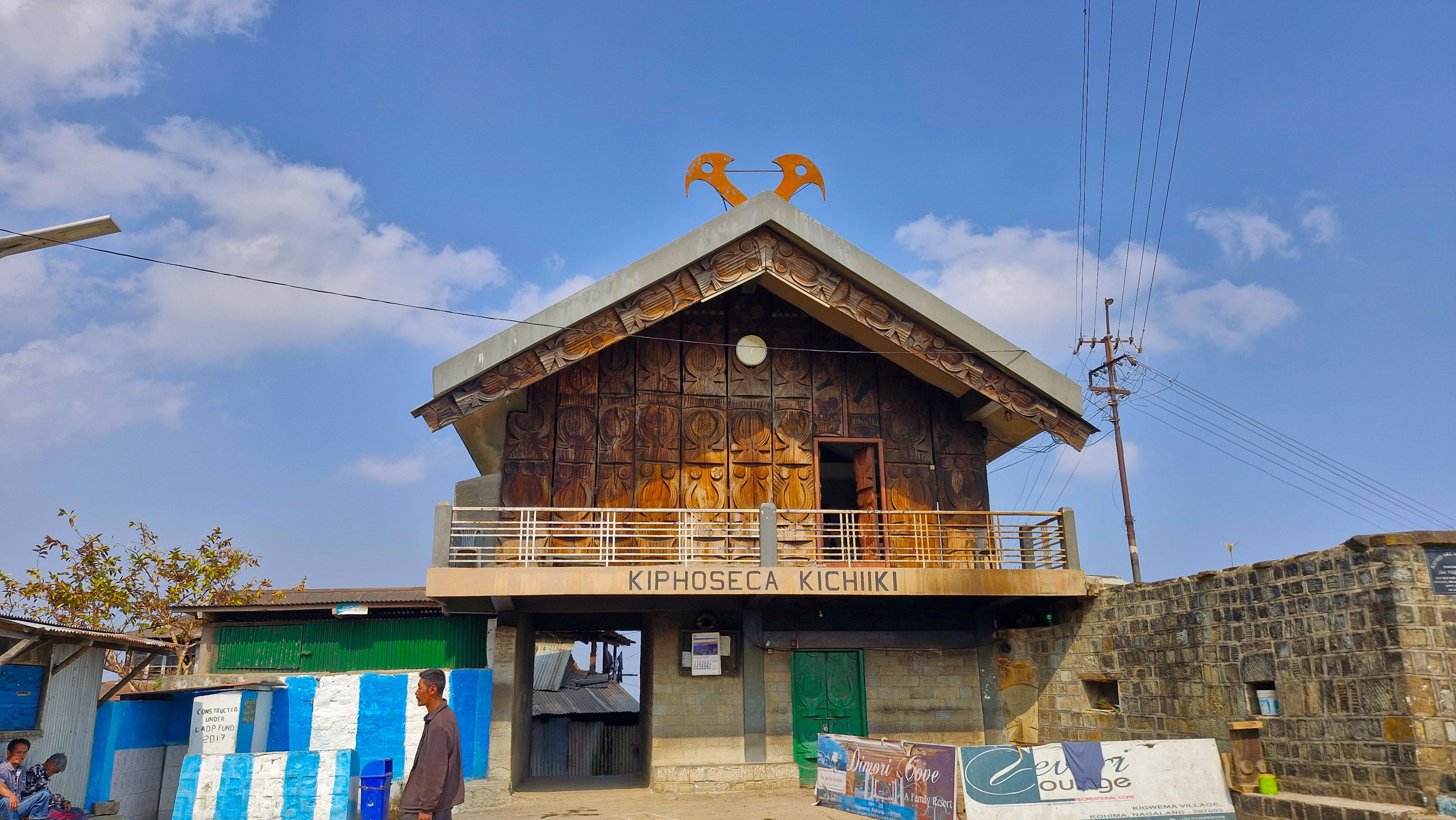
As we walked, he pointed out the khel walls — clan boundaries marking lineage within the village. Kigwema began with three clans and expanded. Other villages began here. The name carries that forward:
Ki. We. Ma.
House. Inherit. People.
At a bylane corner, he stopped again. A small community library — built into a recessed wall, open to anyone passing, shelves arranged with care. No fancy arrangements. No announcement. Just there, between clan walls and carved beams.
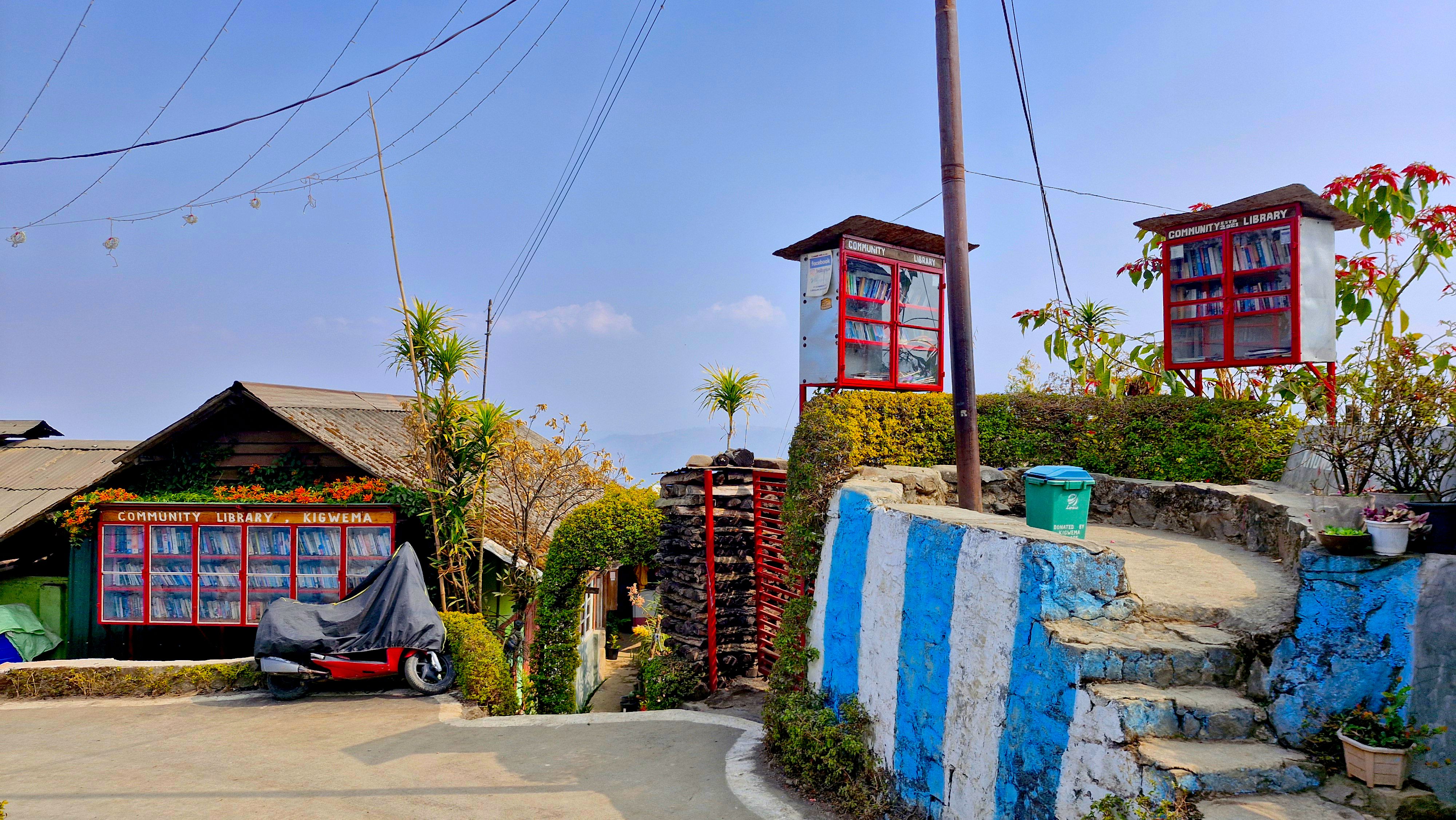
The village hadn't chosen between its ancestral identity and the pace of the present. It had simply made room for both. I stood in front of it longer than I expected — not with surprise, but with something closer to relief.
We continued as the lane descended. At the edge of the village, he stopped in front of a house — older, quieter, set slightly apart. A long flight of stone steps leading down.
He said one word.
"Sato."
James filled in the rest.
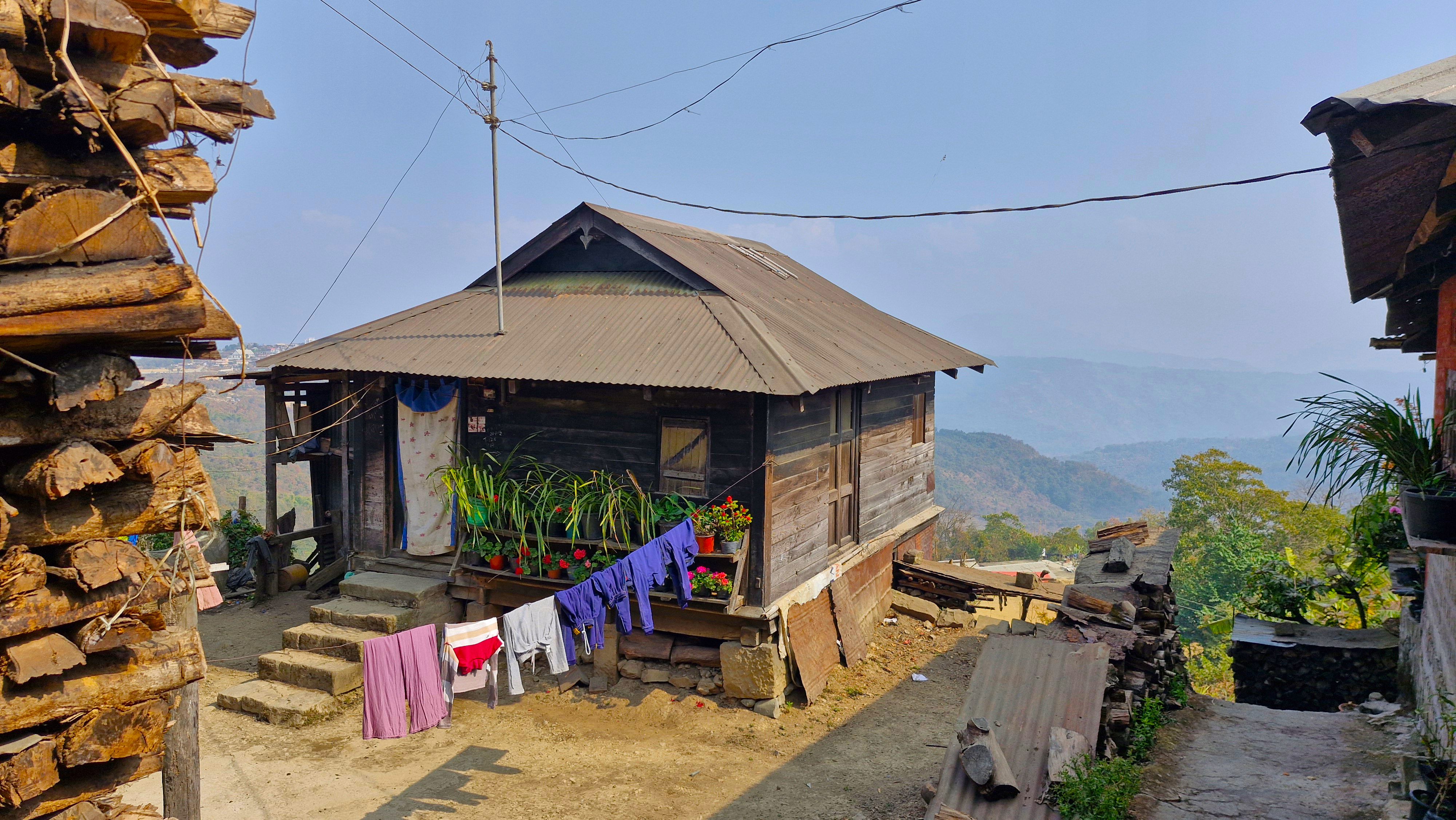 Gen. Kōtoku Satō's House
April 1944. The Battle of Kohima. General Kōtoku Satō, commander of the 31st Division, Japanese Army, had been stationed there. The bullet marks on the outer walls remain — not preserved, not marked. Just there, absorbed into the surface over eighty years.
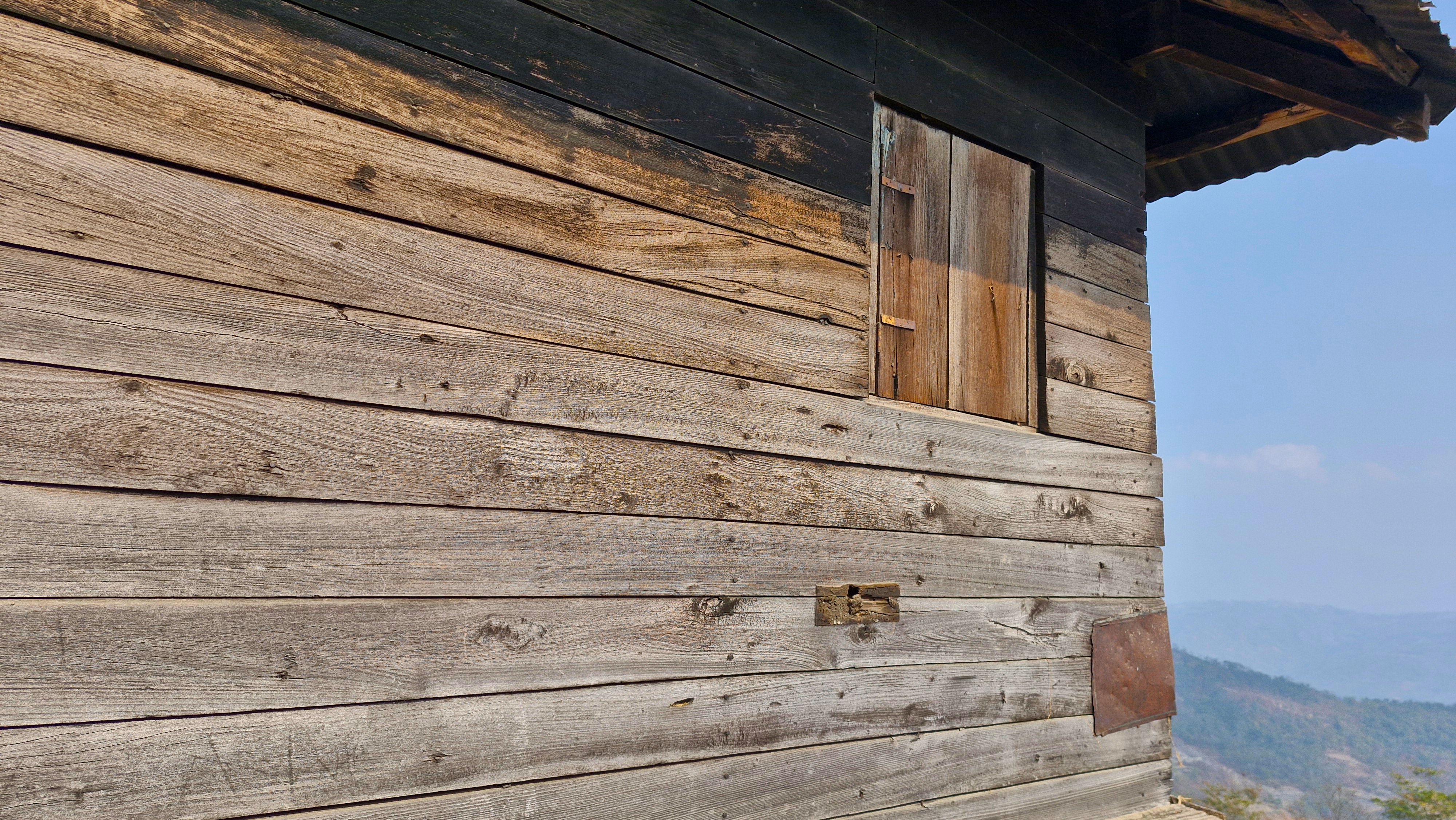 The bullet marks on the wall
The man who lives there now, James said, remembers what he was told. The Japanese soldiers lived alongside families. They paid for what they took. Satō was remembered as kind.
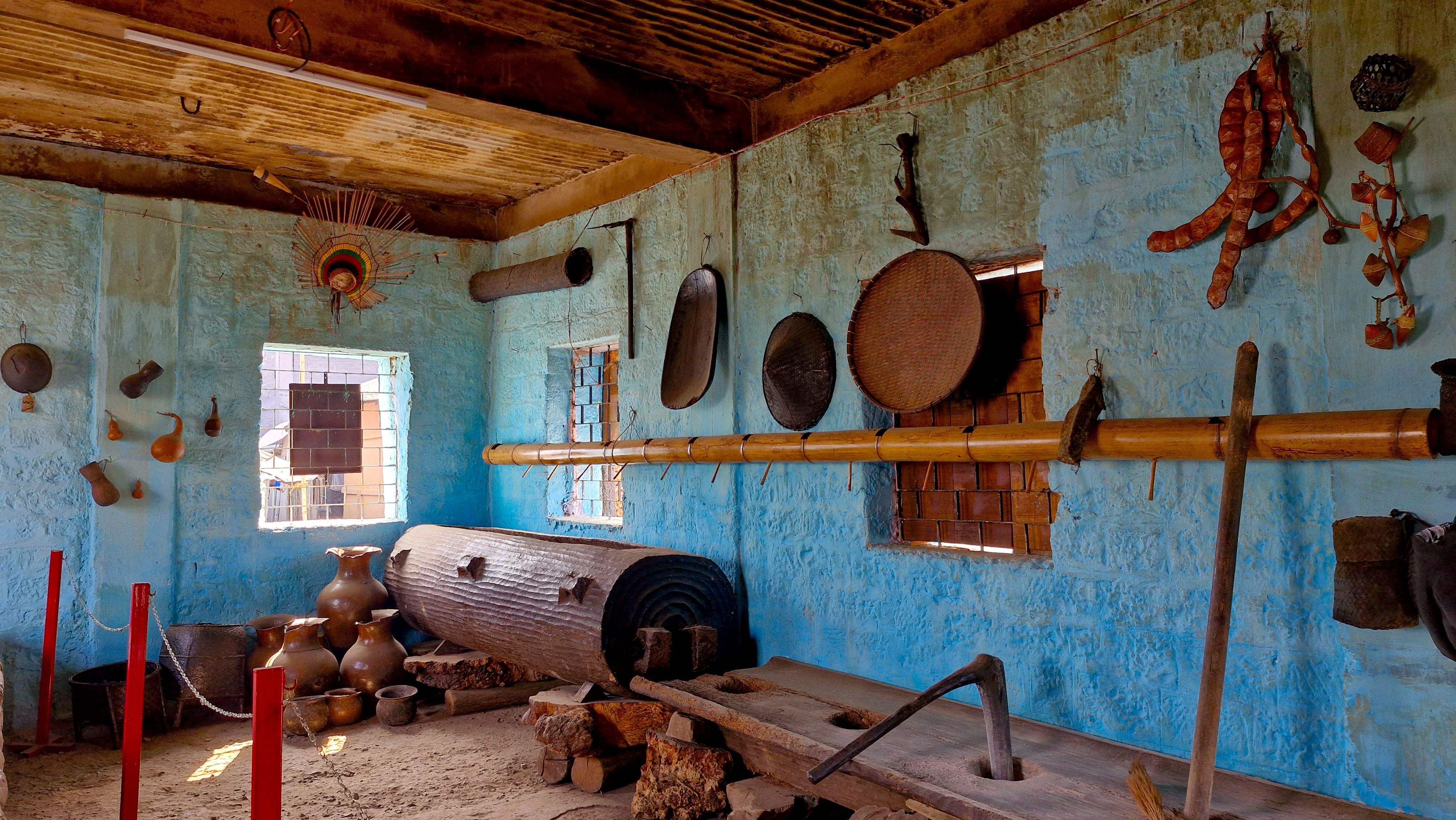
Nearby, a small room in the form of a local museum held what was left behind. Rusted brass utensils. Bullet torn WWII helmets. The log drum. Objects that shaped the people who lived there. The room didn't perform its weight.
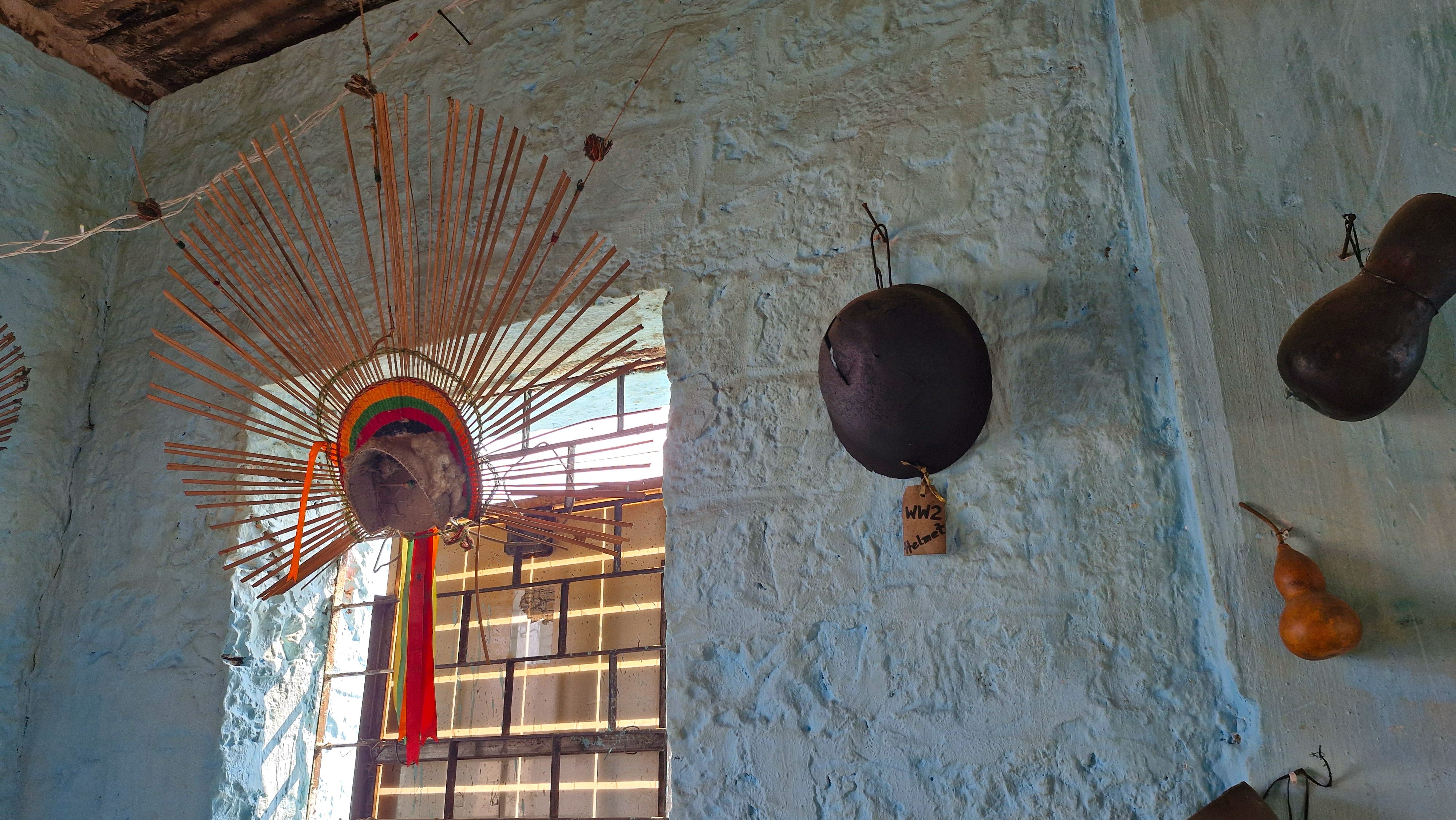
It just held it.
I expected to feel the drama of it — standing where history had been made. What I felt instead was something quieter. The place hadn't frozen around these events. It had absorbed them, the way old walls absorb old smoke, and kept going.
History written at ground level rarely sounds the way it does in books.
Before we turned back, he led me to Mosen View Point.
It wasn't built as a tourist stop. A man named Mosen is said to have created it in memory of his beloved — the kind of thing a person builds when grief needs somewhere to go, and the hills are the only thing large enough to hold it.
I didn't know the full story. He didn't have the words to tell it. But standing there, I understood that some places are named not to explain but to remember.
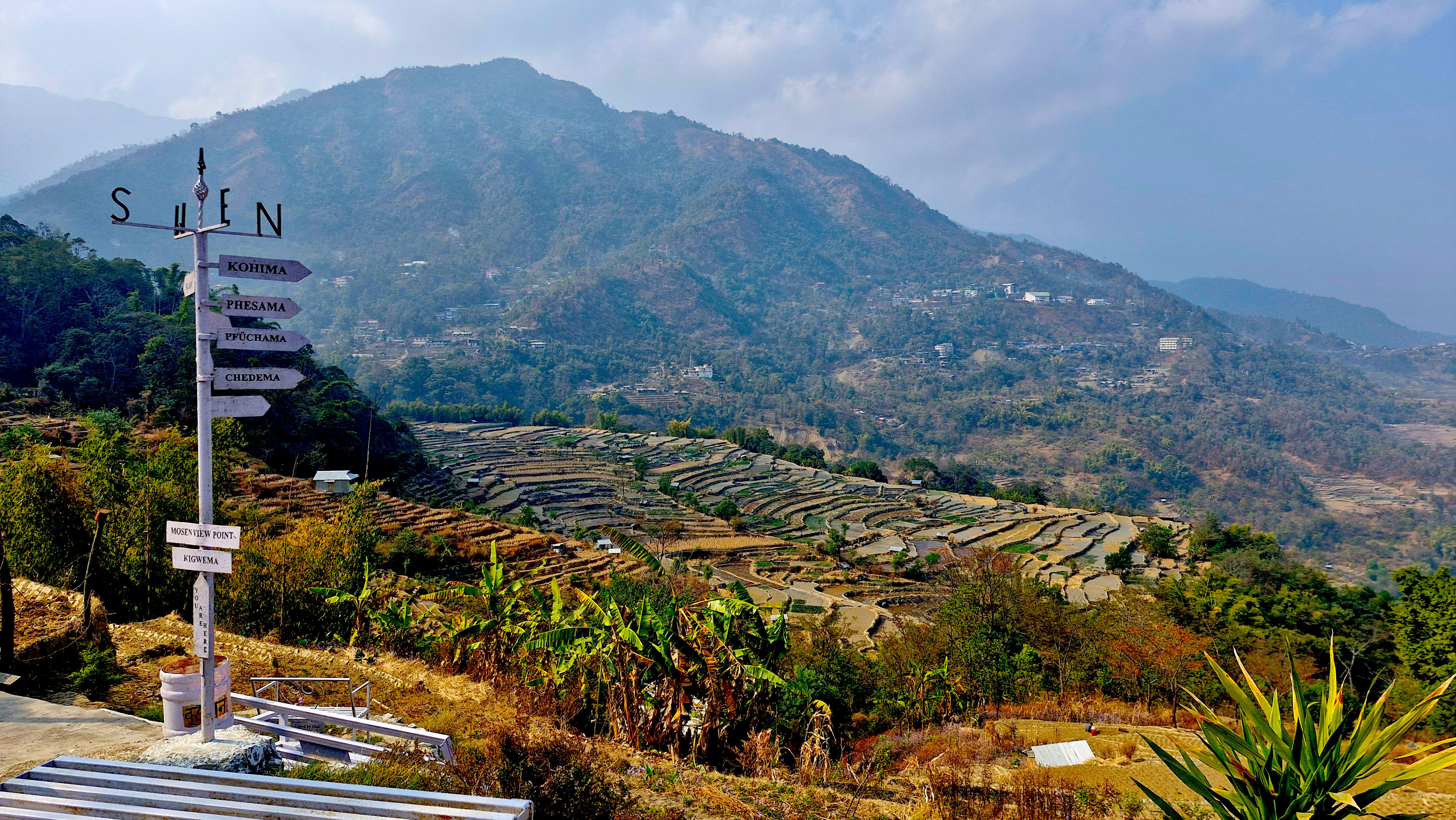 Mosen View Point
The land opened suddenly. Terraced fields stepped down the hillside. Ridgelines folded into each other. Kohima, faint in the distance. The same terrain where two armies had moved through the same valleys — completely still.
He said the name once.
And then nothing.
I didn't fill it.
We walked back without saying much.
I came back to my two-wheeler a different kind of tired than I'd arrived with.
He hadn't explained anything. He had just walked. The kichu above the fire. The clan walls. The house where a general stayed. The place where someone built something out of grief and didn't name it loudly. One thing at a time. No rush.
The guilt of almost leaving never quite goes away. I think it's meant to stay — a reminder that the most important things about a place rarely present themselves to people who've already decided they've seen enough.
I picked up my helmet.
It was still warm from the sun.